
Because of construction delays, students in several programs of the Lake Region vocational program will be without a permanent base of operations when school starts in a month.
Littlefield Bros., the general contracting firm based in Wells and responsible for overseeing construction of a new metal building to house the automotive and construction trades programs and the bus maintenance garage, is running several months behind schedule. According to Superintendent Kathleen Beecher, the crews were to be finished in April. That projected end date was pushed back to June, and now the project won’t be completed until about Oct. 1, she said.
The delay is a problem since the existing home of the automotive and construction programs, located in a wing of the Lake Region High School, has been gutted and is undergoing complete renovation. Other programs such as drafting, culinary arts and health care can still meet in a modular set of classrooms nicknamed “The White House,” but the district has had to scramble regarding the automotive and construction trades programs, which accept students not only from Lake Region’s sending towns of Bridgton, Naples, Casco and Sebago, but also from school administrative districts 72 (Fryeburg) and 55 (Sacopee Valley).
On Tuesday night, the district’s school board voted unanimously to shift several programs to the Memorial School in Bridgton, a vacant building behind Stevens Brook Elementary that has been used for storage in recent years. Students in the programs scheduled to use the new building will meet for classes at Memorial instead. Since limited hands-on programming will take place at Memorial, field trips will be scheduled to expose seniors to various automotive-related opportunities such as area public works garages.
“For seniors, who are more hands-on, this will be an issue, so we’re working on creating field trips to compensate,” Beecher said.
Rosie Schacht, vocational programs director, said she and teachers are already meeting to line up curriculum. Schacht said the large classrooms at Memorial would be conducive to several programs such as the law enforcement program, which offers martial arts.
Schacht also said renovations will be limited with one wall being torn down. Despite the hassles, she hopes the temporary home will be suitable.
“We’ve been known to be very flexible and accommodating, “ Schacht said. “Certainly it’s not our wish and dream to start the school year off like this, but we’ll try to be as structured as we can as we plan out the first month.”
According to Andy Madura, who oversees the transportation department and is also the owner’s representative dealing with the various construction firms on the $13.8 million project, the construction delays are a scheduling headache, but overall the project is going well.
“Littlefield is slow, and it’s going to cause us some problems, but his work is good,” Madura said of the general contractor, which specializes in metal buildings. “And ultimately, as a facilities director here and owner’s rep, I’d like to get in earlier than we will, but not at the cost of shortcomings. But in the end, it’s the only building we’re going to have in a long, long time and we want it done right.”
Madura, who is meeting with Littlefield officials this week to discuss the delay, said he’s not sure why Littlefield is running behind.
“I imagine there are various reasons, and in the next few days, I hope to know more about those reasons. I suspect crew size is one of them,” Madura said Wednesday.
When contacted for comment, Littlefield Bros. president Tom Chase said since the metal building is unique in design, the design engineering work was delayed. Chase had expected to receive the drawings in September by PDT Architects and begin work on foundations at that time. The designs came in four months late, which put the project behind schedule.
“It’s unfortunate circumstances, but the engineering had to be done first, and they got behind, so that means we got behind. But I expect we’ll be done three weeks into the school year, around Oct. 1,” Chase said.
PCB issues
The Lake Region High School renovation project is huge, includes three phases, will take two years to complete and is meant to update the appearance and function of the high school and vocational center and get students and programs out of portable classrooms surrounding the 1968 building.
A primary benefit of the project will be separating the main high school from the bus garage and automotive program, both of which create exhaust that a 2005 accreditation review committee determined was allowing pollutants to seep into the high school. A new cafeteria and library will eventually be built as well as new classroom space. A new arched fac?ade is in the works, as well. The project will improve traffic flow at the school and cut down on the use of modular classrooms that are located on the grounds.
However, while performing the required environmental testing last summer, workers found that caulking around all of the windows and doors contained PCBs (polychlorinated biphenyls), which are known carcinogens and were banned in 1979. Removal costs are expected to reach $800,000 to $1 million, and replacement is in the works this summer. Most expensive is the need to replace the windows, which will cost $12,000 each, up from the budgeted $5,000. That cost takes into consideration removal of about 7 inches of brick around the perimeter of each window that became contaminated with PCB through the years. Hazardous materials crews have also removed the entire section of brick below each window including two feet of dirt.
“It’s interesting, (the PCBs) kept the caulk limber and kept the mold out for 42 years, but the bad news is it was in there. So this was a huge project, and it’s definitely delayed things, as well,” Madura said.
The school board has had to be creative in finding ways to pay for the unexpected PCB issue. Voters in June approved taking $250,000 from the district’s capital reserve fund. Another $125,000 has come from state sources through a revolving renovations fund. A further $125,00 is coming from this year’s and next year’s maintenance budget. And the remainder will be taken from the $13.8 million that voters already approved for the project.
“Certainly it’s a problem, but it’s not going to cost taxpayers any extra. It’ll come out of the construction budget,” said Beecher.
Temporary bus fix
In addition to the new facility for automotive and construction trades, a new area is being cleared for bus parking. That area, which will have an above-ground fuel tank on site, is adjacent to the new vocational center since part of the vocational center will serve as an office for bus transportation officials, bus drivers and maintenance staff. However, with construction still taking place at the site during the first few weeks of school, Madura has had to scramble to find a place for bus parking and maintenance. Luckily, he recently inked a deal to rent a former commercial three-bay garage at 527 Portland Road, located about a mile and a half from the high school.
“Things are moving ahead on both accounts, where the students will be as well as the buses. So, we’re needing to be realistic and come up with alternatives, which we are doing,” Madura said.
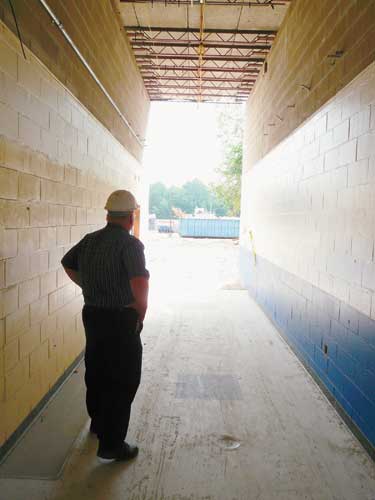 Andy Madura, SAD 61’s transportation director who is overseeing
Comments are no longer available on this story