
In the list of the 390 Westbrook residents who signed on for duty in World War I, Cora DeCormier stands out.
A nurse who served four years in the Great War, DeCormier was awarded several medals of honor and decoration by two European kings and the government of France.
One of 10 children, she was born in Westbrook in 1887 to French Canadian immigrants Francois and Regina DeCormier. She was a parishioner of St. Hyacinth’s Catholic Church and attended local schools up through graduation.
“She is a great promoter of new ideas, but owing to the slowness of the class of 1906, she has never been able to carry out any of them,” reads an entry in her 1906 Westbrook High School yearbook.
Her classmates must have caught an early glimpse of her potential.
After high school, DeCormier attended St. Mary’s Nursing School in Lewiston, graduating in 1912 in a class of only four women. She then began work with tuberculosis patients throughout Maine, the South, and the Midwest although an adequate drug treatment for the disease would not be available until 1943.
Upon return to Maine, she was named nursing superintendent of Webber’s Hospital, now the Southern Maine Medical Center, in Biddeford.
In August of 1914, military military skirmishes had broken out in Europe. Germany invaded Belgium and France, and Britain formally declared war, which automatically pulled Canada into the conflict as well. It was the Valcartier camp outside of Quebec City that drew the first Canadian volunteers.
Canada’s first unit arrived in England and was committed to battle by October of 1914. The troops went to war in France the following February.
Perhaps it was the pull of family patriotism – directed toward the Quebecois volunteers, or her distant ancestors from Paris and Brittany – that motivated DeCormier into action.
At the age of 27, DeCormier travelled to Montreal, along with a number of other Westbrook volunteers who could not wait for the United States, still teetering on the edge of its isolationist policies, to declare war.
She completed her enlistment papers on March 22, 1915, lying about her birthplace – listing it as Canada instead of Maine – in order to join the military effort. The healthy 5-foot-2-inch nurse, with dark hair and eyes, was approved for service with the Canadian Army Nursing Service on April 1.
DeCormier arrived in Europe when conflict was at a high. Confrontations such as the devastating Ypres Salient in Belgium and the Battle of Marne in France were being fought on the Western Front. Fearsome losses on both sides resulted. The wounded were numerous, their injuries grave.
One physician with the Canadian army Lt. Col John McCrae (the author of “In Flanders Fields,” one of the most memorable war poems of the era) was in the midst of the horror.
In his journal, he referred to the Battle of Ypres as 17 days of Hades. “At the end of the first day if anyone had told us we had to spend seventeen days there, we would have folded our hands and said it could not have been done,” he wrote.
While treating war injuries has never been for the faint of heart, new military technologies and strategies presented challenges for medical personnel. Tanks, mines, flame throwers, and air attacks – all unknown before World War I – caused horrific injuries, often resulting in shattered and missing limbs and paralysis.
TB, pneumonia, influenza, and serious infections were also common, and antibiotics remained undiscovered until 1928, years after the war had ended. Soldiers died of tetanus, gangrene, and other infection-related complications, and amputations were common.
This war also introduced two other new classes of injuries that drew on the skills of the nurses: wounds from chemical warfare (chlorine and mustard gas were now utilized in battle), and the often serious complications of shell shock or neurasthenia, understood today as Post Traumatic Stress Disorder.
Thus the nurses, known as sisters and matrons, labored on, wanting for supplies, witnessing the horrors, and never knowing if a day of work would bring eight patients or 300.
In addition to her base hospital work, DeCormier tended to soldiers directly in the trenches. While performing her duties on the battlefield, she was once exposed to gas and injured. Although reports say she never completely recovered, she refused to give up her work.
DeCormier’s great contributions were first officially recognized in 1917. King George V of England summoned her to Buckingham Palace along with five other nurses for a special wartime investiture ceremony in which she was decorated with the Royal Red Cross. Her later decorations included the Croix de Guerre medals of Belgium and France.
Even after the war, DeCormier continued to dedicate herself to the service of the community. She was put in charge of public health nursing in Southington, Conn., and became involved in studies of communicable illnesses and the vaccination of school children.
She was also a charter member of the Canadian Legion in Westbrook, formed by servicemen who, like her, enlisted in Canada before the United States entered the war.
Although the 1923 community directory places her in New York, she eventually returned to Maine to serve as maternity ward superintendent of St. Mary’s hospital in Lewiston until she herself succumbed to illness. She died of a cerebral hemorrhage on March 27, 1942 at the age of 54.
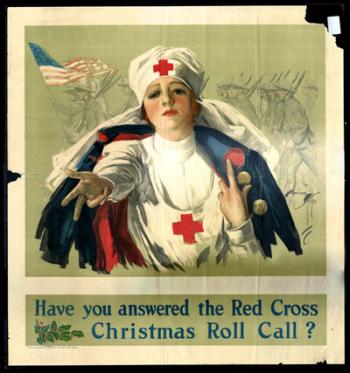 The Red Cross used this poster to call nurses to service during World War I.
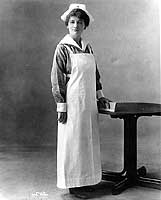 A World War I Army nurse is shown in uniform.
Comments are no longer available on this story