
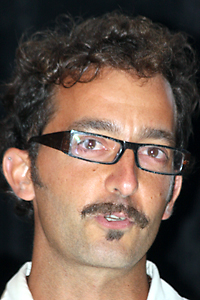
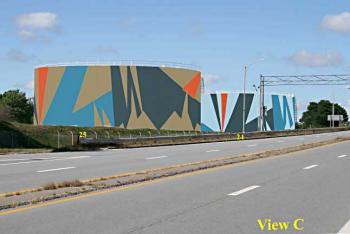
Jaime Gili’s abstract designs are planned for permanent display on the Sprague oil tanks in Portland Harbor. But little is known about the Venezuelan artist and his vision for transforming 16 oil storage tanks in South Portland into Maine’s largest public art installation. Gili, who specializes in public art projects, says his roots are traditional but his style modern. He also is outspoken in his criticism of U.S. oil consumption. Gili says he hopes that the oil tanks – with his art intact – will one day be empty relics as the world ends its dependence on fossil fuel.
“I really hope these tanks will not be in use in 30 years’ time,” says Gili, who describes all art as political. “I hope the city will make a park around them, a public museum, with some tanks becoming galleries.
As the creator of the design that won the Maine Center for Creativity’s Art All Around contest, Gili received a $20,000 prize. Gili, who lives in London, recently responded to a series of written questions – describing his style, his politics and his goals for the public art project in Maine.
Q: What inspired you to create a proposal to design art for the oil tanks in Maine?
A: I was inspired by the tradition of public art in industrial places in Venezuela, where I come from… like Cruz Diez’s work in the Guri dam in Ciudad Guayana.
Q: What are your personal impressions of South Portland and Portland Harbor, where the oil tanks are located?
A. Oil tanks are recurrent views in the city… They are all part of the landscape, like ships and forests, and they change with the weather just like nature does. They reflect a history of the world, and will also change with the world, when our dependency on fossil fuels diminishes, as it will.
Q: What is your interest in public art installations?
A: My interest comes from a thoroughly modernist spirit. I am interested in art reaching out of the gallery spaces and entering as many fields as possible in the rest of the man-made environment. This spirit includes an optimistic view of humanity, science, development and art itself.
Q: How do you describe your style? What was your aim or goal with the oil tank design?
A. I am a contemporary abstract painter who makes big expanding paintings and installations even when working on small canvases. Often my works contain energy and speed, coming from a very old tradition of painting. My goal was to have each view of the tanks to be interesting and to surprise the viewer. The forms and colors tell a kind of “story” with the whole tank farm. From the cemetery view to the highway view, from airplane to satellite view, all the tanks will come together and change with the weather and with the moving eye.
Q: What influences your color selections?
A. In this case it was the environment, the nature and the skies and sea of Maine, the palette of industrial colors that was available, and of course my own particular palette.
Q: Some residents of Maine say they prefer a more literal or traditional type of artwork, such as landscapes. Do you think your art will help them learn to appreciate abstracts?
A: The abstract versus figurative discussion ended about a hundred years ago. It is all the same, as the work will become part of the landscape when the tanks are done. If the question refers to art versus non-art, then the answer is even easier: My tanks will not be an illustration or a forest or a seascape to cover or hide the industrial needs and the industrial history of this country. The designs celebrate the history of Portland and the world. The work celebrates the tanks; it doesn’t hide them.
Q: How do you feel about your art appearing on oil tanks, when there is so much controversy over oil consumption and its environmental impact?
A: I am glad you asked this question. First of all, we are not talking about a refinery. These are petrol storage tanks. They are there because that is what people need at the moment. Second, we have to depend less on fossil fuels, and I know we will. We are moving toward the end of our dependency, but the U.S. is not moving in that direction but rather the opposite.
I have always campaigned to reduce fossil fuel consumption, and I have always criticized the U.S. government for not having a strong position in the world to change things. I hope the new government will, rather than keep exchanging blood for oil, have a more intelligent approach and really works toward a change in the industry that brings a change in the lifestyle of the American people and influence the world in a positive manner.
I really hope these tanks will not be in use in 30 years’ time. I hope they will be saved because of the art. I hope the city will make a park around them, a public museum, with some tanks becoming galleries.
Q: Is there a political message behind your oil tank design or any of your public art installations?
A: Of course. All art is political.
Q: Will you be returning to Maine soon? What is the next step in your project?
A: I am coming back in February for a show in Miami, and I will visit Maine to see the tanks in the snow. I am coming back in spring to supervise the beginning of the works. I am preparing an exhibition of paintings in Portland, so people can see the rest of my work, and enjoy the research from where the work on the tanks comes.
 Q&A with Jaime Gili – His design ‘celebrates the tanks; it doesn’t hide them’
 Oil tank design winner named
Comments are no longer available on this story