
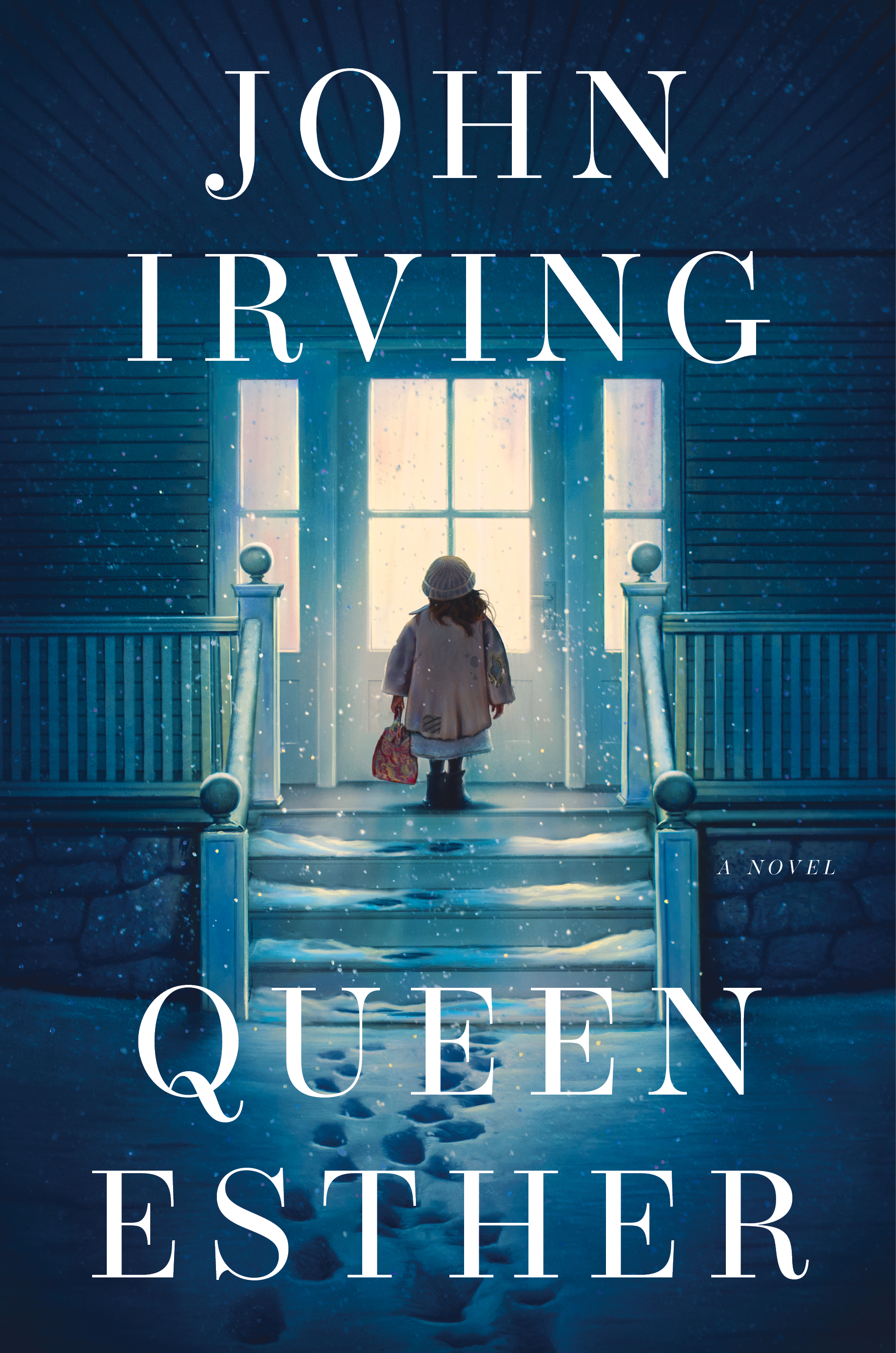
John Irving, 83, has just published his 16th novel. The fact that “Queen Esther” isn’t a masterpiece seems neither surprising nor, frankly, the point. What’s most wonderful about “Queen Esther” is that it returns us to the St. Cloud’s orphanage immortalized in Irving’s magnificent 1985 novel, “The Cider House Rules.”
Fans of that earlier book and the Academy Award-winning film starring Tobey Maguire will naturally want this new novel to be a sequel. It’s not that exactly – I’m not sure exactly what it is – but for a few chapters we’re back in the company of Dr. Larch, along with Nurse Edna and Nurse Angela, and their 40-year absence falls away like a trivial misunderstanding.
In the opening pages of “Queen Esther,” Constance and Thomas Winslow, prominent citizens of Pennacook, New Hampshire, drive to St. Cloud’s to pick up an au pair for their fourth daughter, Honor. After careful consideration, Dr. Larch has selected “the best one” from among his orphans: a 14-year-old Jewish girl named Esther Nacht. Little is known of Esther’s background, except that antisemites dumped her at St. Cloud’s as a toddler after her mother was bludgeoned to death. The Winslows, strict atheists, are concerned they can’t help Esther learn more about her Jewish heritage, but the girl isn’t worried. “That’s not your job,” she assures her new guardians and employers. “Learning how to be a Jew is my job.”
As the Winslows drive back home with their confident new au pair, Esther casually brushes off hateful glances and remarks that come their way. “Don’t be afraid,” she tells them. “This is just how it is.”
Those opening arrangements – conveyed in a thicket of historical vignettes, flashbacks, social commentary and domestic antics – serve as a kind of preface for this novel, which offers as many false starts as spring in Maine. Given her title billing, you’d be forgiven for expecting Esther to be the central character, but that brief adoption-hiring scene at the St. Cloud’s orphanage is most of what we’ll see of her for hundreds of pages.
The story immediately reopens 15 years later, jumping over Esther’s service as Honor’s caregiver and her time as a member of the Winslow household. From here on out, Esther is essentially an absent loved one, a rumored hero in Palestine serving in a Zionist paramilitary organization. In the novel’s final pages, long after we’ve come to the same conclusion, Irving concedes, “There was something more mythical than actual about Esther.”
In the basement of this book, there’s a thrilling story about a woman fighting for the establishment and then the defense of the modern state of Israel. But we get that story only in snippets of letters and in passages that fall somewhere between newsreel headlines and teacherly explanations. We learn, for instance, that “Simon Wiesenthal opened the Jewish Documentation Center in Vienna in 1961. Wiesenthal had survived the Nazi death camps and his documentation of Holocaust crimes assisted Mossad agents in the capture of Nazi war criminals.” That’s not storytelling; it’s Wikipedia.
Irving’s real subject – once again – is a young man who wends along the contours of Irving’s own life. (In one of many winking asides, he notes: “He would be criticized for writing about real people.”) In this case, the future writer is Esther’s son, Jimmy, intentionally conceived as a gift for Honor, who wants a baby but doesn’t want to have sex. Jimmy becomes a prep school wrestler (of course), is a great fan of Charles Dickens (naturally), feels separated from his father (inevitably) and is determined to be a novelist (voilà).
This may be a story about the education of a novelist, but I don’t think I’ve ever read a novel that struggles so long to cohere. That failing feels all the more disappointing considering the masterful structure of “The Cider House Rules,” which, despite a long, lumpy plot, always finds its way home. Here, though, no one else in the Winslow family holds the author’s attention long enough to seem like anything but a caricature. Jimmy’s adoptive mother, Honor, is flattened into a single-minded effort to keep him out of the Vietnam War with either a wrestling injury or a baby of his own – it makes no difference to her. And the story drifts through various digressions and preoccupations, such as circumcision, which, pardon me, should have been cut.
And then, smack in the middle of “Queen Esther” drops a 150-page tale about Jimmy’s junior year in Vienna – an absurdist interlude that lodges itself in the novel like an undigested biscuit. All the usual zany ingredients of Irving’s fiction are here: Jimmy rents a room from a prostitute’s mother and lives with a young lesbian determined to help him lose his virginity and a Frenchman who bursts into tears at the slightest provocation. But the sex comedy grows belabored, and the stagnant plot feels like some cruel prankster keeps moving your bookmark backward.
Weirder still is how the theme of Jewish identity blows through the novel, reminiscent – in a troubling way – of Howard Jacobson’s satire of philosemitism in “The Finkler Question,” where gentile fascination curdles into otherness. Irving’s story idealizes Jews while seeming to push them away. He lionizes the mysterious Esther, who becomes a Mossad hero, yet despite all her devotion to Zionism, she wants Jimmy to know: “For your own sake and mine, you should not be Jewish, but you better stand up for Jews.” Later, he realizes that “she had protected (even prevented) him from being Jewish.”
In these pages, there’s an unnerving implication that Jewishness is something akin to diabetes, a condition people should avoid if possible while also participating generously in every Run for a Cure. I wish “Queen Esther” were self-conscious enough as a novel to critique the inherent complications of this position. Jimmy may be the son of a brave Jewish woman, but we’re told – as though it’s a victory of some sort – that he would “forever be an ally,” not an actual Jew.
Oy vey.
Let this flawed novel inspire you to go back to “The Cider House Rules,” where, fortunately, the princes of Maine and the kings of New England are still snug in their beds.
Comments are not available on this story. Read more about why we allow commenting on some stories and not on others.
We believe it's important to offer commenting on certain stories as a benefit to our readers. At its best, our comments sections can be a productive platform for readers to engage with our journalism, offer thoughts on coverage and issues, and drive conversation in a respectful, solutions-based way. It's a form of open discourse that can be useful to our community, public officials, journalists and others.
We do not enable comments on everything — exceptions include most crime stories, and coverage involving personal tragedy or sensitive issues that invite personal attacks instead of thoughtful discussion.
You can read more here about our commenting policy and terms of use. More information is also found on our FAQs.
Show less