
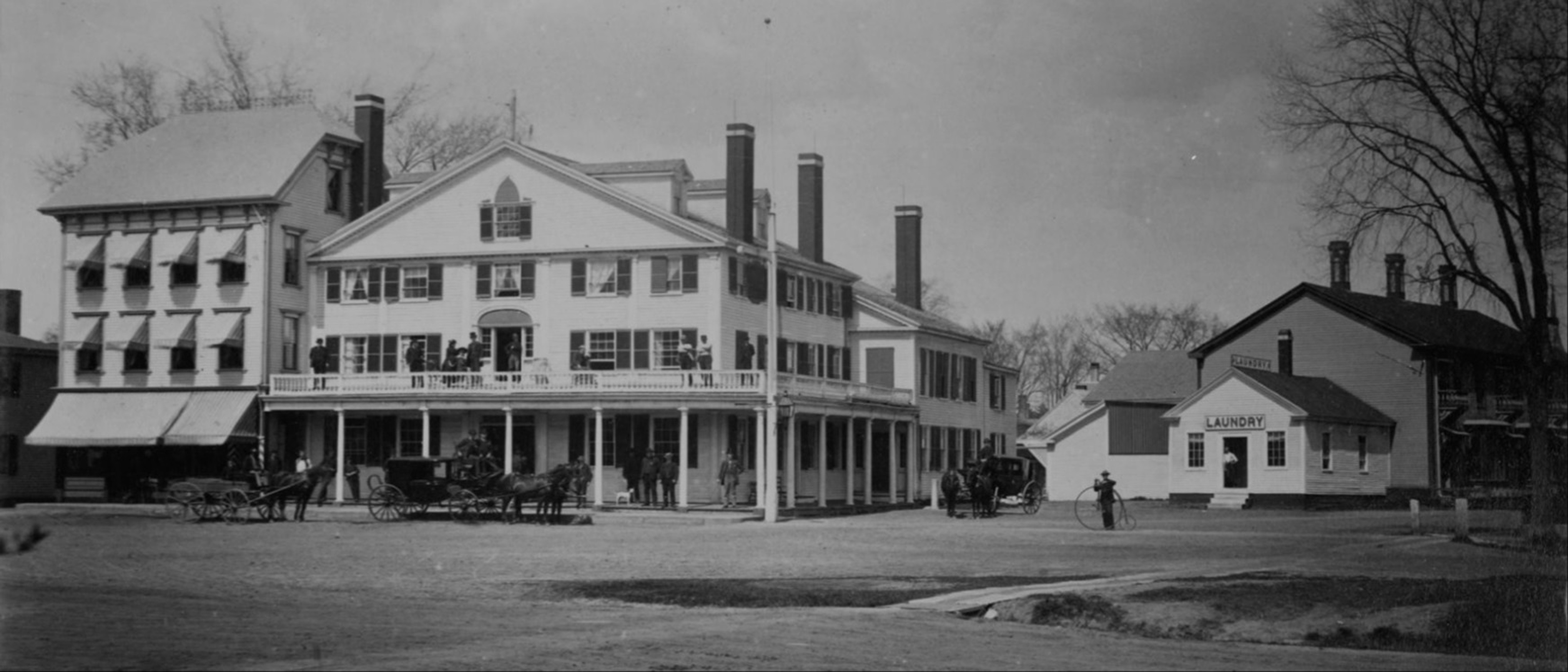
In a time when “there were no electric lights, telephone” or automobiles, and before the “railroad extended through Brunswick,” overland travel depended on hard men, stout horses and an extensive system of stagecoach lines. And Brunswick was the busy hub, where “all stages used to connect.”
“As early as 1793, a highway opened between Portland and Augusta,” and the “first regular stagecoach commenced about 1800.”
These stagecoaches had “rounded sides, doors that swung on hinges and windows that could be raised or lowered.” There were “seats inside and a-top,” and the larger of the coaches fit nine to 14 paying passengers, luggage and cargo.
Two types of stagecoaches existed; one being an accommodation stage for passengers and the other was a U.S. Mail stage, which “would take everybody who wanted to go, piling them outside and in.”
Many privately owned businesses, such as “the Maine Stage Company, William B. Peters, and the Brunswick and Turner Stage Company,” operated specific daily routes.
Stage drivers provided “pleasant, facetious, and oft-times instructive conversation.” These men were strong, tough, weather worn and “among the who’s who of their day.” These drivers were also known to blow “a tin horn when coming into town, to announce their arrival.”
“Henry McIntyre drove the first four-horse stage from Portland to Brunswick in 1803.” Other names such as “John Marshall, Abner McDonald, Charles Owen, Joseph Thomas, and Cyrus Plummer” were well respected by the traveling public.
Bath’s Cyrus Plummer drove “for the Maine Stage company” and was the most famous of the drivers, who “drove over the road every night, Sundays included.” For nearly 20 years, Plummer carried passengers and the U.S. Mail, “and never met with an accident.”
“Brunswick was the resting place for drivers,” the hub-town where all stages met and passengers transferred over. Brunswick was also “the collecting point” where passengers paid their fares” and where horses were swapped out for fresh teams.
Horses were changed every “10 to 12 miles, and stabled to await a returning coach.” The smallest of these coaches employed two horses, and the largest were “pulled by a team of 6 to 8.”
The many local taverns and public houses provided meals for passengers and drivers. “For years the Pejepscot House, which stood on the corner of Maine and Pleasant Streets, [served] as the stopping place for coaches.”
When the Tontine Hotel opened in 1828, the stagecoach office moved into the hotel. There, passengers could clean up, rest or take a meal. A “stiff drink cost 6-1/2 cents, dinner was 37-1/2 cents,” and these stages “would often bring together a hundred people for dinner.”

Normally, half a dozen stages arrived in Brunswick at the same time. Residents “used to watch for the stage with varying interest” as these coaches brought “letters, packages, and newspapers” with the latest news and gossip.
“When [Bowdoin] College let out it was no uncommon sight to see eight or nine coaches” loading homeward bound students for a trip to Portland.
A number of locations in Bath, such as the “Elliott House and the Stagecoach Inn,” served as stops in a time when “the run from Bath to Portland [was] five hours and it took days to go from Bangor to Boston.”
These stages “were not stopped … by snowstorms, but kept plugging through.” In Bath, “Rocky Hill was a hard place to come down in winter and spring” as the top-heavy coaches provided “hair-raising rides” over snow covered roads.
At Harpswell Neck, there was a daily stage to “Pott’s Point, Cundy’s Harbor, and Orr’s Island.” In Topsham, “Hunter’s Tavern,” better known as the Old Red House, was located 3 miles from town on the Middlesex Road and was a popular stop.
“Accidents were not infrequent … in several instances the towns of Brunswick and Topsham were obliged to pay damages to the stagecoach companies caused by defects in the highways.”
On Nov. 17, 1829, one such accident occurred on McKeen Street in Brunswick, “when a stage containing eleven passengers, among whom were Governor Dunlap of Brunswick and Mr. Charles J. Noyes, tipped top-down into a ditch full of water. No one was seriously injured, but all were bedaubed with mud.”
On June 9, 1849, “the first train crossed over the bridge into Brunswick,” sounding the first death knell for stagecoaches in the Midcoast. “The final end of the stagecoach came with the arrival of the automobile.” By the start of World War I in 1914, the stagecoach had all but disappeared in the United States and Midcoast Maine.
Today, these numerous and once vital means of public conveyance still exist in museums and at state fairs, and they continue to traverse the many rough-and-rumble Midcoast highways of our Stories from Maine.
Historian Lori-Suzanne Dell has authored five books on Maine history and administers the popular “Stories From Maine” page on Facebook, YouTube and Instagram.
Comments are not available on this story. Read more about why we allow commenting on some stories and not on others.
We believe it's important to offer commenting on certain stories as a benefit to our readers. At its best, our comments sections can be a productive platform for readers to engage with our journalism, offer thoughts on coverage and issues, and drive conversation in a respectful, solutions-based way. It's a form of open discourse that can be useful to our community, public officials, journalists and others.
We do not enable comments on everything — exceptions include most crime stories, and coverage involving personal tragedy or sensitive issues that invite personal attacks instead of thoughtful discussion.
You can read more here about our commenting policy and terms of use. More information is also found on our FAQs.
Show less