
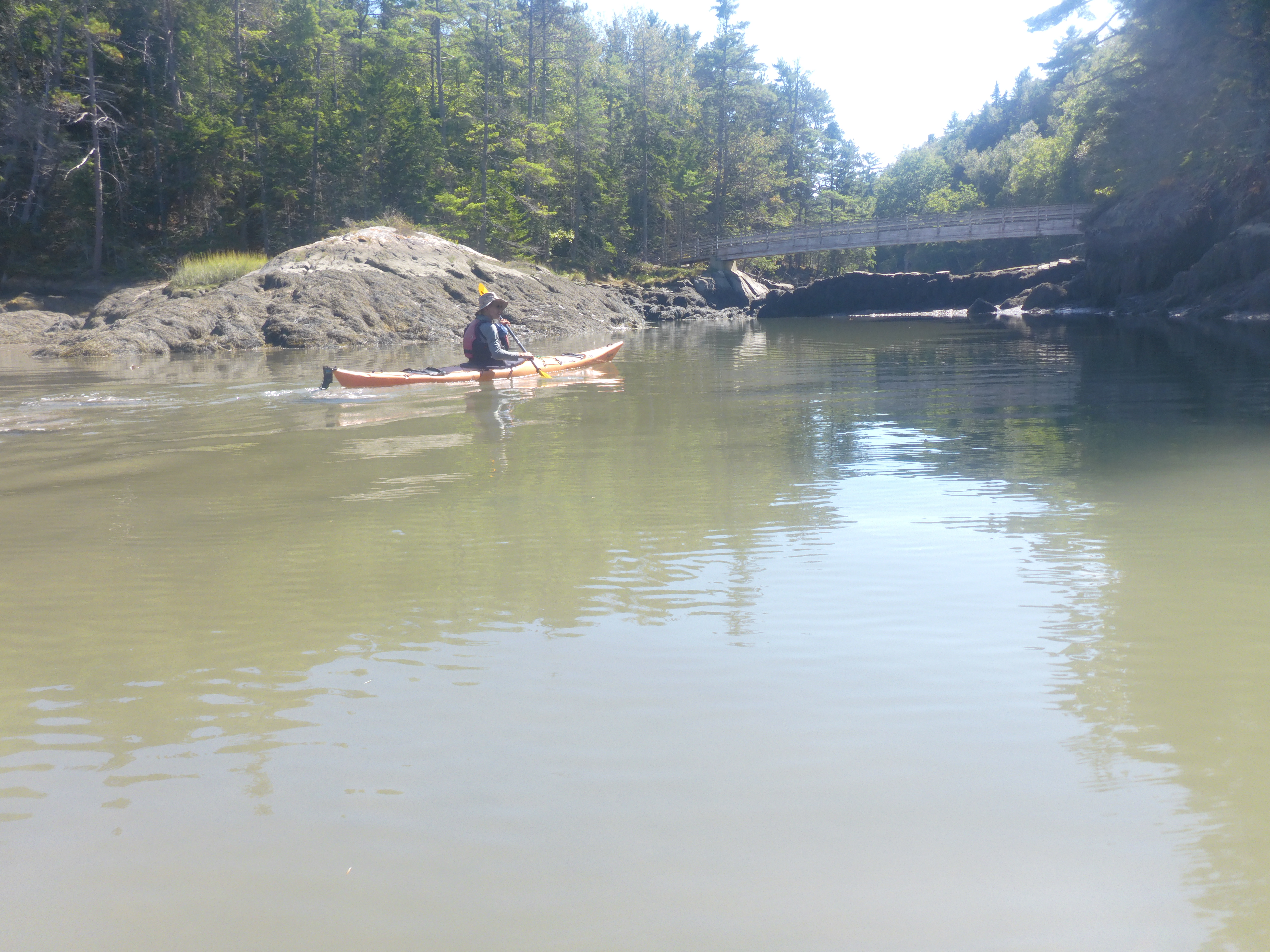
After a recent hike on the Ovens Mouth Preserve trail system in Boothbay with my wife, Nancy, I was intrigued with the prospect of kayaking through the unique Ovens Mouth Passage. The historic, sometimes treacherous waterway appeared to be a fascinating body of water to investigate.
My research indicated there was no convenient way to easily access Ovens Mouth and the surrounding waters. A lack of nearby boat landings was the problem. A 12-mile traverse north from Boothbay to Wiscasset with a favorable wind and tide appeared to be the most efficient way to solve the dilemma.
During a phone conversation with my friend and frequent paddling companion, Brent Elwell, I mentioned my interest in an Ovens Mouth sea kayak trip and he was enthusiastic about the prospect. Weather, winds and tides were important factors to consider. We identified an early fall day when sunshine and moderate southwest winds were forecast with a rising tide through the middle of the day. A tailwind with a complementary tide on a sunny day was too good an opportunity to pass up. A trip was on!
The sun was shining and a light wind blowing out of the southwest when the two of us met late morning at the Wiscasset town dock. We left Brent’s vehicle in the large parking area for the return shuttle and transported two solo sea kayaks south following Route 27 through Edgecomb and then west on Barter’s Island Road to a landing at Knickervane Island Park in Boothbay.
We launched from a convenient ramp onto Back River, paddled under Barter’s Island Road Bridge and embarked on our trip north. Initially, we enjoyed calm seas, a light tailwind and an incoming tide as we progressed between Morrow Island on the right and substantial Barter Island to our left.
After stopping in a small cove for some kayak adjustments, we continued north towards Miles Island. The water depth on the east side of Miles was too low, so we proceeded west, then passed Tibbetts Island and entered a wide section of the river.
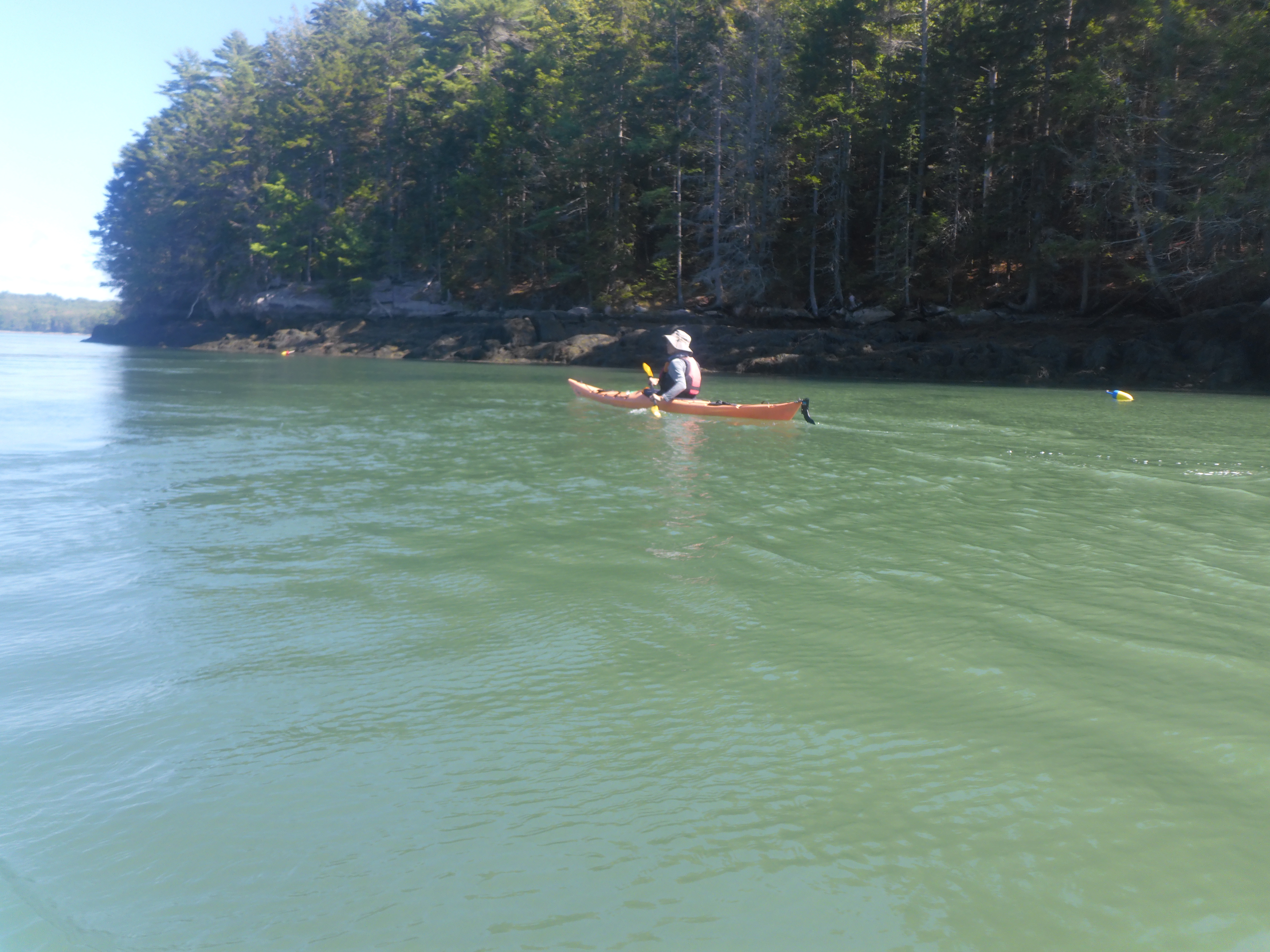
Although the entrance to Ovens Mouth Passage was not visible, our marine chart indicated we should travel northeasterly to locate the narrow opening. Persisting past tiny Gooseberry Island, we turned east around the northwestern end of the Boothbay mainland and entered Ovens Mouth, where turbulent tidal currents were pouring into the narrow twisting channel. We carefully maneuvered our kayaks through confusing rip currents and caught an eddy in a tidal cove on the right.
From there, we angled east back into the passage, followed high cliffs along the right shore and entered Ice House Cove on the right. Since the tide was still relatively low, the remains of a 19th-century dam that once formed a freshwater pond used for ice harvesting were exposed. A pedestrian bridge that connects trails in the Ovens Mouth Nature Preserve crosses over the cove just south. We stopped on rocks next to the dam for a lunch break. Afterwards, we continued east until the passage ends where it joins Cross River tidal basin.
A strong, swirling tidal current was flowing against us when we began a laboring return through the attenuated passage. When a lobster boat approached from behind while accelerating into the powerful incoming tide, we managed to catch a small eddy on the left to avoid a possible collision. Once the channel was clear, we exited Ovens Mouth.
A gusty headwind confronted us as we paddled southwest across the north shore of Back River and joined the Sheepscot River above Barter’s Island. Breaking waves and strong winds from our port side were an added challenge when Brent and I turned north around rugged Cross Point on the southwest coast of Edgecomb.
A tailwind and rising tide helped propel us north for several miles between elongated Westport Island on our left and Edgecomb on the right. Beyond Clough Point on the northeastern terminus of Westport, we passed historic Fort Edgecomb on the right and kayaked west across the widened river to Wiscasset town dock.
Once our exceptional Ovens Mouth exploratory was completed, we celebrated the successful navigation of a famed maritime route used by Native Americans and early Colonial settlers for hundreds of years.
My book, “Maine Al Fresco: The Fifty Finest Outdoors Adventures in Maine,” narrates 28 exciting exploits around the state sea kayaking, whitewater canoeing and kayaking, lake paddling, canoe tripping, and downriver racing.
The author of “The Great Mars Hill Bank Robbery” and “Mountains for Mortals – New England,” Ron Chase resides in Topsham. His latest book, “The Fifty Finest Outdoor Adventures in Maine,” will soon be released by North Country Press. Visit his website at ronchaseoutdoors.com or he can be reached at ronchaseoutdoors@comcast.net.
Comments are not available on this story. Read more about why we allow commenting on some stories and not on others.
We believe it's important to offer commenting on certain stories as a benefit to our readers. At its best, our comments sections can be a productive platform for readers to engage with our journalism, offer thoughts on coverage and issues, and drive conversation in a respectful, solutions-based way. It's a form of open discourse that can be useful to our community, public officials, journalists and others.
We do not enable comments on everything — exceptions include most crime stories, and coverage involving personal tragedy or sensitive issues that invite personal attacks instead of thoughtful discussion.
You can read more here about our commenting policy and terms of use. More information is also found on our FAQs.
Show less