
It is one of the ironies of outdoor work or advocacy that its plannings and meetings often take place in the close geometry of rooms. Still, irony be damned, there we were on Oct. 23, Brunswick’s Steering Committee for the Improvement of Mere Brook, arrayed along the table edges like so many hothouse flowers, heads canted this way or that. And there before us, on a large screen, were a couple of attendees who needed to Zoom in.
As chairperson of this meeting, I called it to order, thanked everyone for their attention to this town brook that carries so much news of us and turned to the work at hand. As I’ve made clear in a series of Times Record pieces about “urban-impaired” Mere Brook and its 2,760-acre town watershed, this is personal water. How it thrives and where it struggles is down to us, citizens of Brunswick.
Mere Brook’s meanderings — from the Columbia Avenue neighborhood, by the Coffin School, under Maine Street, through Meadowbrook and its ice pond, and then into and through the Landing to head of tide in the Furbish preserves — are easy to follow on a map. Sloshing along on foot is more of a challenge, as Mere Brook crosses square after trapezoid of private property on its way to the sea. But from these properties flows news of us and our habits and choices. If Mere Brook is to grow healthier, it is, in part, how each of us treats property that will either help or hinder.
And, as salt season nears, the brook’s many road crossings will offer another town choice: What will we do about the sluice of salty melt-water that will add to Mere Brook’s already toxin- and fertilizer-heavy burden?
None of this was news to our committee. Each of us in our various ways keeps trying to bring the brook to wider attention and better treatment. A large part of that work lies in convincing our neighbors that each of us is a watershed citizen, that what we do on our lawns, in our gardens, on our driveways either promotes watershed health or diminishes it. There is, as is true for much of life, no neutral, no living without affecting this brook. The question persists daily: What will you do?
That sounds, and is, preachy. Which makes it no less true. If I scatter salt against the ice on my driveway, I can see the ice melt and I can follow the salty trickle. It runs down to the road, joins there the too-much rock salt on the road, gullies a bit along road’s edge, passes my neighbor’s house, rounds a bend and slips into the stormwater drain. A walk of 50 yards to the south brings me to Mere Brook’s bank, and there lies the modest construction of Outfall 19, which conducts my stormwater into the brook. If I choose salt, my fingerprints are soon on the brook’s waters.
And each of us can fill in the blank with whatever substance we scatter or moisten our lands. Will it be toxin to kill a weed? Chemical fertilizer as steroid for grass? What we add to our water is part of our legacy.
November light — an antidote
Here, November is the month of sight, and it is not just because of the cool, low-riding sun and its light’s nosy angles. The leafless trees wave their bare limbs, stonewalls emerge from hiding, the river shines with sky. Long views open up, even as the days shorten. Once, someone said to me that living through November was like looking down a well — it was a dark place rimmed with stone, ending in watery reflection. I looked out my window. The neighborhood broad-winged hawk waited atop a pine, probably scouting for a snack; the air looked like the clearest water. If darkness were to be found it was in the hawk’s eyes — November is, after all, also the hungry season. “You’re crazy,” I said. “Why not take a walk?”
Taking a walk is often sound advice, but in November, it’s necessity. Only a little of the short day’s magic makes it through the window; you have to be out there to see it. Let’s go.
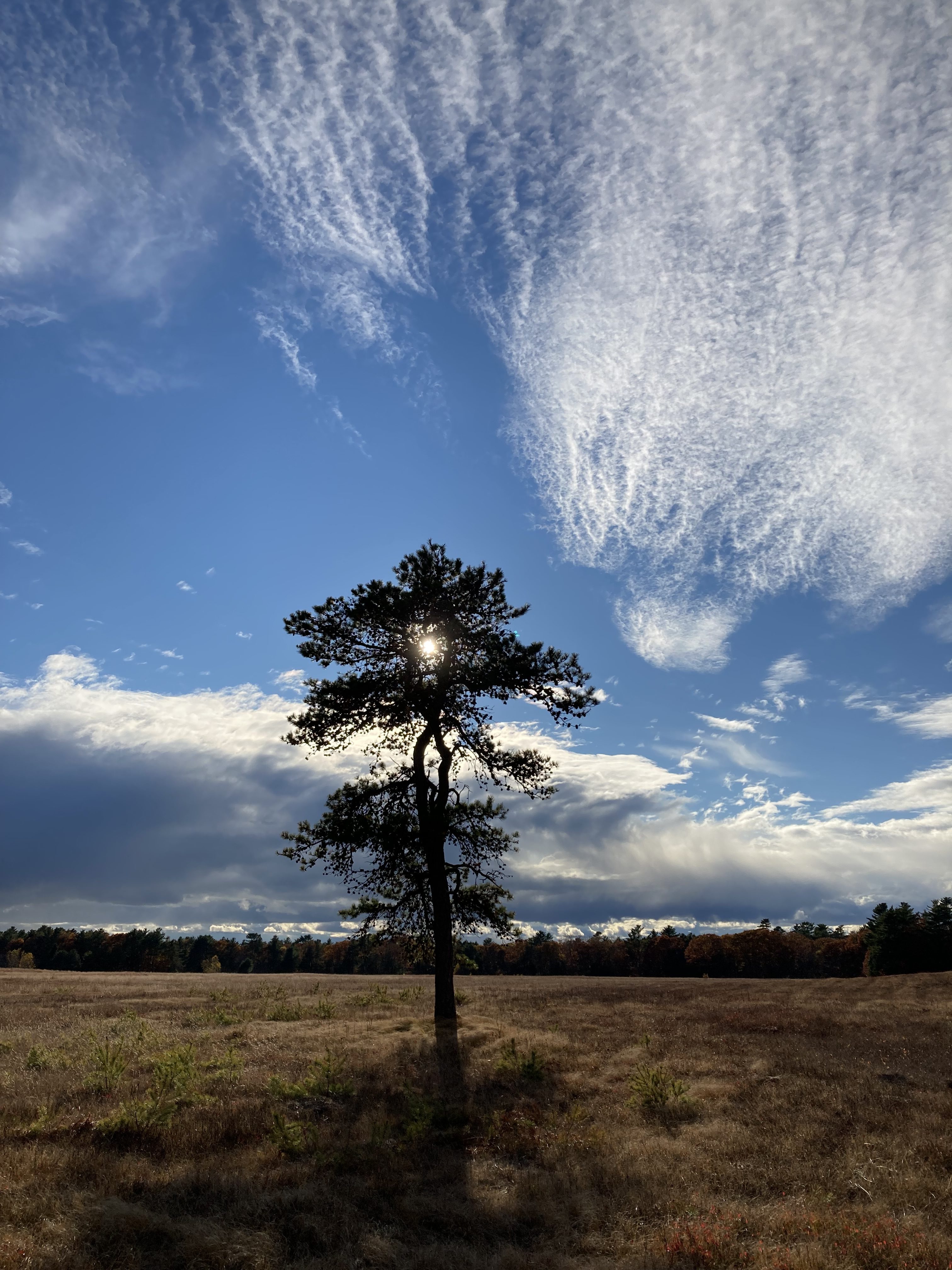
The other day, in the Brunswick-Topsham Land Trust’s Crystal Spring woods, time’s slow hands slid south to 4 o’clock. I had been ambling along in a dreamy fashion, my mind skimming the surface of one thought then another. Suddenly, streaming light washed through the understory of the woods, even as the treetops lifted still into a near dusk. It seemed that some impressionist had been turned loose with collections of pale leaves that she had wired to the spare branches of first this thin tree, then that one, stretching away to where they fused into a hammered gold backdrop. My back to the sun, I watched the leaves glow, saw light rise from the matted forest floor and ricochet wildly through the limbs. Suffused with light, like many before me, I felt lifted; affection brimmed.
And I thought of the desk work I’d walked away from for short sojourn amid the trees and grasses. There is always the gray-brown of routine laced with fatigue — it is always stereotypical November in some workspace, in the pages of some text, in our plodding minds. We read on, calculate odds, solve for our various Xs.
Oddly, ironically, the same routine, the same November walking, brings us also to flooding light, to moments when insight burns like lit leaves and the whole room of the mind is bright.
Sandy Stott is a Brunswick resident, chairperson of the town’s Conservation Commission and its Steering Committee for the Restoration of Mere Brook, and a member of Brunswick-Topsham Land Trust’s board of directors. He writes for a variety of publications. He may be reached at fsandystott@gmail.com.
Comments are not available on this story. Read more about why we allow commenting on some stories and not on others.
We believe it's important to offer commenting on certain stories as a benefit to our readers. At its best, our comments sections can be a productive platform for readers to engage with our journalism, offer thoughts on coverage and issues, and drive conversation in a respectful, solutions-based way. It's a form of open discourse that can be useful to our community, public officials, journalists and others.
We do not enable comments on everything — exceptions include most crime stories, and coverage involving personal tragedy or sensitive issues that invite personal attacks instead of thoughtful discussion.
You can read more here about our commenting policy and terms of use. More information is also found on our FAQs.
Show less