

In 1781, “slavery became illegal in the Massachusetts colony,” which included the District of Maine, and many African-Americans and former slaves chose to remain in the Midcoast, sink roots and settle in the towns of Harpswell, Topsham, Bath and Brunswick.
In Harpswell, “Black Will was a slave … who obtained his freedom and settled in Harpswell in 1739.” He then changed his name to William Black, “acquired property” and became one of “the first settlers on what was known as Will’s Island.”

Today, that land is better known as Bailey Island, and it is believed that “some of William Black’s descendants still live … on Orr’s Island.”
At Topsham, “Brigadier General [Samuel] Thompson had a Negro servant named Hallup, [although] it is unclear if she was a slave” or a free woman.
In Brunswick, the local connection to slavery was notable. “Andrew Dunning… who came to [town] in 1717 … kept slaves.” Dunning was later “killed by the Indians” at Fort George in 1735.
“Captain Benjamin Stone … kept a tavern in Fort George in 1737” where he “had a slave named Sarah Mingo.” Sarah “obtained her freedom” and then “kept house for Timothy Weymouth, near the Congregational Church.”
Many of the local shipbuilders and sea captains took some part in the slave trade. “Joseph Badger was a shipbuilder, merchant, banker, and slave trader” from New Hampshire, who settled in Brunswick. “Badger continued to engage in the illegal trade of enslaved peoples into the 1800’s.”
And Brunswick’s famous shipping family, the Skolfields, “were deeply connected to slavery … [and] profited from ships carrying cotton, tobacco, and other commodities … grown by enslaved people.”
In the meeting houses, where church services were performed, “the color line was strictly observed in those days, separate seats were provided … for negroes, whether free or slave.”
By the late 1700s, though slavery was now outlawed in Massachusetts and Maine, slavery still existed — and was growing — in the southern America states. But Maine became a place of freedom and safety for African Americans.
By 1811, Francis Heuston and his wife, Mehitable, purchased “20 acres of farmland in East Brunswick.” Francis was “likely born into slavery in Massachusetts,” and his wife “a widow and native Mainer [was] descended from former slaves.”
Francis was a military veteran, having “served on an American ship during either the Revolutionary War or the War of 1812.”
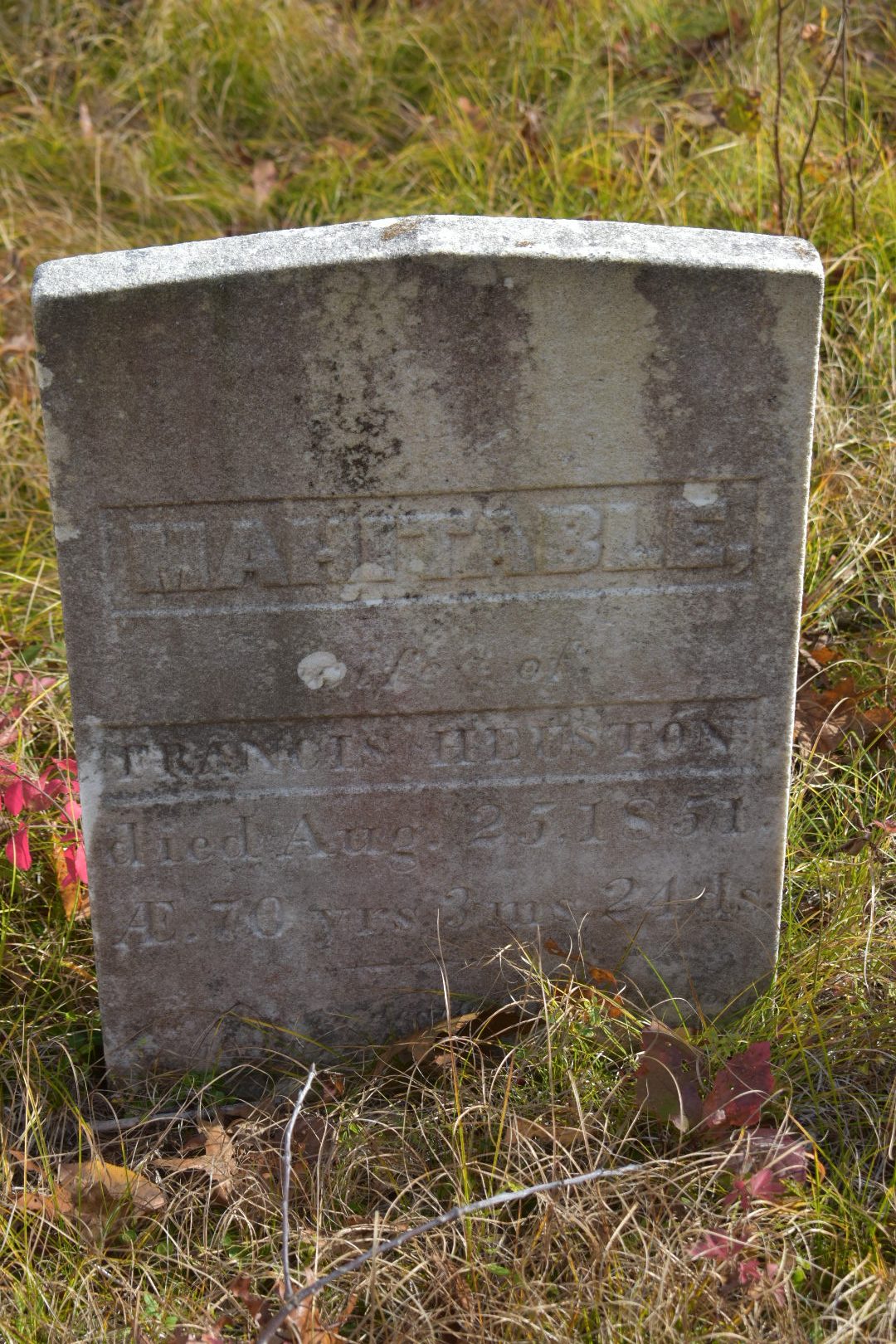
Here in Brunswick, the Heustons raised “a family [of] at least a dozen children and were a part of an integrated neighborhood.” When Mehitable died on Aug. 25, 1851, “Francis married Clara Battease,” a former escaped slave “who took the name Mary.”
The Heuston farm also served as a stop on the Underground Railroad, a secret network that smuggled runaway slaves to freedom in Canada.
Today, the “Heuston Burying Ground,” which was established in 1829, is carefully preserved alongside the old “Chapel of Our Savior” church on the Old Bath Road, where the Heuston Farm was located.
By 1850, as Harriet Beecher Stowe was about to make history on Federal Street by writing her anti-slavery novel “Uncle Tom’s Cabin,” a southern runaway slave named John Andrew Jackson made his way to Brunswick and the home of William Smyth, a professor of mathematics at Bowdoin College.
While a new “Fugitive Slave Law” forced all Americans to return escaped slaves back into bondage, Smyth’s home was also “a stop on the Underground Railroad.”
Bowdoin’s professor Thomas G. Upham and Harriet Beecher Stowe “had given [Jackson] money, food, clothing, and encouragement,” then sent Jackson to Reverend J.W. Ellingwood in Bath, where a population of “black sailors, shipbuilders, caulkers, longshoremen and stevedores worked” and lived. There, Jackson was able to blend in and vanish.
By 1892, Bowdoin graduate and newly minted African-American physician Salustiano Fanduiz opened his medical practice on Union Street in Brunswick. Fanduiz served the Brunswick, Topsham and Harpswell communities for the next seven years.
In 1970, Bowdoin College opened the Packard-Smyth House as “the Russworm African American Center,” the first such center in Maine. John Brown Russworm, the son of “a black enslaved woman” was the first African American to graduate from Bowdoin College in 1826.
In 2002, the Heuston Cemetery was restored as an Eagle Scout project by Boy Scout Michael Mulligan and his crew. And the Heuston Burying Ground was “designated as a National Park Service Freedom Site” in 2013.
In September of this year, the Brunswick Town Council designated roughly 230 acres surrounding the Heuston Burying Ground — Brunswick’s only African-American cemetery — as a portion of a newly designated recreational center to be known as the “Francis and Mehitable Heuston Park.”
Today, our evolved African-American history continues to be discovered and celebrated by scholars, and their lives and history are also remembered in the many pages of our Stories from Maine.
Historian Lori-Suzanne Dell has authored five books on Maine history and administers the popular “Stories From Maine” page on Facebook, YouTube and Instagram.
Comments are not available on this story. Read more about why we allow commenting on some stories and not on others.
We believe it's important to offer commenting on certain stories as a benefit to our readers. At its best, our comments sections can be a productive platform for readers to engage with our journalism, offer thoughts on coverage and issues, and drive conversation in a respectful, solutions-based way. It's a form of open discourse that can be useful to our community, public officials, journalists and others.
We do not enable comments on everything — exceptions include most crime stories, and coverage involving personal tragedy or sensitive issues that invite personal attacks instead of thoughtful discussion.
You can read more here about our commenting policy and terms of use. More information is also found on our FAQs.
Show less