
I was recently invited to speak to the Wiscasset County Garden Club on how to use up all the edible things in the garden at this late date in the growing season. When organizers first asked me to talk at their September meeting, my thinking went something like this: “Who? Me? I don’t garden!” I leave the produce-rearing to the professionals and am never disappointed by what local farmers bring to my table. What advice could I give these masters of their own gardens?
But as the request for my presence persisted, I popped out of my produce-buying bubble. I slowly realized that many, if not all, of the tips, tricks and techniques I use to use up every ounce of farm produce I pay for, will also work perfectly with garden produce. Now that I’ve written that down, it seems obvious. But an exercise that forces you to take on a new perspective on anything is always a good one.
I started the talk with infused vinegar as an easy, universal technique for making use of the last of heartier herbs like thyme and rosemary and edible flowers. I got some converts to the idea when I passed around a sample of the marigold vinegar I’d made in May as part of my column on edible flowers with its fetching golden hue and its musky, saffron scent. The audience’s interest was piqued, rapt even when I explained that the extent of the work to make that concoction was to simply drop the flowers into the vinegar and wait a few weeks.
We moved onto quickles, the process of cutting fresh hearty vegetables (red onions, carrots, cauliflower) into uniform shapes and arranging them in a pint jar, then submerging them in a brine made from equal parts vinegar and hot water, a tablespoon each of salt, sugar, and aromatics of your choice. You let the quickles hang out in the refrigerator overnight and use them liberally on salads, sandwiches and cheeseboards. The class sampled my pickled onions.
For leafy herbs and greens, we talked about using them liberally in salsa verde, pistou and chimichurri. When you mix finely chopped parsley, kale, chard, spinach, carrot tops, beet greens, and/or mint, with a bit of salt, a pinch of sugar, a cook’s choice of chili pepper, chopped nuts or seeds if you fancy them, and oil and vinegar, you have a fresh condiment that is as at home stirred into a tomato soup as it is slathered on piece of steak or a fish taco.
It’s not September if we’re not talking about ways for dealing with a bumper tomato crop. Watching how a frozen, whole plum tomato will slip out of its skin after 10 seconds in hot water made some members of the audience gasp! Another woman bought my cookbook because she though the recipe for the slow-roasted tomatoes in olive oil I passed around to sample was worth the $25 cover price alone.
I wanted to give attendees a formula for making a hearty roasted vegetable soup with whatever produce they might have still coming from the garden. Yet, I also needed to be mindful of freezer real estate I was telling them to consume with their tomatoes.

I settled on concentrated soup cubes. Think uber-flavorful ice cubes that, when you needed a cup of soup, you would take out of the freezer, place in said cup with about the same amount of boiling water, stir and sip. Think commercial soup concentrate without all the preservatives.
The process is simple. Take about 2 cups of raw vegetables and cut them into right-sized pieces so they will all be done roasting at about the same time. For example, whole cherry tomatoes will roast in roughly the same time frame as 1/4-inch thick carrot rounds, 1/2-inch-thick onion slices, raw corn kernels and 1-inch cauliflower florets. Toss the vegetables with olive oil, salt and pepper and roast them in a 375-degree F oven until they are tender.

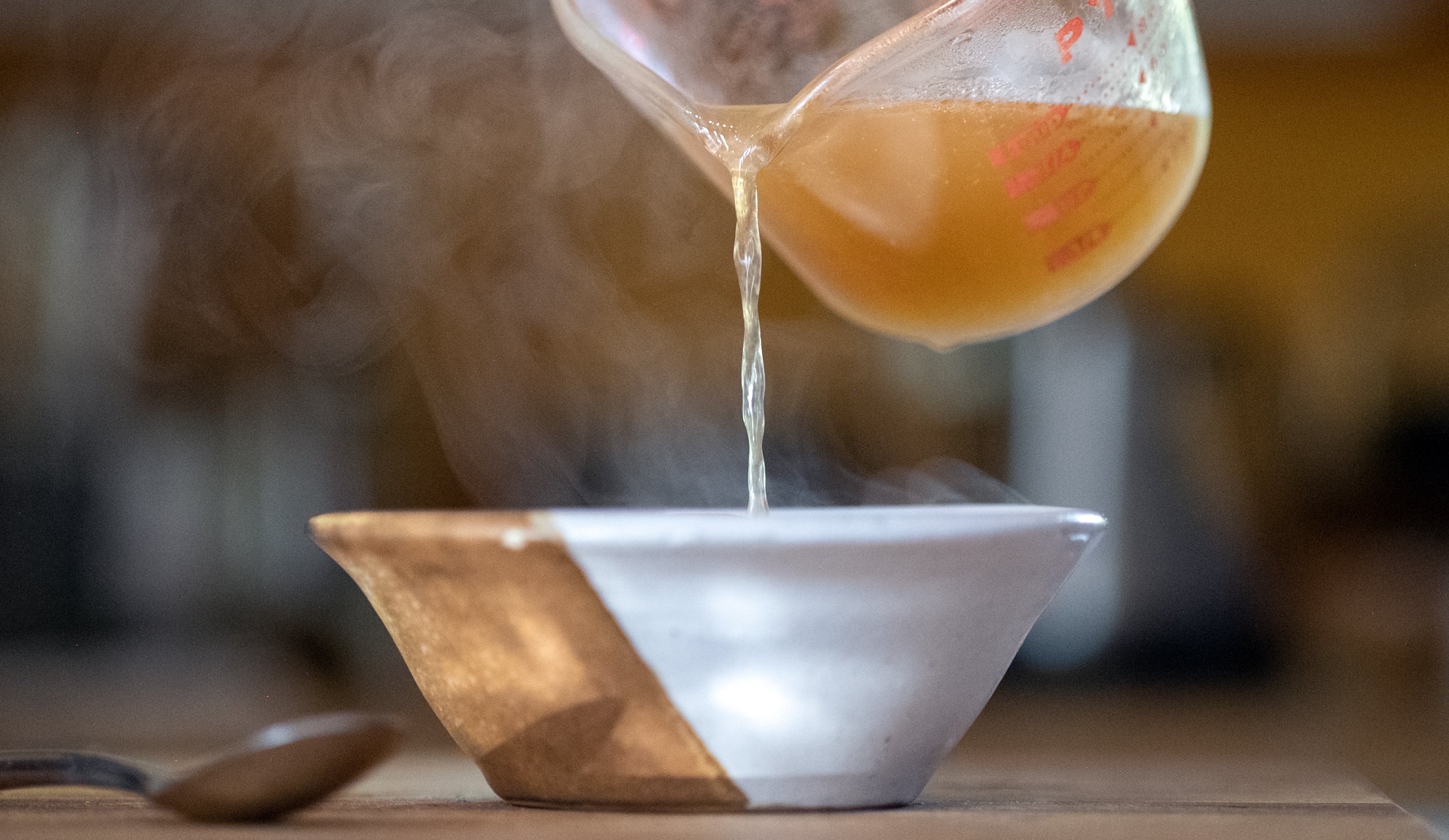
In the meantime, sauté a generous 1/2 cup of aromatics (garlic, ginger, shallots and spices) of your choice in a couple of tablespoons of olive oil. Add a cup of stock. When the vegetables have finished roasting, add them and your highly flavored broth mixture to a blender and puree all until smooth and creamy.
Then you simply scoop the puree into ice cube trays and freeze until solid. Once the cubes are frozen, you can transfer them to a bag, where they will keep in the freezer until you’ve come in from a football game, raking leaves, or playing in the snow and you need a nice hot cup of soup lickety split!
My one warning is that you will not always have the same bits and bobs on hand to make the soup. While as a cook, that is the fun of the challenge, you may want to label your soup cubes to prevent eaters from any surprises.

CONCENTRATED VEGETABLE SOUP CUBES
This is a recipe that has infinite number of possible variations. The one trick to it is making sure the puree is extremely flavorful before freezing it into cubes. To get a cup/bowl of soup, you will mix roughly equal measurements of cubes with boiling water or stock.
Makes 8 large or 16 small iced soup cubes
2 cups fresh vegetables (such as carrots, peppers, onions, squash, sweet potatoes, corn, cherry tomatoes, etc.), sliced and diced to account for equal roasting times
Olive oil
Kosher salt
Ground black pepper
1/2 cup sliced aromatics (such as garlic, ginger, turmeric, shallots, chili peppers)
1 tablespoon ground mixed spices (such as curry powder, coriander, cumin, smoked paprika, herbs de Provence, Chinese five spice)
1 to 1 1/2 cups vegetable or chicken stock
1 to 2 teaspoons lemon juice
Combine the vegetables with 1 tablespoon olive oil, 1 teaspoon salt and ½ teaspoon black pepper. Arrange them in a single layer on a baking tray. Put the tray in the oven. Turn the oven on to 375 degrees F and roast until the vegetables are soft and starting to brown, about 20 minutes after the oven reaches temperature.
Combine the aromatics, spices and 2 tablespoons of olive oil in a large pot. Place the pan over low heat and allow the ingredients to soften while the vegetables roast. When the vegetables are roasted, add them to the pot along with 1 cup of the stock. Transfer the mixture to a blender and process until smooth. If the mixture is too thick and your blender stutters, add the other ½ cup of broth.
Taste the puree; it should be very highly flavored. If it is not, add more salt and pepper and 1 teaspoon of lemon juice at a time to bring all of the flavors forward. Once you have achieved a flavor you like, freeze the puree in ice cube trays. Once they are frozen, transfer the cubes to a container. They will keep in the freezer for about 6 months.
Local foods advocate Christine Burns Rudalevige is the former editor of Edible Maine magazine and the author of “Green Plate Special,” both this column in the Portland Press Herald about eating sustainably and the name of her 2017 cookbook. She can be contacted at: cburns1227@gmail.com.
Comments are not available on this story. Read more about why we allow commenting on some stories and not on others.
We believe it's important to offer commenting on certain stories as a benefit to our readers. At its best, our comments sections can be a productive platform for readers to engage with our journalism, offer thoughts on coverage and issues, and drive conversation in a respectful, solutions-based way. It's a form of open discourse that can be useful to our community, public officials, journalists and others.
We do not enable comments on everything — exceptions include most crime stories, and coverage involving personal tragedy or sensitive issues that invite personal attacks instead of thoughtful discussion.
You can read more here about our commenting policy and terms of use. More information is also found on our FAQs.
Show less