

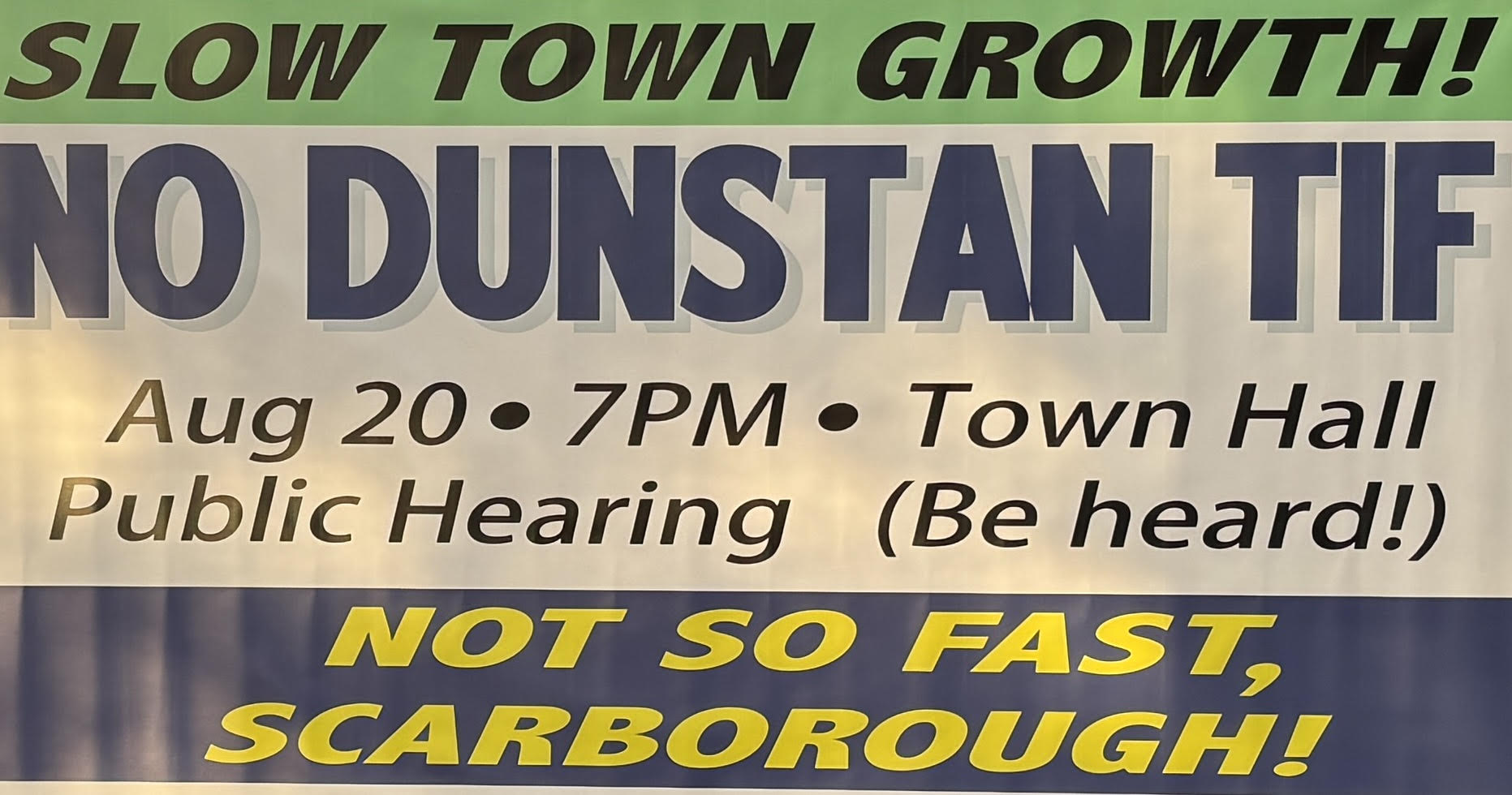
Yard signs that popped up around Scarborough beckoned the Town Council to “Slow Town Growth … No Dunstan TIF.”
On Wednesday, the Town Council voted unanimously against the proposed tax increment financing zone in the Dunstan area.
The district would have funneled taxes on new value added by the increase in property valuation into a fund with designated municipal purposes like transportation infrastructure improvements.
Town Manager Tom Hall said that town staff had been eyeing the 230-acre zone for about 10 years because of the many large, undeveloped parcels that are currently zoned for development in the area. The proposal identified 100 acres of empty land.
By creating a TIF, he said, the town would be maximizing economic development potential and getting ahead of a specific project.
The proposed district would be able to support 375 new housing units — 70% of which would be multifamily and 120,000 square feet of commercial space — including food stores, restaurants, coffee shops and entertainment.
But the plan received pushback since it was first brought before the council in July.
Over the summer, hundreds of residents banded together in a lobby called Not So Fast, Scarborough, said Don Hamill, one of the spokespeople for the group.
The group organizes generally against what it calls “excessive growth,” and for the past few months, it has mobilized against the Dunstan TIF.
At the public hearing for the TIF in late August, there were approximately 100 people in attendance — more people than chairs. More than a dozen people gave public comment.
“We don’t want to be the poster child for growth anymore,” Hamill said. “We’ve done more than our fair share.”
In council discussion at the Wednesday meeting, councilors said public sentiment swayed them. Jon Anderson said that despite his own pontificating about the benefits of a TIF, he voted “no” because he wanted to “make sure we take a breath, listen to the community and really make sure that we do the work.”
A few days before the vote, he wrote in an opinion column that he feels comfortable waiting a year before trying to pass more TIFs or credit enhancement agreements.
“It’s clear we have more work to do to bring the community along,” he wrote. He also encouraged engaged residents in this issue to join town committees.
This isn’t the first time in town history that the council has sought public input in studying growth. In the early 2000s, after a decade of residential growth, a Growth and Services Committee released a report chronicling the impact of growth on the municipality.
The council will host a series of workshops beginning in October to discuss the context and possible futures regarding growth in town.
Councilor Bill Donovan, who voted “yes” for the project at the first reading, switched his vote to “no” Wednesday. He said that there’s no need to pursue a TIF when the attached development was killed.
The tax increment financing zone was originally proposed in tandem with a credit enhancement agreement for a 50-unit low-income senior housing project within the Dunstan area. The Town Council voted down this agreement at its July meeting, and without it, the project didn’t have the legs to stand on. South Portland Housing Authority, the developer, withdrew its plan for the parcel and plans to sell the land.
Donovan believed that the opposition to the credit enhancement agreement was misguided given that senior housing is a relatively low-impact development.
Councilor Larry Cain also noted the impracticalities of passing a TIF without a corresponding project. This district would have a 30-year time frame. “Why start the clock now?” he said.
Other councilors were more ardently against growth. Councilor Karin Shupe said that she “will not be supporting a TIF any time going forward.”
“No matter how you spin it, they support growth,” she said. And to her, the town “does not need to be supporting more development right now.”
To organizers of Not So Fast, Scarborough, the defeat of the TIF is a major win.
“All of that work paid off,” Hamill said. “The town listened. The Town Council heard us.”
An email sent to its mailing list the day before the vote declared that a rejection of “the Dunstan TIF would mark the end of the high growth era that began with the November 28, 2018 council vote that approved the massive tax break for The Downs.”
Hall said that a TIF, or the lack of one, doesn’t change the fundamentals of land use and what can or can’t be developed on property. If a parcel is zoned correctly for a proposed project, the development doesn’t need to go before Town Council, instead simply needing Planning Board approval.
“It all begins and ends in zoning and what’s allowed to be developed,” Hall said.
Hamill said that there is still work ahead. Not So Fast, Scarborough plans to discuss development moratoriums: how to consider, evaluate and utilize them.
A moratorium would have to have a specific consideration and motive, Hall said, and it would start with six months, with the option to be extended to up to 12 months total. Hall cautioned against rushing into a moratorium.

We invite you to add your comments. We encourage a thoughtful exchange of ideas and information on this website. By joining the conversation, you are agreeing to our commenting policy and terms of use. More information is found on our FAQs. You can update your screen name on the member's center.
Comments are managed by our staff during regular business hours Monday through Friday as well as limited hours on Saturday and Sunday. Comments held for moderation outside of those hours may take longer to approve.
Join the Conversation
Please sign into your Press Herald account to participate in conversations below. If you do not have an account, you can register or subscribe. Questions? Please see our FAQs.