

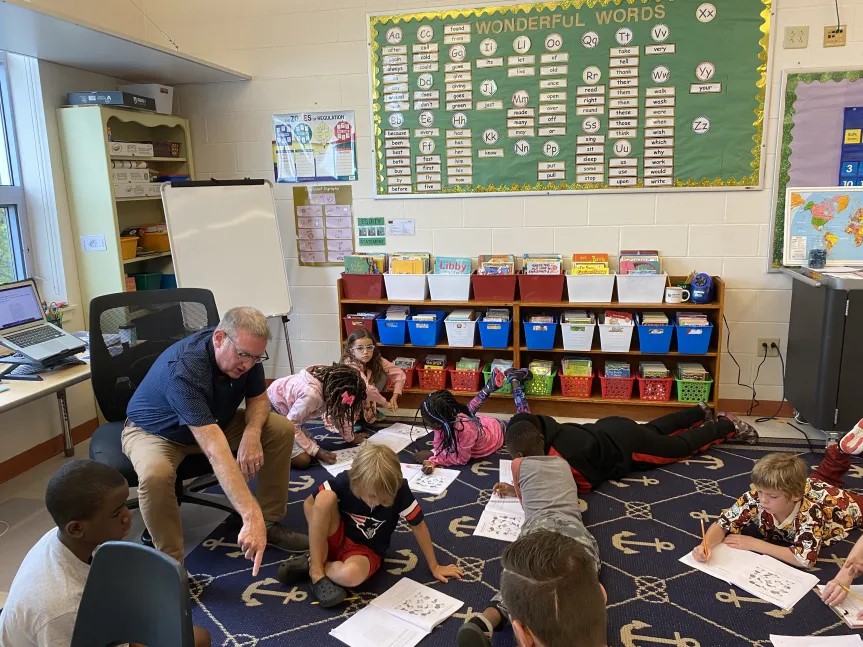
Joshua Chard is shown working with students in his East End Community School classroom in 2023. Photo courtesy of Maine Department of Education
The maps that determine where children attend elementary and middle school in Portland could change for the first time in about two decades.
A committee has been meeting for a year to discuss changes to Portland’s K-8 attendance boundaries that would more equitably balance enrollment and demographics among schools. The committee will vote this Thursday on its final recommendations for proposed changes, but the public will have a chance to give input before a final vote from the Board of Public Education this fall.
About 340 students (or 8.4 % of all students enrolled) would attend a different school under the latest proposed changes, which would likely take effect prior to the 2026-27 school year.
The district’s boundaries haven’t changed since the mid-2000s, but Portland has seen many population shifts during that time, including the building of new housing developments, according to school board Chair Sarah Lentz, who also heads up the attendance boundaries committee. Those shifts have resulted in major variations in capacity at different schools, and in certain populations like economically disadvantaged students, and prompted the school board to create a committee by resolution in June 2024.
“The board was really interested in looking at: Are there ways that we could better balance the ways that our schools are being utilized?” Lentz said.
Under the current boundaries, for example, Longfellow Elementary on Stevens Avenue is only at 57% capacity, and less than a quarter of students there are economically disadvantaged.
Compare that to Lyseth Elementary in North Deering, which is currently at 80% capacity and has 35% economically disadvantaged students, or East End Community School at 71% capacity and with 78% economically disadvantaged students.
Over the past year, committee members — including administrators, board members, parents, teachers, staff and local residents — have worked with an outside consultant and software programs to model how different boundary adjustments would change those ratios.

The Longfellow Elementary School on Stevens Avenue in Portland (Ben McCanna/Staff Photographer)
After the proposed boundary changes, Longfellow would increase to 76% capacity and 31% economically disadvantaged, while Lyseth would drop its capacity to 74% while keeping a similar proportion of economically disadvantaged students, and East End would decrease to 66% of capacity and 77% economically disadvantaged.
The district’s three middle schools are less varied, but still uneven in their distribution of enrollment and demographics.
Under the current boundaries, King Middle School is the most full, at about 72% capacity, and has the highest proportion of economically disadvantaged students, also 72%. Under the most recent proposed changes, capacity at King would drop to 61% and economically disadvantaged students would drop to 65%, although the committee has yet to decide on a final proposal for new middle school boundaries.
The committee looked at several priorities when adjusting the boundaries, including balancing capacity, maintaining walkable neighborhood schools and minimizing the number of students impacted. The group also factored in 5- and 10-year population projections to make sure the boundaries account for predicted shifts.
Early in the process, the committee did discuss potentially closing one of the city’s eight elementary schools but decided against it after hearing community feedback, Lentz said. The group also was tasked with considering reducing the number of middle schools, but the boundaries up for consideration do not propose any closures.
Questions about implementation, including whether students who are in fourth grade at the time of the change would be allowed to finish out elementary school at their current building, are still under discussion.
Lentz said she knows that this process will inevitably come with some difficult conversations for families.
“I think that where your child goes to school is deeply personal. I feel that myself as a parent, and so I think that there are a lot of emotions that sometimes come into these conversations,” Lentz said.
She recalled one committee member who said she had been telling her young child “this is where you’ll go to school one day” for years, but with the new boundaries that would no longer be true.
“And that feels like a really big thing to change for your kid, right?” Lentz said. “So I both understand that, and also know that all of our students in the district are going to get a better education if we’re able to redistribute things to make them a little bit more equal.”
The Attendance Boundaries Committee will meet virtually on Thursday at 5 p.m. to vote on recommending the elementary school boundaries, and then finalize and vote on middle school boundaries. The proposed changes will be presented at public meetings scheduled for October to gather public feedback, before coming back to the school board for a vote, likely in November.

We invite you to add your comments. We encourage a thoughtful exchange of ideas and information on this website. By joining the conversation, you are agreeing to our commenting policy and terms of use. More information is found on our FAQs. You can update your screen name on the member's center.
Comments are managed by our staff during regular business hours Monday through Friday as well as limited hours on Saturday and Sunday. Comments held for moderation outside of those hours may take longer to approve.
Join the Conversation
Please sign into your Press Herald account to participate in conversations below. If you do not have an account, you can register or subscribe. Questions? Please see our FAQs.