

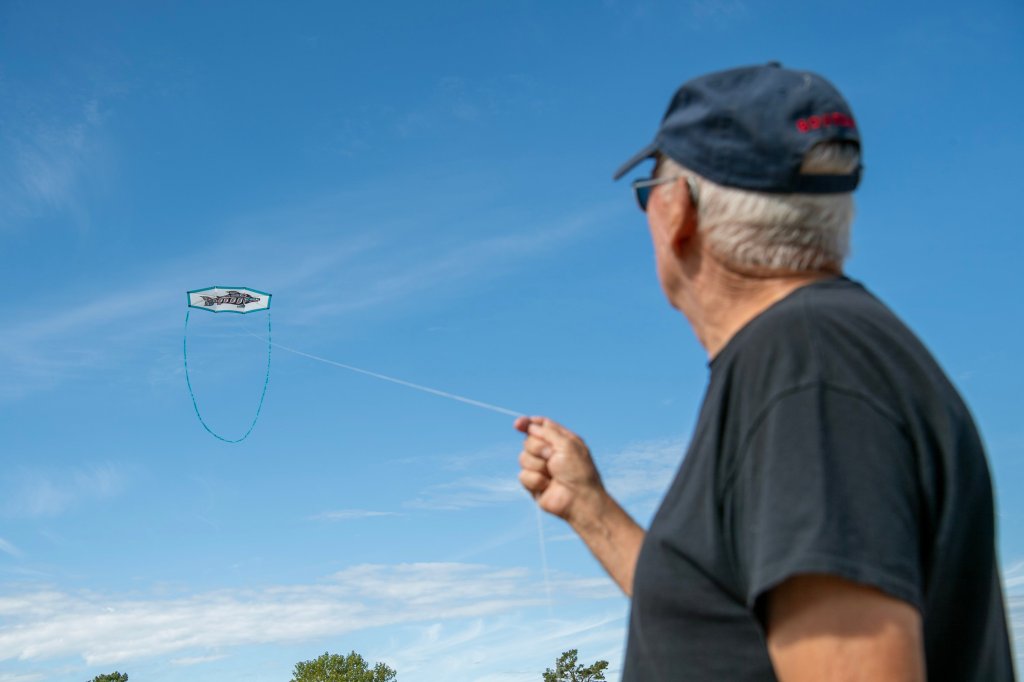
John Martin flies his kite Wednesday at Bug Light Park in South Portland. Martin made the Genki style of kite himself. He sewed various layers of material together to resemble a salmon. (Daryn Slover/Staff Photographer)
It was a still morning at Bug Light Park, with only a few gentle gusts.
But that didn’t deter John Martin.
He unfurled his neon-greenish-yellow mantra kite — a shape that resembles a bird, with a sloping head, wings and tail. A small gust caught the kite.
“See the wind on the water?” he said. “It’s rolling. When it hits the ground, it’s still rolling.”
He pulled on the line with one hand, and with each yank, the kite climbed a few feet higher, bobbing up and down.
“The goal is to get the kite above the interference and let the wind take it all the way up,” he said. This kind of kite is so light, he explained, that it can even ride the thermals like some birds.
After nursing the kite for a few minutes, it leapt in the air, soaring about a hundred feet overhead. Martin let go of the line and the kite held steady.
Martin has been flying kites since he was 7 years old, and he continued to fly while serving in the Navy for 31 years. “I always took a kite with me,” he said. Today, he owns 200.
“Ask my wife, she’ll say I have one too many,” he said with a laugh. “I tell her I have one too few.” He estimates that he made 40 to 50 of his kites.
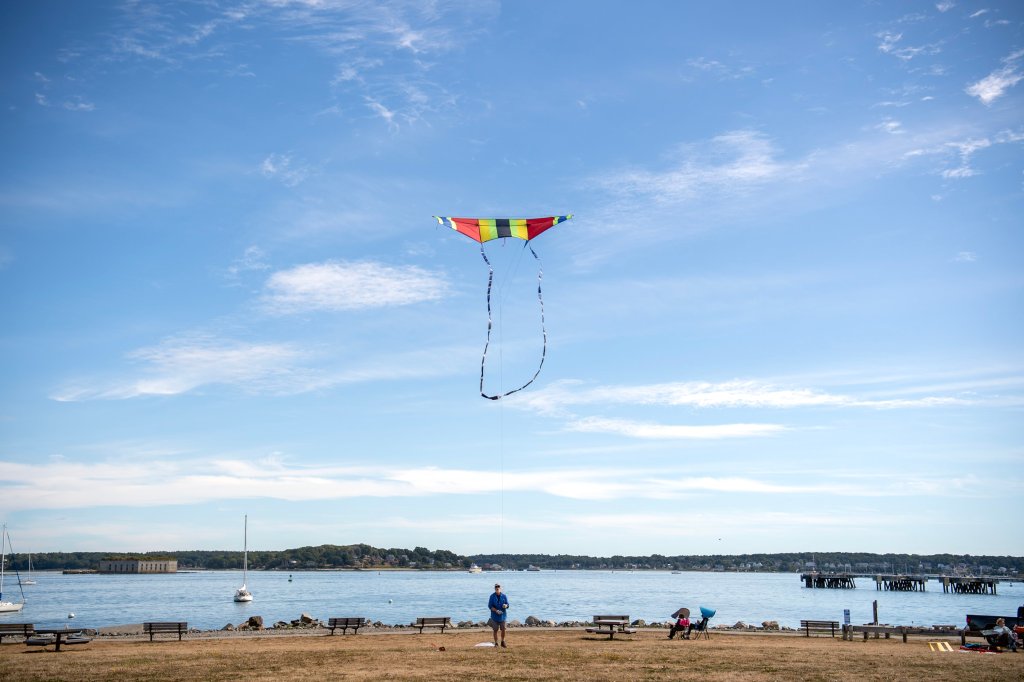
Tony Otis flies his kite Wednesday at Bug Light Park in South Portland. The Genki style of kite has a lot of sail area and is designed to fly well when there is not much wind. (Daryn Slover/Staff Photographer)
Of all of the places he’s flown, Bug Light Park is one of the best, with its swirling sea breeze and open field, he maintains.
And there’s a group of people who agree. The Nor’Easters Kite Club gathers to fly kites together, usually at Bug Light Park. They’ve been flying together for more than 20 years.
There are 129 people on the mailing list for the group, with some hailing from as far away as Florida, Georgia, California and the Midwest. They even have some members from England and Canada.
They take the hobby seriously. Many are past or current members of Kites Over New England, a more formal group that encompasses the whole region.
At most Nor’Easter meet-ups, the group expects between three and 20 people to show up, and they usually fly for hours.
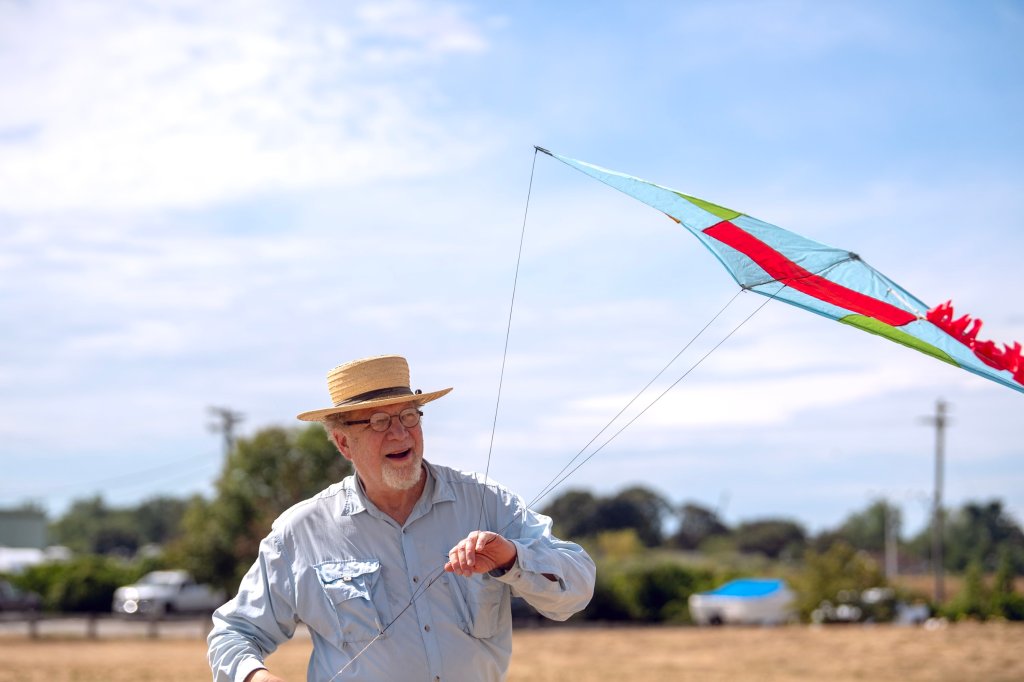
Joel Eckhaus prepares to fly his kite Wednesday at Bug Light Park in South Portland. Eckhaus said that the design of his kite matches the design on his socks. (Daryn Slover/Staff Photographer)
Joel Eckhaus was once a newcomer. He’d been flying kites for 65 years, on and off, so when he saw “a gang of kite people” at Bug Light Park 10 to 15 years ago, he decided to bring a couple of cheap kites he found at Marden’s.
“They showed me how to fly,” Eckhaus said. It reminded him of his childhood, of when he bought a cheap kite for a dime at the local grocery store, of when he flew homemade kites in college.
Members of the group also showed him how to make his own kites.
He used to fly by himself once or twice a week at sunset. Now, he goes once a month, whenever the group is having an event. “It’s more fun to fly kites with other people than it is when you’re alone,” Eckhaus said.
On this particular morning, he wiggled the line of the kite as if he was a wizard casting a spell. His white and red kite caught a gust and gently bobbed a few feet above his head.
Other kite enthusiasts come from farther away to participate in the group. Ralph Reed lives in Lowell, Massachusetts, and he’s been flying with the group since it started. He tries to fly with them twice a month.
“I get to be outside, and I get to hang out with my friends,” he said. “And I can pretend like I’m exercising, but I’m not, really.”

Joel Eckhaus flies his box kite Wednesday at Bug Light Park in South Portland. Eckhaus made the kite himself out of silk that he found at Marden’s. (Daryn Slover/Staff Photographer) Daryn Slover/Staff Photographer
He brought Mike Taylor, his son-in-law, with him to this meet-up. It’s his fourth year flying, and he makes the trip with his father-in-law once a year.
As the group got going, a cluster of kites flew over the park, narrowly avoiding tangles.
Many of the Nor’Easters consider themselves hobbyists, but for the more competitive at heart, there are kite competitions. The American Kitefliers Association hosts a range of competitions including flying, fighting and making.
Tony Otis, who Martin described as the focal point of the group, has only entered two competitions in his life, and he placed in both of them. In 1983, he won a maker’s competition at the Smithsonian Kite Festival, and he got fourth place in a competition in Tennessee with a kite style he designed himself. They typically judge on the basic parameters: Is it symmetrical? Can it fly? Is it artistic?
If the competition is close, the judging can get intense, he explained. Rulers come out to measure stitches.
Otis takes the hobby seriously. He brought 40 kites with him on this particular morning, most of which he made. He flew many of his creations throughout the course of the morning, including a kite with a kidney design on it.
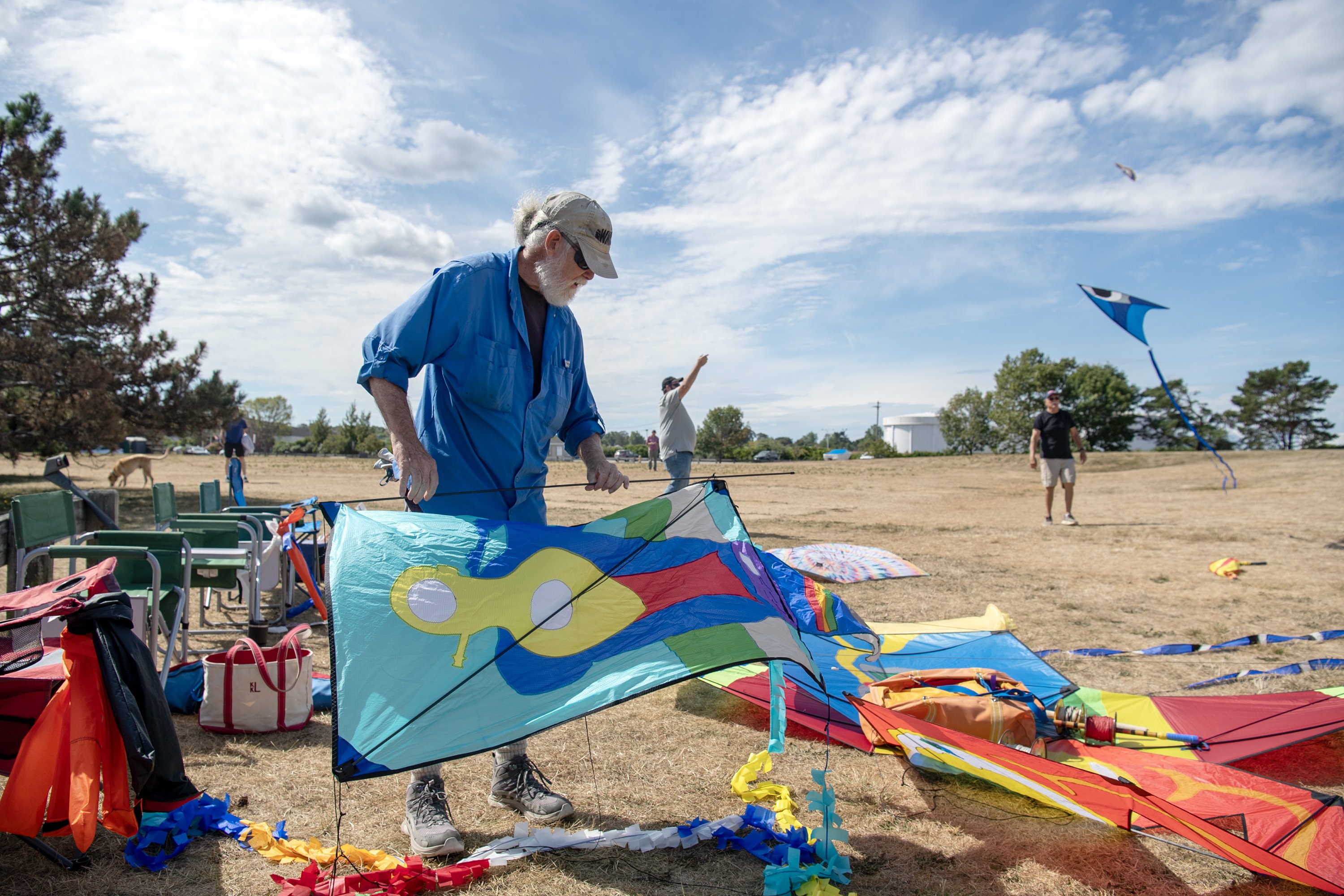
Tony Otis prepares to fly his kite Wednesday at Bug Light Park in South Portland. Otis based the design of his kite off of Apocalypse, the 1974 record album from Mahavishnu Orchestra. “There is no other kite like this in the universe,” Otis said. (Daryn Slover/Staff Photographer)
But he still remembers his first real kite.
In 1976, he biked to a kite store on a fishing pier on Virginia Beach while he was stationed at Portsmouth Naval Medical Center. He was amazed by the colorful inventory.
He bought a kite for $30, which back then was not cheap. “On the salary I was working on, I didn’t eat for a few days,” Otis said.
It was worth it to him, though, to fly. But when that kite got stuck in a tree, he decided he didn’t have enough money to buy a new one. Instead, he decided to start building his own. He gathered books and magazines from the local library and had access to a sewing machine.
But the first kite, “it came out awful,” he said. By 1979, he had access to better materials and a different sewing machine, and he got the hang of it. A plain box kite takes him 13 hours to make. If he starts getting fancy and adding designs, that number jumps to 26 or 27 hours.
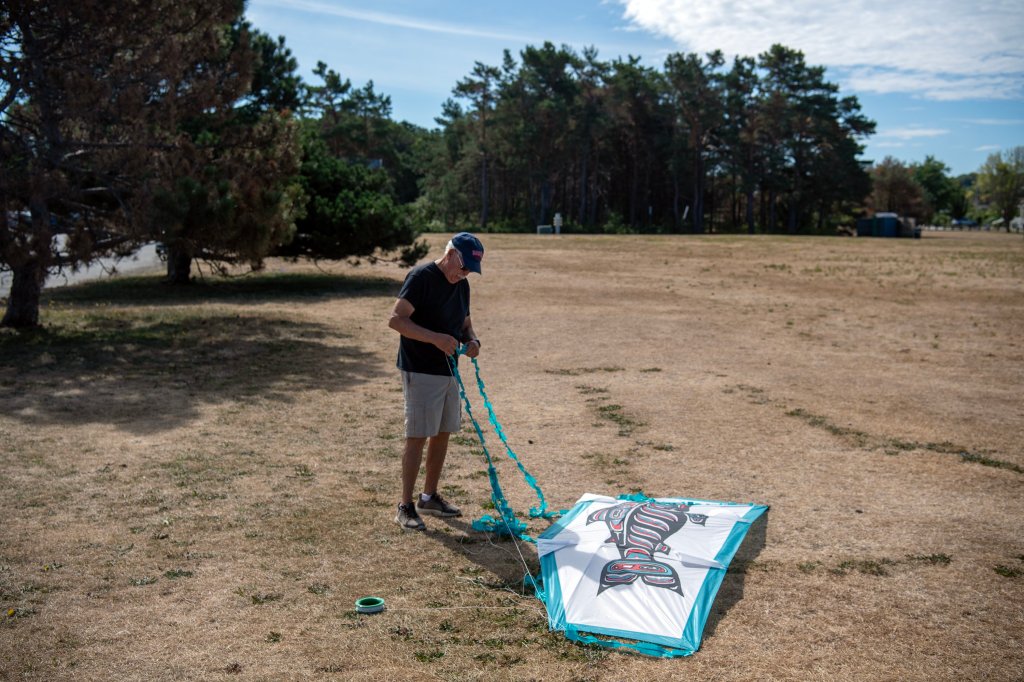
John Martin prepares to fly his kite Wednesday at Bug Light Park in South Portland. Martin made the Genki style of kite himself. He sewed various layers of material together to resemble a salmon. (Daryn Slover/Staff Photographer)
The labor is worth it for him.
“I’m flying a kite,” he said, a grin spreading across his face. His kite danced a hundred feet above him.
“It still feels like when I was 9 years old and I would throw up a cheap kite I bought for 10 cents and then to my surprise it would fly,” he added. “That feeling is joy.”
“I still get that feeling every time I fly,” he said. “It’s fleeting but accumulating. The more times you do it, the easier it is to recall that feeling.”

We invite you to add your comments. We encourage a thoughtful exchange of ideas and information on this website. By joining the conversation, you are agreeing to our commenting policy and terms of use. More information is found on our FAQs. You can update your screen name on the member's center.
Comments are managed by our staff during regular business hours Monday through Friday as well as limited hours on Saturday and Sunday. Comments held for moderation outside of those hours may take longer to approve.
Join the Conversation
Please sign into your Press Herald account to participate in conversations below. If you do not have an account, you can register or subscribe. Questions? Please see our FAQs.