
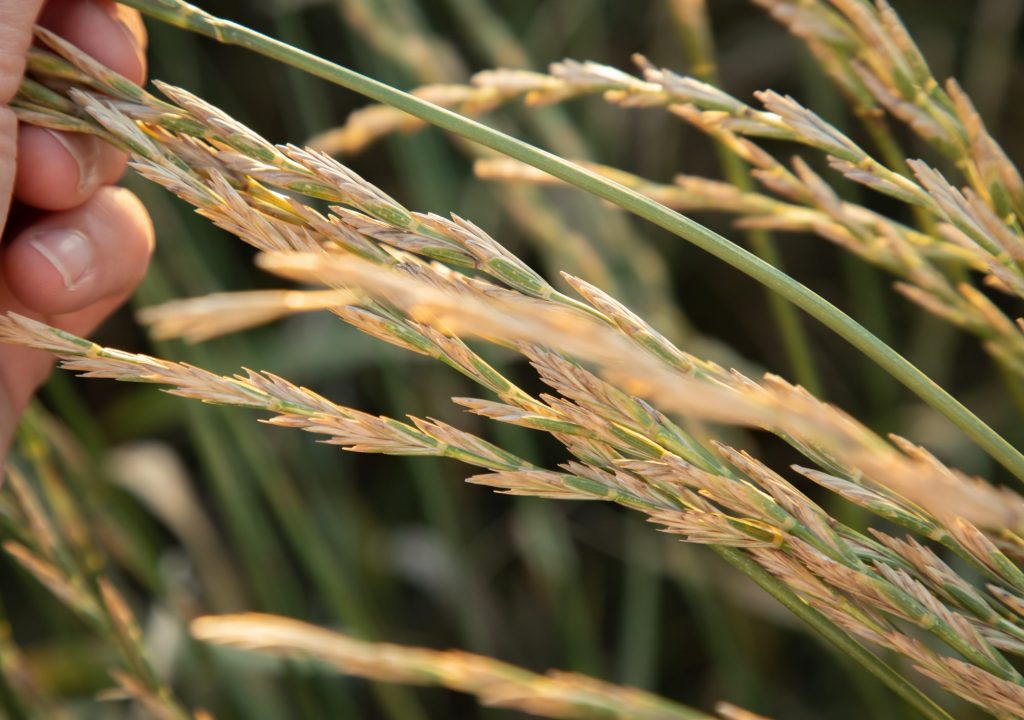
A Kernza grain head. (Courtesy of The Land Institute)
I don’t garden much. And I probably could have paid more attention in my high school biology classes. Considering those two facts, it’s not a surprise that I only recently learned one reason perennial plants are a greener option than annual ones.
The secret lies in their roots.
Because perennials are planted once and can thrive for multiple growing seasons, they have deeper, more complex root systems than rip-and-replace annuals like marigolds and pansies or corn and tomatoes. These perennial plant root systems stabilize soil and prevent erosion. They aerate the soil and enhance its ability to hold water. They also help sink atmospheric carbon multiple feet deep into the soil. And, when perennials are no longer productive in 5, 10 or 15 years, the roots decay and participate in the digestive microbial party alive and well in healthy soil.
The belles of the edible perennial ball in Maine are asparagus, strawberries, blueberries and raspberries, rhubarb, and herbs like chives, parsley and thyme. But not much perennial wheat grows in these parts, not yet anyway.
I am a big fan of Maine-grown grains, the flours milled from them, and the farmers and food producers working to make Maine a regional bread basket. However, almost all grain grown in Maine must be planted annually. I am here to tell you about a perennial one from away. It’s called Kernza.
Kernza is the trademark name for the whole grain of domesticated intermediate wheatgrass being developed at The Land Institute, a research nonprofit based in Salina, Kansas. According to the organization’s website, researchers at the Pennsylvania-based Rodale Institute, circa 1983, selected Eurasian forage grass called Thinopyrum Intermedium as a promising perennial grain candidate. By 1998, Rodale and USDA scientists had completed two breeding selection cycles to improve this plant’s fertility. Since 2003 the Land Institute has conducted many more rounds of selecting and inter-mating plants based on traits geared toward making it a viable commercial crop. Kernza is currently being evaluated and adapted to thrive in over 100 diverse environments around the world. These trials have shown that Kernza plants can produce berries for eight years, live for another eight, and have roots that reach up to 10 feet.
The traits Kernza breeders have focused on include seed size (making them larger), yield (encouraging a higher number of seeds per plant), yield stability (yielding relatively stable) amounts year over year), and disease resistance to things like ergot and rust, explains Eric von Wettberg, a University of Vermont professor in the agriculture, landscape and environment department and director of the Vermont Agricultural Experiment Station, a Land Institute partner site.
They have had less success in selecting for a trait called “shattering” or “indehiscence,” von Wettberg said. Most widely grown cereal crops – like wheat, rice and corn — have seeds that stay on the plant as it matures. “But naturally wild plants have seeds that disperse. This wild trait is hard to breed for in many grasses that could become crops,” he says.
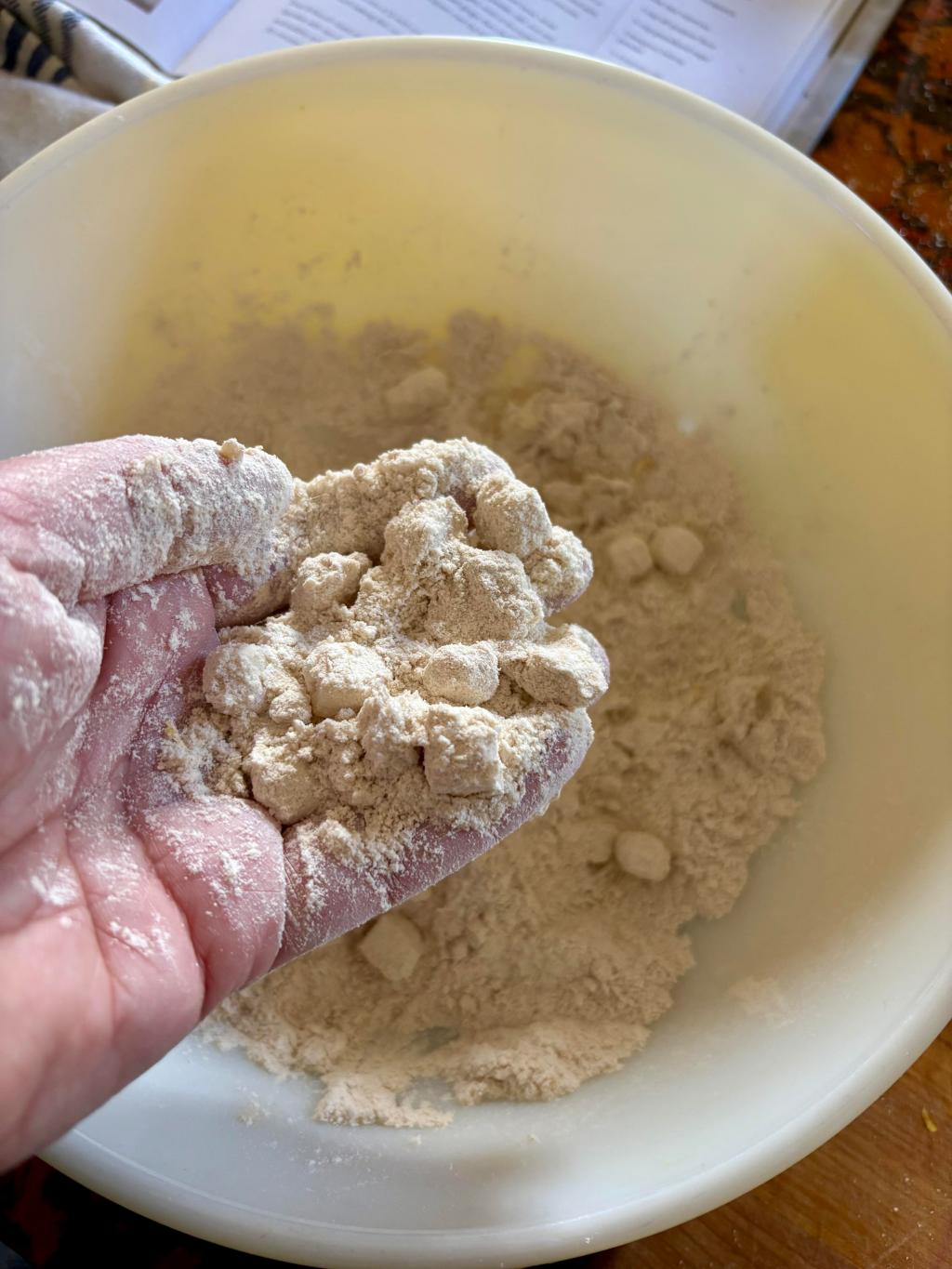
Columnist Christine Burns Rudalevige checks the butter incorporation while making Peach and Raspberry Cobbler with Whole Wheat Drop Biscuits. (Photo by Christine Burns Rudalevige)
At the Vermont Agricultural Experiment Station, scientists have been growing Kernza in several 20-by- 20-foot test plots since 2021. Much of the work has been getting the plants established and preventing them from being overrun with tenacious weeds. The researchers are also interplanting Kernza with alfalfa to test the pairing for hay production, and they hope to study how it can be used in rotational grazing schemes in the future.
“Perennialization certainly holds promise for the environment and food security,” says Amber Lambke, founder of Maine Grains in Skowhegan. Lambke’s company sources grain and legumes from farmers in this region and makes many products for wholesale and retail sale. “We’ve tried a few times to get (Kernza) into our seed restoration project at the Maine Grain Alliance, but (The Land Institute) hasn’t been ready to share it yet. But we will keep trying.”
The Land Institute’s communications officer Tammy Kimbler says its partners in the United States farmed over 3,200 acres to produce 600,000 pounds of de-hulled, clean Kernza grains in the 2024 harvest. As a comparison, USDA accounting says 1.97 billion bushels (118 billion pounds) of winter, spring and Durum wheat were harvested from 38.5 million acres in the same year in the U.S. The Land Institute reports that another 970 acres of Kernza were planted in the fall of 2024 and will add to the 2025 harvest numbers. Kimbler adds that many farmers have sourced Kernza seeds through other channels and are experimenting with them outside of the official trials.
Ben Rooney of Ararat Farms in Lincolnville is among that group. Rooney says he’s planted in several 5-by-15-foot plots intermixed with beds of perennial herbs. “Currently, it is more about keeping the plant alive and with (getting) viable seed for future possibilities. We aren’t doing anything commercial at this time with it, though I would love to at some point,” Rooney said.
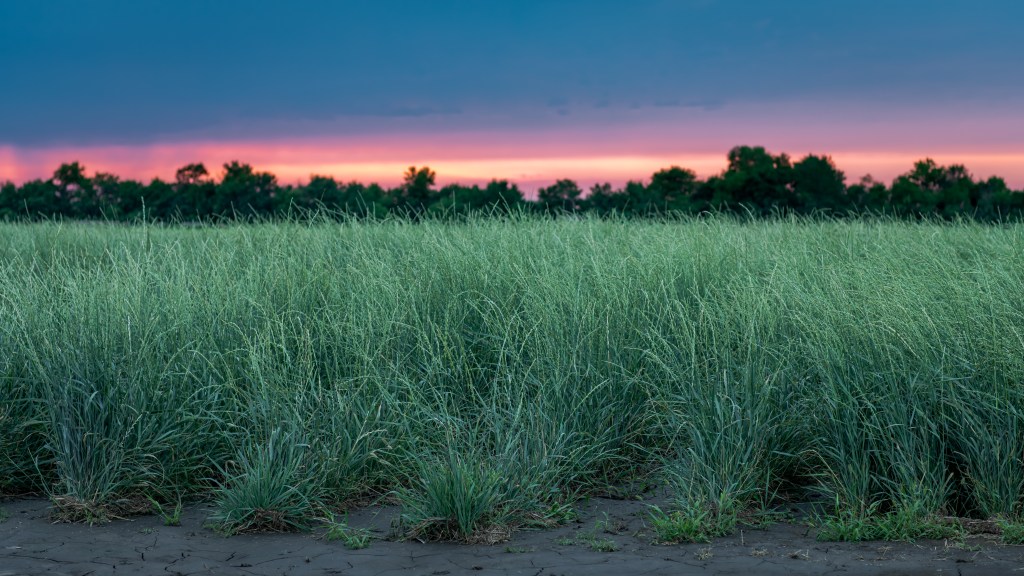
Kernza, which is being developed as a perennial cereal crop by the nonprofit Land Institute in Kansas, ripens in a breeding plot. (Scott Seirer for The Land Institute)
Minnesota seems to be the state with the most commercial activity around Kernza, largely due to the work the University of Minnesota is doing to breed it, support the farmers who are growing it, and build a marketing machine to encourage its use. Minneapolis-based General Mills has also started adding it to some of the cereals is sells under the Cascadian Farms label in retail outlets from Walmart to Whole Foods. I was able to purchase whole berries ($9.25 for 14 ounces), flour ($9.75 for 14 ounces), pancake mix ($6.99 for 14 ounces) and pasta ($7.50 per pound) made with Minnesota Kernza from the online retailer The Perennial Pantry in Burnsville, Minnesota. Nutritionally, Kernza has 18 grams of fiber and 19.2 grams of protein per 100 grams compared to wheat’s 10.8 grams of fiber and 9.2 grams of protein. Kernza is not gluten free, but has less gluten than wheat.
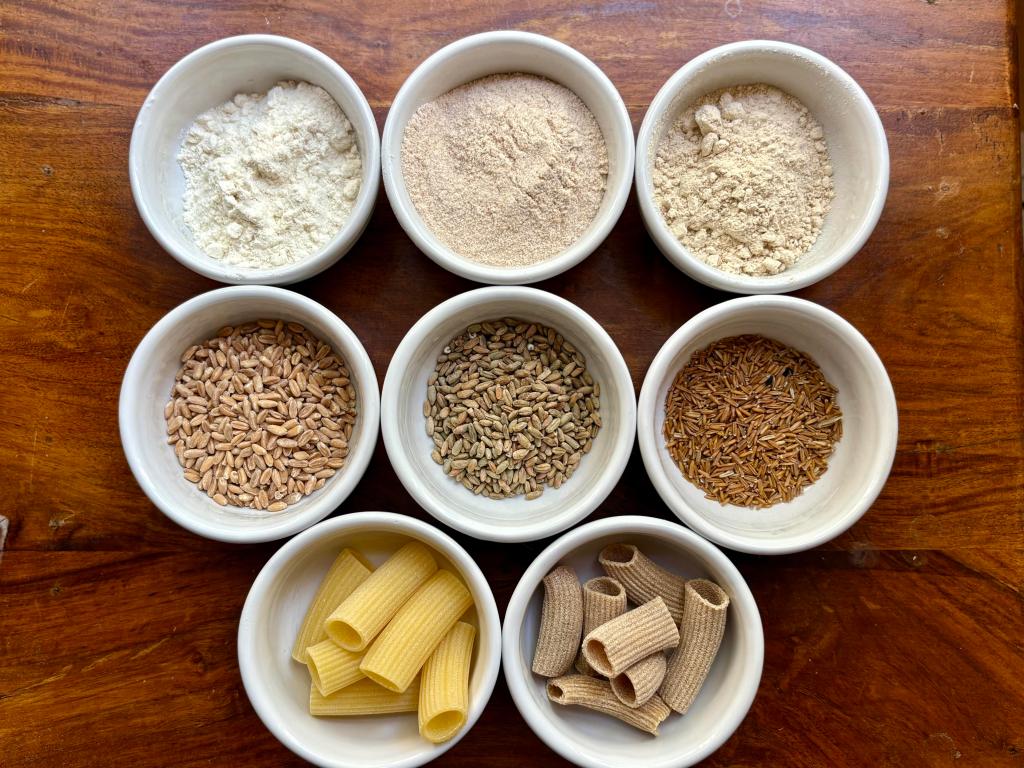
Top row, from left: all-purpose flour, whole wheat flour and Kernza flour. Middle row, from left: Bob’s Red Mill Farro, Maine Grains Rye Berries and Kernza berries. Bottom row, from left: all-semolina rigatoni and rigatoni made with an 85/15 split of semolina and Kernza flour. (Photo by Christine Burns Rudalevige)
Culinary grain expert and Boston-based cookbook author Maria Speck has been working with Kernza for a number of years. For any cook looking to experiment with it, Speck says to cook berries in a 3:1 ratio of water or broth to Kernza for about 25 minutes, and serve it as a simple side dish topped with olive oil or butter so that you can experience is wild rice-like texture and nutty flavor. Once you’ve tasted it, she suggests adding the cooked grains to hearty salads and brothy soups. When baking with Kernza flour, whose texture reminds her of oat flour, Speck advises replacing no more than 1/3 of the all-purpose or whole wheat flour called for in a recipe. In her upcoming “Ancient Grains for Modern Baking” cookbook, to be published by Chelsea Green, Speck has developed a recipe for crunchy, deeply nutty shortbread with Kernza and almonds.
Meanwhile, I have adapted a peach cobbler recipe from chef Erin French’s “Lost Kitchen Cookbook” to use Kernza.
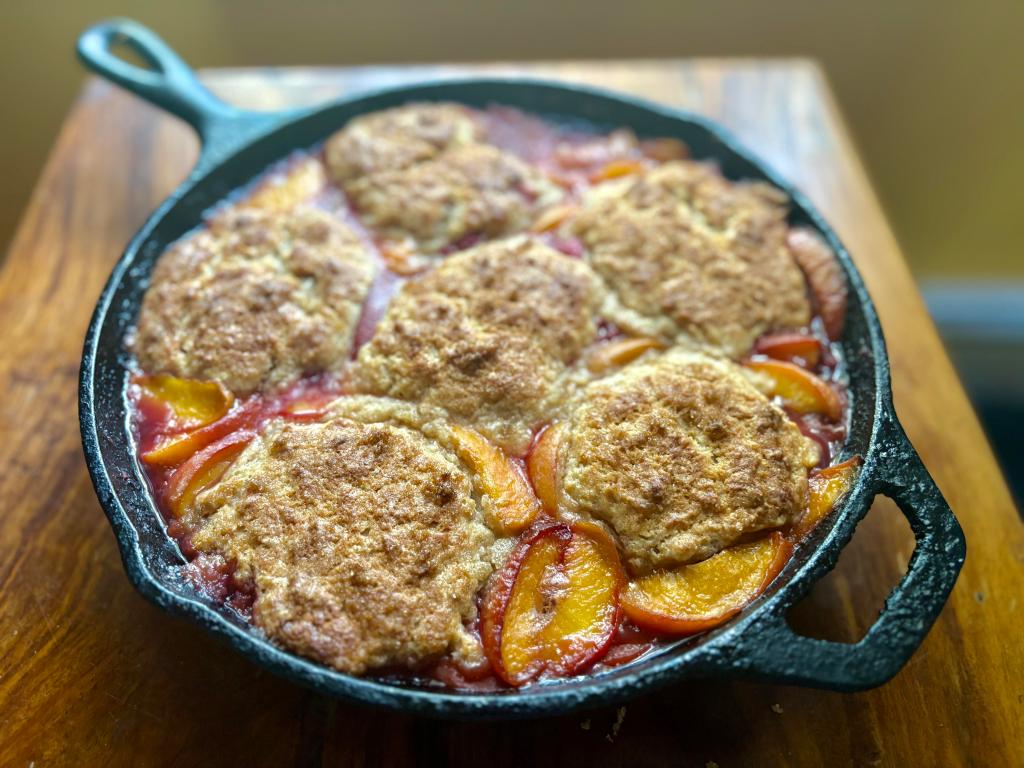
Peach and Raspberry Cobbler with Whole Wheat Drop Biscuits. (Photo by Christine Burns Rudalevige)
Peach and Raspberry Cobbler with Whole Wheat Drop Biscuits
I’ve eliminated the ginger Erin French uses to flavor the filling and the biscuits. Instead, I’ve added local raspberries to the filling and Kernza flour, from perennial wheatgrass grown sustainably in Minnesota, to the biscuits. If you don’t have Kernza, substitute an equal amount of whole wheat, rye, or spelt flour.
Serves 6
FOR THE FILLING:
6 ripe but firm peaches, sliced
1 cup fresh raspberries
1/4 cup granulated sugar
2 teaspoons cornstarch
Zest and juice of 1 lemon
FOR THE BISCUITS:
2/3 cup all-purpose flour
1/3 cup Kernza flour
1/3 cup granulated sugar
1 teaspoon baking powder
½ teaspoon kosher salt
2 teaspoons grated lemon zest
6 tablespoons cold, unsalted butter, cut into ¼-inch cubes
1/3 cup buttermilk
Raw sugar
To make the filling, combine all the ingredients in a 10-inch cast iron pan. Let the mixture sit for 20 minutes at room temperature, stirring twice, so the juices from the peaches and berries mix with the sugar.
Preheat the oven to 425 degrees.
Combine the flours, sugar, baking powder, salt and lemon zest in a bowl. Drop in the butter cubes and toss so they’re all coated with flour. Work the butter into the flour until it’s in uneven, pea-sized pieces. Stir in the buttermilk. Drop 6 equally sized dollops of this shaggy dough atop the pan of filling. Sprinkle raw sugar over each biscuit.
Bake in the hot oven until the peaches are tender, the juice is bubbling, and the biscuits are golden brown and cooked through, 30-35 minutes.
Serve warm with vanilla ice cream.
Local foods advocate Christine Burns Rudalevige is the former editor of Edible Maine magazine and the author of “Green Plate Special,” both a column about eating sustainably in the Portland Press Herald and the name of her 2017 cookbook. She can be contacted at: cburns1227@gmail.com.
We invite you to add your comments. We encourage a thoughtful exchange of ideas and information on this website. By joining the conversation, you are agreeing to our commenting policy and terms of use. More information is found on our FAQs. You can update your screen name on the member's center.
Comments are managed by our staff during regular business hours Monday through Friday as well as limited hours on Saturday and Sunday. Comments held for moderation outside of those hours may take longer to approve.
Join the Conversation
Please sign into your Press Herald account to participate in conversations below. If you do not have an account, you can register or subscribe. Questions? Please see our FAQs.