

Bowdoin College juniors Natalie Emmerson and Larsen Van Horn dispel disillusionment and misunderstandings around Maine state government through their podcast, “Pine State Politics: In Session.” Now, they’re working with the Maine Department of Education to develop classroom conversations about the series.
The “Pine State Politics: In Session” logo. (courtesy of Natalie Emmerson)
In the first eight episodes of “Pine State Politics,” released in May, the hosts ask questions like, “What is ranked choice voting?” and “How do petitions work?” and even “Who in the government can get potholes fixed?” Maine newsmakers — lawmakers, lobbyists, journalists and experts — join Emmerson and Van Horn each episode to share their experience in politics and decode an aspect of Maine government.
“We wanted to embody the philosophy of, ‘There are no dumb questions,’” Emmerson said. “Maybe these are self-explanatory, but we don’t hear anyone asking them, so we’re going to go ask them.”
Emmerson, from Woolwich, and Van Horn, of Oklahoma City, Oklahoma, were inspired to create the podcast after working as interns for Sen. Angus King, where they observed the gaps in the general publics’ knowledge of the election process.
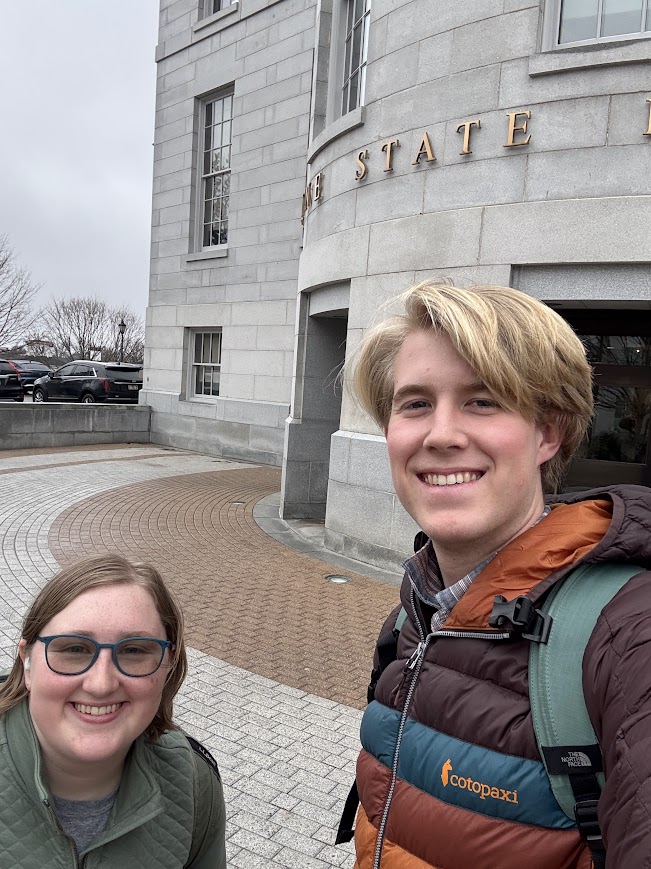
Natalie Emmerson and Larsen Van Horn, Bowdoin students and the hosts of “Pine State Politics,” at the State House. (Courtesy of Natalie Emmerson)
King and his Chief of Staff Kay Rand join them in the second episode to talk about the process of campaigning as an independent in Maine. Other notable guests include Maine Secretary of State Shenna Bellows and former U.S. Secretary of Defense Bill Cohen.
“I think [the guests] really loved the idea, because we were talking about diving into the mechanics, not the partisanship, not the policy,” Emmerson said.
The hosts secured funding for the production through the college’s McKeen Center for the Common Good, and took the podcast project on as an independent study class last school year.
Emmerson and Van Horn said they were thrilled when the Department of Education expressed interest in a partnership, since the podcast is based in learning.
“I think the fact that Natalie and I are students, and we approach this project as students, makes this podcast unique and hopefully interesting and hopefully approachable,” Van Horn said. “We’re learning it, too, for the first time — we’re not the expert.”
This summer, they’re working with the DOE to build high school–level classroom materials based on the eight episodes by identifying key points and drafting questions that spark conversations around the podcast. They hope those conversations can help make politics a little less overwhelming for young people.
“[We wanted] to create a tool, especially for people our age, who are like, ‘Oh my god, this process is so unbelievably complicated,’” Emmerson said.
Emmerson and Van Horn said they expect the lesson plans to start going out to classrooms in the spring. “Pine State Politics” is available on Spotify, Apple Podcasts and on the McKeen Center website.

We invite you to add your comments. We encourage a thoughtful exchange of ideas and information on this website. By joining the conversation, you are agreeing to our commenting policy and terms of use. More information is found on our FAQs. You can update your screen name on the member's center.
Comments are managed by our staff during regular business hours Monday through Friday as well as limited hours on Saturday and Sunday. Comments held for moderation outside of those hours may take longer to approve.
Join the Conversation
Please sign into your Press Herald account to participate in conversations below. If you do not have an account, you can subscribe here. Questions? Please see our FAQs.