

Maine’s small population and unique geography make it a wonderful place to put down roots, pursue a career, and raise a family. This human scale and the personal relationships that it fosters make it unlike any other state in the union.
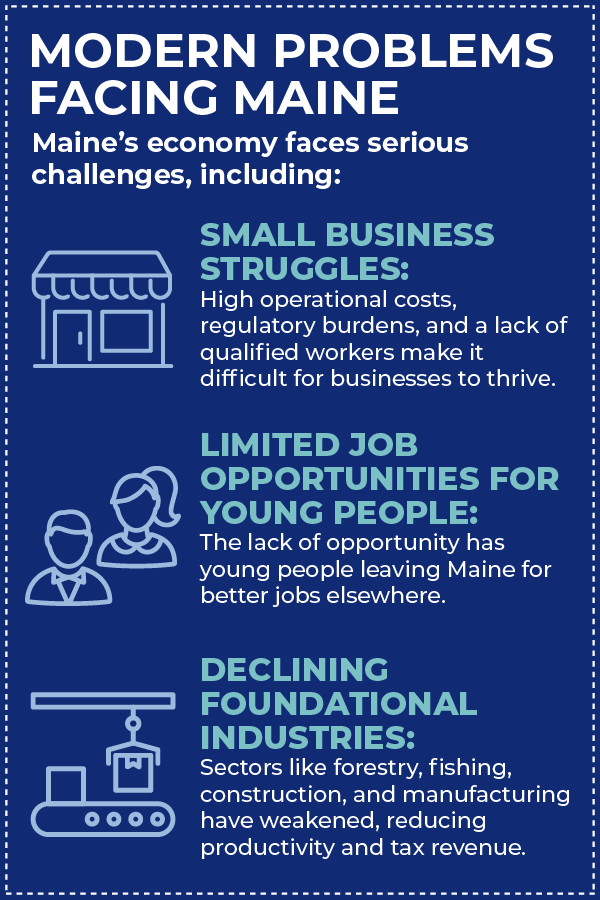
Maine is also unlike any other state in the union for not-quite-so-desirable reasons: the economy is one of the least competitive out of all 50 states. A recent study found that Maine has the 9th lowest rate of personal income, yet the 12th highest cost of living. It has the third worst regulatory environment and the worst of all job growth projection: so bad, that it’s the only state projected to have little, if any, job growth in the next three years.
How did this happen? Amongst many factors, Maine’s state government and legislature have often enacted policies in isolation without considering how they interact with other laws or policies, affect the overall economy, influence investors, and impact many other strategic, long term factors.
But a prosperous future for Maine people can be secured. Focusing on assets and strengths to find nonpartisan compromises that strengthen Maine’s economy will help legislators, voters, and business leaders create a distinctive economy that can put Maine in healthy competition with other states and global partners.
Why partisan politics hurts Maine’s economy
Too often politics focuses on short-term issues, party politics, satisfying “us” and defeating “them” rather than enabling Maine to compete for jobs, talent, and investment. Too many politicians are more focused on defeating their opponents than ensuring Maine is in serious competition for jobs, talent, and investment. Too many voters believe their political side or ideology is entirely right, while the opposition is entirely wrong.
These mindsets and practices go far beyond a lack of civil discourse. They damage Maine’s economy in two major ways. First, legislative gridlock prevents the passage of beneficial policies and the repeal of harmful ones. Second, division among citizens fosters distrust, making it harder to work toward common goals.
Depoliticizing economic policy would allow the development of a long term plan for sustainable growth. Bipartisan solutions can address key issues such as high business costs, workforce shortages, and economic stagnation.
Cohesive policy can help solve Maine’s problems
Maine can require that every new proposed law is reviewed for its impact on the state’s economic development goals. However, enacting legislative reform will be one of the hardest steps of a multi-pronged strategic plan.
Maine’s state government and legislature have long enacted policies in isolation without considering how they impact other laws, interact with other policies, affect the overall economy, influence investors, and impact many other strategic, long term factors. This style of policy making has occurred in numerous areas, such as Medicaid expansion, the substance abuse crisis, regulated marijuana sales, renewable energy policy, forestry and fishing regulation, workers’ compensation, state pensions, infrastructure funding, education initiatives, and more.
Rather than look at each issue in isolation, Maine’s voters and state government officials should consider how individual policies affect the broader strategy for the state. For example, if a new program needs expenditures approved, the impact of those higher costs on Maine’s ability to attract investment and create and retain jobs needs to be considered. Questions like, “what will this law do to grow the tax base? Will this policy retain residents, particularly those raising families? Will it reduce or increase housing and energy costs? Will it impact the delivery of health care services?” must be considered through a methodical process.
A brighter future for Maine
Addressing these issues starts with citizens. Listening to “the other side”, finding common ground, and supporting a long term vision for the majority takes self reflection. To launch effective political policies and incentives to stimulate job growth, can return foundational jobs to Maine, and make the state an ideal place for young professionals and families.
Focusing on shared principles, committing to the common good, and evaluating the long-term economic impact of new laws are key to fostering a thriving economy and a united community, along with:
• Reducing costs for local businesses, especially small and medium sized foundational enterprises, so they can compete, grow, improve wages, and keep up with today’s dynamic changes
• Reducing costs for resident families and businesses
• Training and educating the workforce for skilled trades and foundational job sectors
• Identifying and attracting emerging foundational industries and associated jobs to Maine
• Organically increasing state revenue to support public services and infrastructure
The Alliance for Maine is a non-partisan, community-based effort to educate Mainers about the state’s economic challenges and the need for a plan to repair and grow the economy.
Comments are not available on this story. Read more about why we allow commenting on some stories and not on others.
We believe it's important to offer commenting on certain stories as a benefit to our readers. At its best, our comments sections can be a productive platform for readers to engage with our journalism, offer thoughts on coverage and issues, and drive conversation in a respectful, solutions-based way. It's a form of open discourse that can be useful to our community, public officials, journalists and others.
We do not enable comments on everything — exceptions include most crime stories, and coverage involving personal tragedy or sensitive issues that invite personal attacks instead of thoughtful discussion.
You can read more here about our commenting policy and terms of use. More information is also found on our FAQs.
Show less