
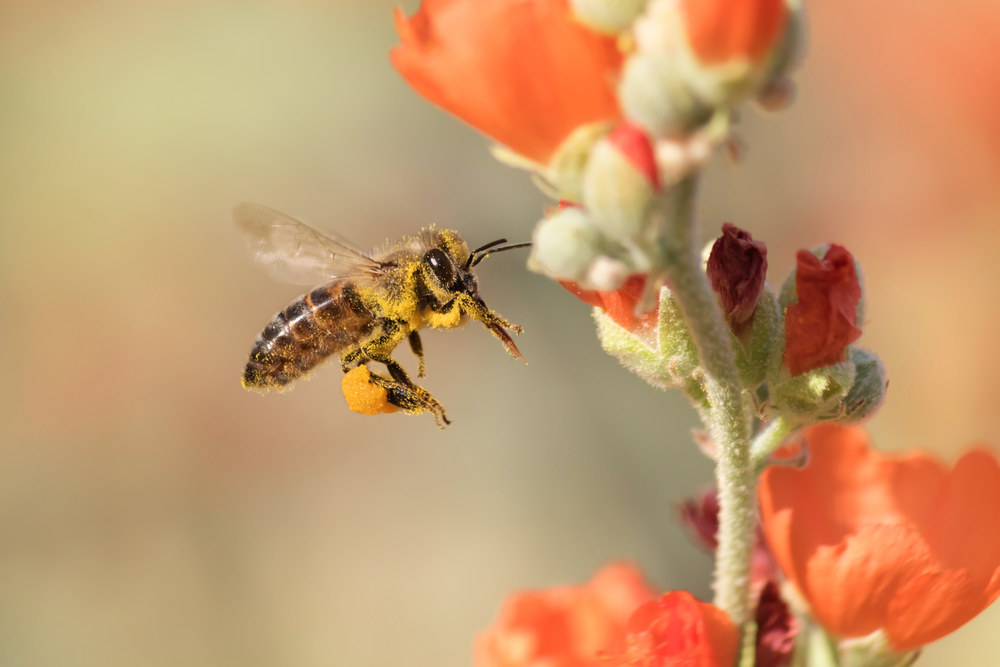
Even while most of us know that honeybees are an integral part of our ecosystem, when a buzzy, fuzzy, yellowish insect zips by, our instincts can command us to swerve, dip, or even run to avoid them. Who has the time to look at those little features when they might belong to a wicked wasp?
“Honeybees are passive, like big flying pandas,” said Joe Hyland, with a little affection in his voice. Hyland is an Associate Certified Entomologist at Modern Pest. He uses his knowledge of native Maine insects and human nature to best do his job, recognizing that people care deeply about pollinators and are aware that climate change is directly impacting their behaviors and patterns, while not always being able to see the difference between types of bees and wasps.
“Honeybees are the major pollinators we prize so much. They’re loud, large, fuzzy and just want to be left alone,” said Hyland. Originally from Europe, honeybees were brought to North America around 1770, by colonists who knew their superpower. However, protecting them, other animals, and the environment has not always been a priority for humans.
“We often need to remove nests because all bees will sting when threatened and many people have allergies that can be lethal,” Hyland shared. “The process we use at the moment is based upon the urgency level of the human or animal being stung. If it is a high-urgency situation, we’ll use more traditional materials. This is the less preferred, but situationally necessary choice.”
By that, Hyland means in an urgent situation, it’s sometimes necessary to blast a nest with toxic chemicals, but that’s no longer the go-to solution. Instead, gentle impact products and organically certified pesticides can be implemented (and they’ve been approved by the Board of Pesticides Control, which falls under the umbrella of the Maine Department of Agriculture, Conservation and Forestry.) Modern Pest service technicians are trained and certified to minimize harmful effects.
Additionally, when called to remove a honeybee nest, Modern Pest will first refer the homeowner to local beekeepers who will come to get them. Hyland said it isn’t illegal to remove and destroy the nest, but “based upon the situation, it could be seen as unethical.”
Hyland holds wasps in lower esteem. “Wasps are aggressive. They have smooth, shiny, bald faces,” he said. “They don’t have much pollinating impact, so it’s an accepted industry practice to exterminate them.”

Hyland said that calls to remove a hymenoptera nest (that’s the order of insects that includes bees and wasps) used to start toward the end of July. This year it started in June, and like many professionals in his field, he predicts that date could shift even earlier due to the warmer, wetter seasons that are trending.
Protecting your home and the honeybees’ home is a delicate balance to maintain, but Modern Pest believes protecting clients from pests while being stewards of the environment is a sweet philosophy to live by.

Comments are not available on this story. Read more about why we allow commenting on some stories and not on others.
We believe it's important to offer commenting on certain stories as a benefit to our readers. At its best, our comments sections can be a productive platform for readers to engage with our journalism, offer thoughts on coverage and issues, and drive conversation in a respectful, solutions-based way. It's a form of open discourse that can be useful to our community, public officials, journalists and others.
We do not enable comments on everything — exceptions include most crime stories, and coverage involving personal tragedy or sensitive issues that invite personal attacks instead of thoughtful discussion.
You can read more here about our commenting policy and terms of use. More information is also found on our FAQs.
Show less