
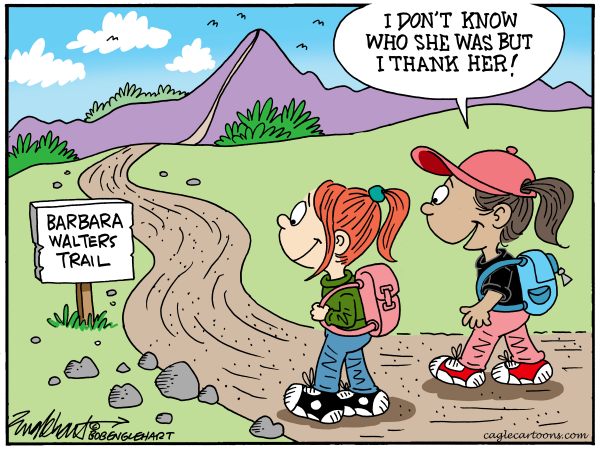
Barbara Walters might never have become a powerful force in broadcast journalism had she lacked the chutzpah to extract a promise from her bosses at NBC News in 1973.
As she explained it to me, she had already worked at the “Today” show for a dozen years, serving first as a writer and then as the “Today girl” on set — a bubbly balance to the program’s male host, the journalist Frank McGee. If McGee were ever to leave, NBC pledged, she would be named co-host, an unprecedented role for a woman.
Eight months later, McGee died of cancer. Five days after that, Walters was named co-host and given a voice in selecting her new on-air partner, the unassuming newsman from local TV, Jim Hartz.
Almost every obit about Barbara Walters, who died Dec. 30 at 93, mentions that she “broke the glass ceiling” in TV news. A measure of the enormity of that challenge was contained in Frank McGee’s own arrangement with NBC, stipulating that during in-studio interviews he would always ask the first three questions, lest viewers conclude that the woman at his side was of equal status.
I suppose it would be considered a compliment to say that McGee was a shrewd negotiator. But to use the same term about Walters would be perceived quite negatively, especially a half-century ago. She was, indeed, shrewd. And demanding. And often manipulative in dealing with superiors, writers like me who covered her and, most of all, the wide range of politicians and showbiz celebrities whom she persuaded to open up — even shed tears — on camera.
She left NBC in 1976 to become TV’s highest-paid news anchor at the time, seated alongside Harry Reasoner on the “ABC Evening News.” Her $1 million annual salary was roughly double what CBS icon Walter Cronkite was earning.
Privately, Reasoner dismissed the new pairing as so much network gimmickry. For her part, Walters acknowledged on her first broadcast that some viewers might have tuned in, “out of curiosity, drawn by the rather too much attention and overblown publicity given to my new duties and my hourly wage.”
She survived the flop that the ABC newscast turned out to be and managed to parlay it into a robust career focused primarily on interviewing, for which she was best known. Even that included careful calculation. Though she did interviews both live and recorded, she preferred the latter format. “Whoever holds the scissors controls the entire interview,” she told me.
Whenever I wrote about her, even a brief mention, I received a hand-written thank you note in the mail. I wasn’t flattered so much as I was impressed by a woman who knew she had to work harder to compete in a male-dominated field.
There are a lot of women in broadcasting today who would like to send Barbara Walters a note of thanks.
Peter Funt’s new memoir, “Self-Amused,” is now available at CandidCamera.com.
Comments are not available on this story. Read more about why we allow commenting on some stories and not on others.
We believe it's important to offer commenting on certain stories as a benefit to our readers. At its best, our comments sections can be a productive platform for readers to engage with our journalism, offer thoughts on coverage and issues, and drive conversation in a respectful, solutions-based way. It's a form of open discourse that can be useful to our community, public officials, journalists and others.
We do not enable comments on everything — exceptions include most crime stories, and coverage involving personal tragedy or sensitive issues that invite personal attacks instead of thoughtful discussion.
You can read more here about our commenting policy and terms of use. More information is also found on our FAQs.
Show less