
After three years of negotations, a settlement agreement has been reached that will lead to the removal of both dams and create fish passage at Saccarappa Falls in Westbrook.
The Saccarappa project, like the Cumberland Mills fish ladder project before it, has been touted by city officials and environmental groups as beneficial to Westbrook – creating a potential tourist attraction for both wildlife enthusiasts and kayakers, as well as other recreational opportunites.
A lengthy back-and-forth between dam owner Sappi North America and multiple environmental organizations on the design and scope of the project had resulted in recent deadline extensions and other setbacks. But, according to a press release Wednesday from the Friends of the Presumpscot River, the agreement filed Tuesday will guarantee the removal of both dams, which is seen as vital to restoring the river.
“Removal of the two dams will eliminate a significant barrier to migratory fish, once counted in the millions on the Presumpscot River, and will open a large segment of prime spawning habitat to several species of sea-run fish,” the press release states.
Sappi is surrendering its license to operate the hydroelectric dams at the site, after previously agreeing to work with environmental organizations and other governmental agencies to remove the dams and create “nature-like” fish passage at the falls.
The agreement was entered into by the Friends of the Presumpscot River, the Conservation Law Foundation, Sappi, the city of Westbrook, the U.S. Fish and Wildlife Service and the Maine Department of Marine Resources. It was filed with the Federal Energy Regulatory Commission and the Maine Department of Environmental Protection, which must approve the agreement.
Sappi’s deadline for establishing fish passage at the site had been extended during negotiations. In 2014, it was first extended by two years, to 2017, and then extended this year to 2018.
Michael Shaughnessy, the president of the Friends of the Presumpscot River, said the settlement will result in “vast improvements for our river.”
“It is an agreement we can all be very proud of,” he said. “When the dams are removed and fish passage finally constructed, we will have a wonderful result for the river and for the people who live in the Presumpscot’s watershed. It will open up the longest and cleanest stretch of riverway in the most densely populated area of the state, and it will greatly enhance the economic and recreational value of the river.”
A final design has not been completed, but its components are part of the agreement. According to Shaughnessy, there will be a double denil fish ladder on the lower falls, with both dams removed on the upper falls closer to the Dana Warp Mill.
Shaughnessy said depending on the timeline for approval, design and bidding, the deadline may have to be extended again.
“We want the best job done possible,” he said.
At the upper falls, there is an island with a powerhouse, with “headwalls” on either side of island. On the lower falls, Shaughnessy said, blasting and other changes that have occurred over the last 250 years have made them impassable to fish.
Negotiations over the design have caused the long timeline toward an agreement. Ron Kreisman, an attorney working on behalf of the Friends of the Presumpscot and the Conservation Law Foundation, said that the negotiations came down to Sappi’s so-called “western channel” design option, as opposed to the two-channel option that was supported by the Friends of the Presumpscot River and the Conservation Law Foundation. The two-channel design, they argued, would make the river passable to fish in both directions.
Kreisman said Sappi proposed its single-channel design last December, but that it was opposed by the environmental groups.
“Opposition (to the design) brought the parties together,” he said about the negotiations. “That compromised solution is what is before you today.”
Sappi agreed to build and operate the denil fishway, and to also design and build a two-channel fishway, reopening fish passage on the river. Previous studies have said the water level could drop as much as four feet once the dams are removed, which could reduce flooding.
Sappi North America, which issued it’s own press release Wednesday, called the agreement a “milestone.”
“Sappi has agreed to remove the dam, including two spillways, as well as fund fish passage facilities for river herring, American shad and Atlantic salmon at Saccarappa Falls,” the release states.
According to Sappi’s statement, the dams will be removed “as early as 2020.”
Kreisman said Sappi is proposing to commit roughly $5.6 million toward the project. He said given the contentious past, it’s “noteworthy that we were able to come together.”
“Looking at where this began, we’ve come a long, long way,” he said.
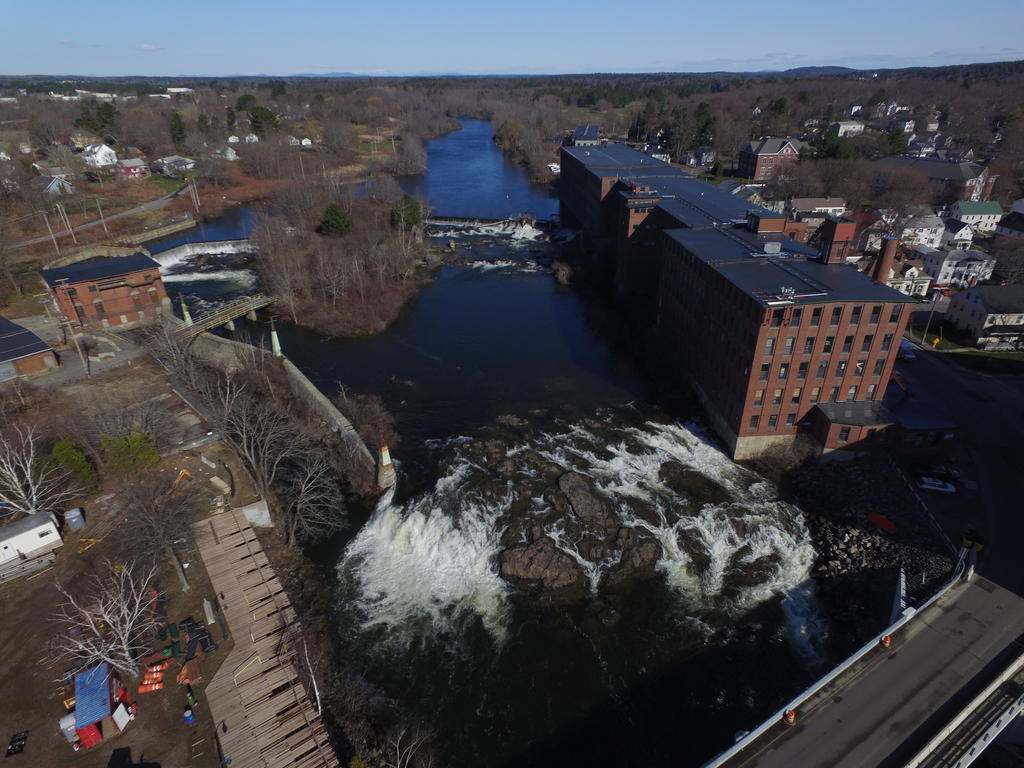
An aerial photo taken in the spring of this year shows Saccarappa Falls in Westbrook. The lower falls near the new Bridge Street bridge will receive a denil fish ladder, while both dams at the upper falls will be removed, and both channels opened to fish.
Comments are no longer available on this story