
Late morning on Thursday, Sept. 29, a dozen students from Windham Christian Academy piled into a dark-green van for a trip into North Windham. These seventh- and eighth-grade students weren’t headed in town to do their shopping, or even for a field-trip activity.
They’re on a mission to rid the town of unsightly cigarette butts.
They set out for North Windham businesses to hang posters showing piles of cigarette butts and asking the public not to throw their cigarettes on the ground.
The effort is one piece of their civic project aimed at improving their school and community.
According to student Elizabeth Wales, they undertook the project at the start of the school year, when they “noticed a problem outside the school,” she said. “There were cigarette butts littered all over the ground. It’s not a good appearance for our school when people drive by, so we wanted to get involved and make a difference.”
Rick Hagerstrom, middle-school teacher, said the goal of the project is “for the students to see they do have a voice.”
He said he all of the ideas for outreach and solutions to the problem have originated with the students. No portion of the assignment is graded, he said.
“It’s something they took and ran with, because it’s important to them,” Hagerstrom said.
To better understand the scope of the problem on their own turf and around the world, the students started to research the issue and undertook several experiments. They ventured onto the shoulders of Route 302 in North Windham, on the outskirts of the school grounds, and calculated the number of cigarette butts in a square foot – 3.6. They used these calculations and data available through other resources to generate figures showing the extent of the problem.
The students estimate that the number of cigarette butts discarded each year could wrap around the Equator 34,000 times. According to nosmoke.org, there are 4.5 trillion cigarette butts disposed per year. To get this figure, the students estimated a cigarette butt to be about three-quarters of an inch, converted the circumference of the earth into inches and divided.
They also learned about the health and safety concerns around the litter. For example, they said the kindergarten and pre-K children at their school, whose playground abuts the road, could pick up the cigarette butts and put them in their mouths, potentially exposing them to germs, dirt and disease.
Cigarette butts are also dangerous to animals.
Kasy Turcois said in her research she saw photos of the insides of animals “filled with cigarette butts.” To see the harmful effects on animals, “is really depressing,” she said.
They also noted the fire-safety concerns of an improperly discarded cigarette.
“On really hot and dry days, those cigarettes could start a fire. We have trees right by the side of the road. We have a school and kids we want to be safe,” said Cailyn Wheeler.
Armed with their facts and figures about cigarette litter, the students started to figure out how to get their information to the public. They each took on projects according to their strengths, said Wales.
Some wrote letters to newspapers, others wrote letters to politicians and the chief of police, while still other students made posters.
Leah Lawler said students “also want to raise awareness for our school. We don’t want our school to look bad and have the disrespect of cigarette butts thrown on the ground.”
Josiah Irish said the students want to make sure the school looks good, “so people will say, ‘Wow, that school looks nice, maybe we should send our kids there.’”
The students have some ideas for how to help people stop littering their cigarettes. They’ve asked law enforcement officials to more strictly oversee litter violations in town, particularly when it comes to cigarette butts.
They’re encouraging people to use the ashtrays in their cars instead of throwing their cigarette butts out of the car window.
They’ve also developed an idea for a cigarette-butt redemption center, similar to one used for bottles and cans. The redemption center would give people back a deposit on their cigarettes once they returned their cigarette butts to the center. This would encourage people to properly dispose of their cigarettes, they said.
They have reached out to state politicians to propose the cigarette redemption center.
The students said since starting this project, they’ve become more attuned to the number of cigarette butts on the road. They notice it “everywhere,” many of them said, sometimes just a few steps away from a public ashtray.
Wheeler said that most people understand that cigarette-butt littering is bad, but because it’s a habit, they do not give it a lot of thought.
Their aim, the students said, is to give people the same sense of awareness they’ve cultivated about the issue.
Cigarette butts account for roughly 40 percent of debris thrown on the road.
Windham Christian Academy students estimate that the number of cigarette butts discarded each year could wrap around the Equator of the Earth 34,000 times. According to no smoke.org there are 4.5 trillion cigarette butts disposed per year. To get this figure, they estimated a cigarette butt to be about three-quarters of an inch, converted the circumference of the earth into inches and divided.
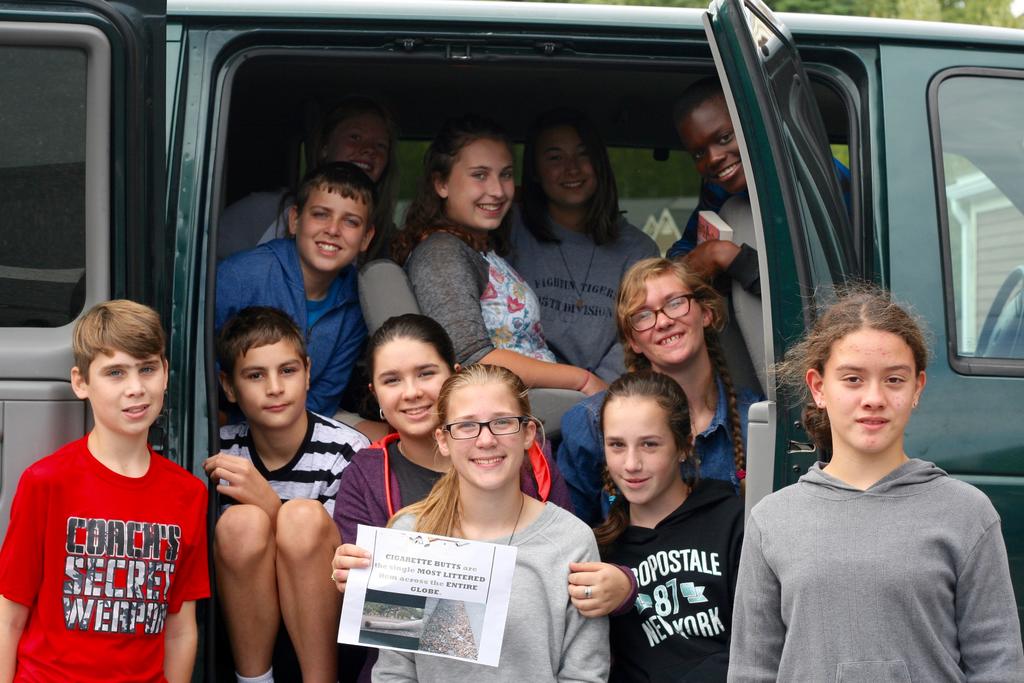
Students from Windham Christian Academy are about to pile into their van to distribute posters asking residents to stop their cigarette-butt litter.
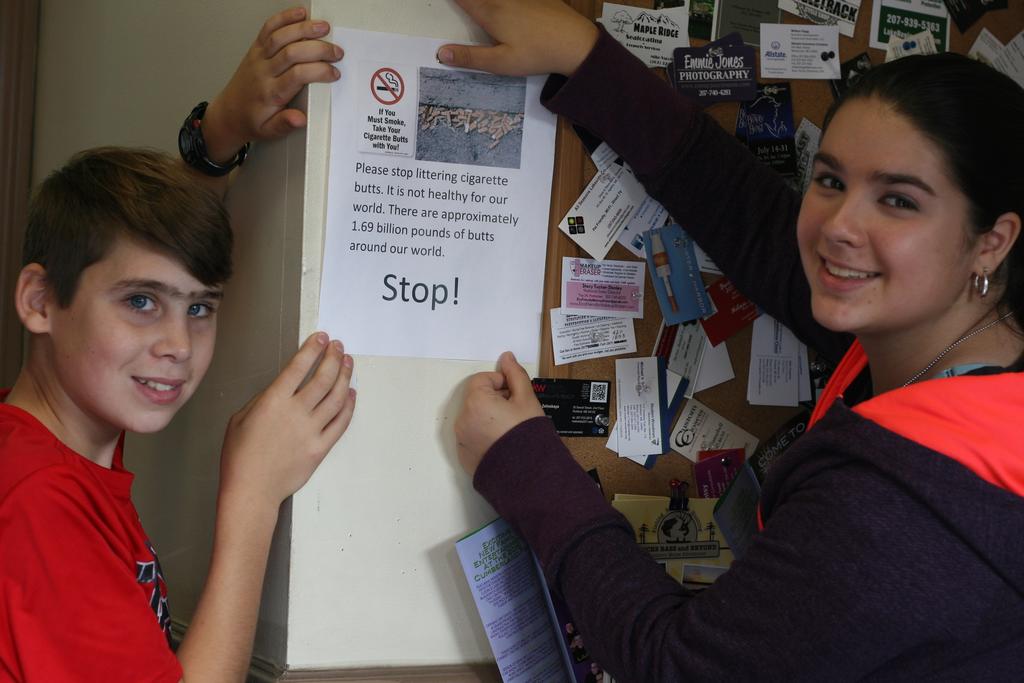
Caleb Hawley, left, and Leah Lawler pin a poster on the community bulletin board at Pat’s Pizza in Windham. Lawler said the students want to raise awareness about the number of cigarette butts littered on their school property, which abuts Route 302, because “we don’t want our school to look bad and have the disrespect of cigarette butts thrown on the ground.”
Comments are no longer available on this story