
The town of Freeport won’t get official results from a recent Department of Environmental Protection audit of its stormwater control system for a couple of months, but Adam Bliss, the new town engineer, feels confident the results will be good.
Should that prove to be the case, Bliss gives his predecessor, Albert Presgraves, the lion’s share of the credit.
“We did excellent,” Bliss said last week, as he and Town Manager Peter Joseph looked over a map of the Concord Gully Brook watershed, one of two urban-impaired streams in town. “Fortunately, we have a water-management plan in place. Al Presgaves was very organized, and managed permit requirements well.”
Freeport is at the southern tip of what is referred to as the MS4s stormwater-management standards set by the Envrionmental Protection Agency for Portland-area communities.
Bliss said that Freeport’s plan implements practices to control stormwater runoff important to all watersheds, but of particular importance to Concord Gully and Frost Gully brooks.
“You don’t just fix it by snapping your fingers,” he said. “Again, Freeport has a plan. The goal is to improve them so they’re not impaired streams. It’s very practical, but it takes a long time. It’s not a quick fix.”
So what’s the plan?
To start, Bliss said, educate the public on the use of pesticides, herbicides and fertilizers. Sound practices on such non-point source pollutants are both the responsibility of the town and the public, he said.
“There are natural alternatives to having a green, healthy lawn other than fertilizers,” he said.
Bliss held up a pamphlet available at the Town Hall, with a drawing of a duck on the cover, on “yard scraping,” a statewide initiative. The pamphlet urges residents to mow their lawns high, which strengthens the roots of the grass, retaining moisture and making it difficult for weeds to germinate.
“Use an aerator to loosen up the soil, which allows water and nutrients to get to the roots. Throw down more grass seed to give the lawn a natural boost. Do soil tests to analyze soil fertility and pH levels, to determine just what the soil needs,” the pamphlet advises.
Concord Gully Brook runs from an area around the Town Hall along U.S. Route 1 South, and to South Freeport, then meets the tidewater of the Harraseeket River at Porters Landing. Much stormwater flows into the brook, Joseph said.
Concord Gully Brook is defined as an urban-impaired stream because it doesn’t have sufficient water quality to support fish and insects, largely due to high concentrations of sodium chloride. Old salt piles near the old Department of Transportation garage near Exit 20 of Interstate 295 and the old public works garage near the Town Hall leached salt into the brook, Joseph said. Today, the state requires salt piles to be kept in salt sheds.
Joseph said that the brook does not appear to have any oil-based or fertilizer issues.
“The quality of the watershed is still compromised,” he said, “and that’s why they call it an urban-impaired stream. “That’s our focus – improvement of Concord Gully Brook. Our No. 1 problem, like with other towns, is that we have impervious surfaces that run off into waterways.”
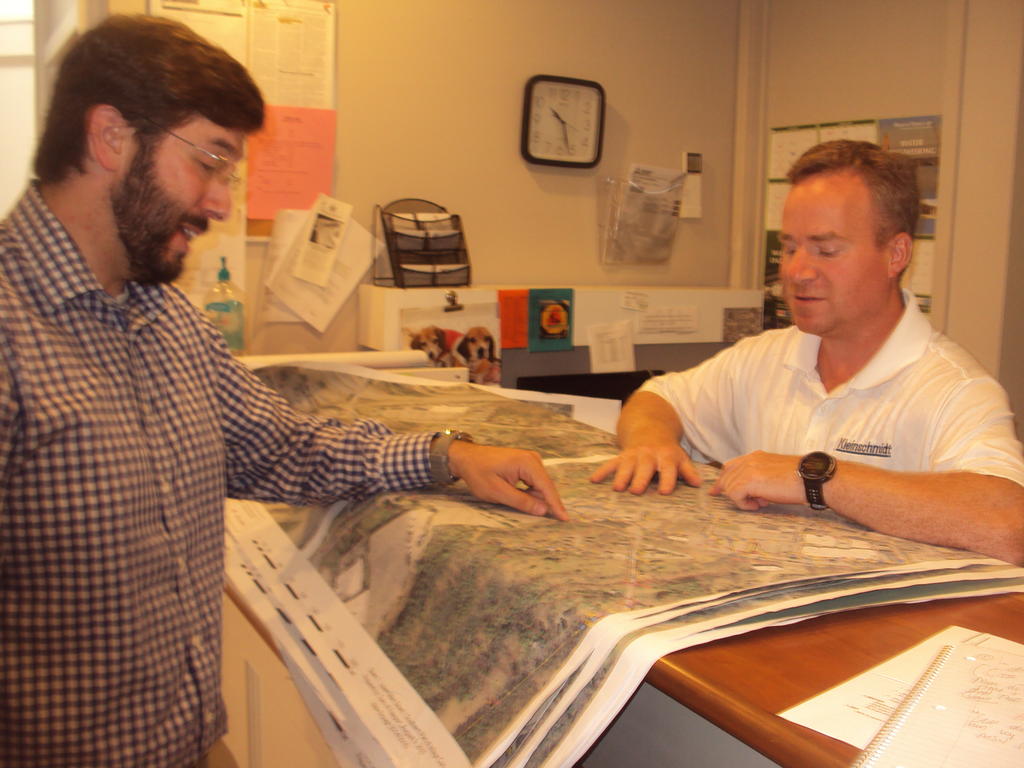
Freeport Town Manager Peter Joseph, left, and Adam Bliss, the town engineer, look over a map of the Concord Gully Brook watershed.
Comments are no longer available on this story