
Liam Wade, Nick Nelsonwood, Travis Libsack and Josef Biberstein don’t fritter away their summer on too many leisurely pursuits. Now college students, the four engineering whizzes who became buddies at Freeport High School are working on yet another project that they hope to market – a binary clock that they call “Clam Clock.”
Wade, Nelsonwood, Libsack and Biberstein, who established Limbeck Engineering, LLC, in high school, made an initial splash in 2014 with the invention of a remotely operated submersible robot they called Project Robo Goby. Limbeck Engineering has secured funding to make Project Robo Goby market-ready, and they have commissioned a partnership with the University of Maine. They hope to have the submersible robot ready by the end of the summer to sell at about $5,000.
But for now, the Clam Clock is occupying most of their time, in Libsack’s basement. They have started a Kickstarter funding campaign, and plan to run a one-day camp for local middle-school students to put together one of the clocks. Wade, Nelsonwood, Libsack and Biberstein want to share their knowledge and love of technology.
“A great deal about this is about sharing our passion for engineering,” Libsack said. “That’s a large part of our motivation.”
The Clam Clock, Libsack said, is a “make-it-yourself” clock. Limbeck Engineering will market it in a kit for around $40, or sell the finished product for $60.
Libsack said that the four of them had been “kicking around” the idea of making a binary clock for some time.
“We wanted a project that was a cool project for people who like to be makers,” Biberstein said. “It incorporates soldering and programming skills. The Clam Clock is a stylish, cool thing to keep on your mantle, your shop or your bedside. It also tells time. We have built one, and it works.”
Biberstein said that when someone goes into production of the clock, it can be done quickly.
“We hope with the Kickstarter project will provide us with 100-plus boards to sell by December,” he said. “It’s made of composite board – that’s the base. There are LED lighting and animated circuit boards on top. It runs through electricity.”
A binary clock uses only two digits to display the time, and lights are used in place of the digits. Reading the clock means converting the binary value to decimal.
Libsack said he hopes people will look at the Kickstarter site, clamclock.com, and take a liking to the clock. The landing page has preliminary images and information.
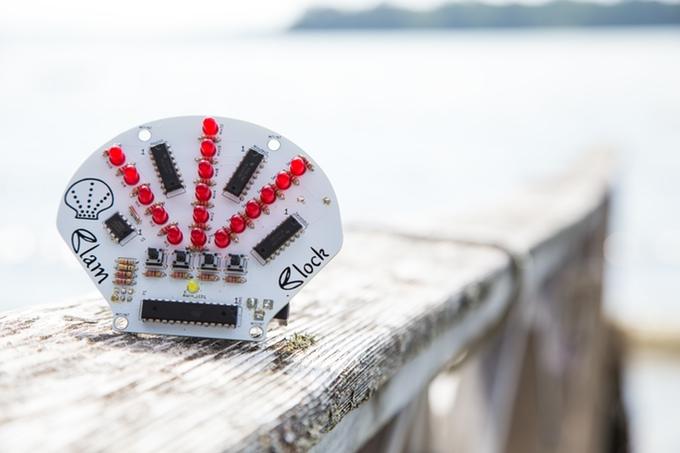
The Clam Clock will be marketed in kits or as a finished product, by Limbeck Engineering of Freeport.

Nick Nelsonwood, center, holds the “ClamClock” that Limbeck Engineering of Freeport is building, and will market to the public. From left are Travis Libsack, Nelsonwood and Josef Biberstein.

Limbeck Engineering’s founders are, from left, Liam Wade, Nick Nelsonwood, Josef Biberstein and Travis Libsack.
Comments are no longer available on this story