
Much has been said about the politics and the economics of the Tri-Town Track & Field Project’s aim to install a new multimillion-dollar track and turf field behind Freeport High School. Less, however, has been said about the impact it would have on sports programs.
Maddy Vertenten, chair of the project’s public relation and communications committee, became involved in the effort to build the track and turf field through the Running Boosters, which she previously presided over for two years.
“We wanted a track, we wanted a field; it’s something that, as a parent and a fan, I could see we really needed,” said Vertenten, whose son, Max Greenwood, graduated from Freeport in June. Greenwood ran cross-country, indoor track and outdoor track for all four of his Falcon years.
Some athletics facilities are rare at schools: swimming pools, for instance. It’s unusual, however, for a school not to have a track. “I’m pretty sure we’re the only Class B school that doesn’t have one,” Vertenten says.
The Tritown Track & Field Project, in addition to its own fundraising, is working with the Regional School Unit 5 board, hoping that the panel will agree to put the project before voters in Durham, Freeport and Pownal in a November referendum. Originally, RSU 5 had planned to renvovate the grass field at a cost of $600,000. The Tritown Track & Field Project wants that money put toward its larger plan. The public must approve the track effort because it is part of a $14.6 million renovation of Freeport High, previously approved by voters.
Efforts to fund the facility – which would be named for Maine native and Freeport resident Joan Benoit Samuelson, who won gold in the first Women’s Olympic Marathon in 1984 – are underway. Nike has pledged $1 million to the project, for instance.
According to Vertenten, the overall cost for the facility could hit $3.2 million on the high end.
Many sports would benefit from the installation of the new facility, those involved in the effort say. Freeport has excelled for some time in distance and middle-distance running, but untapped potential remains, according to Brian Berkemeyer, cross country and indoor track head coach. .
Berkemeyer details the track teams’ present situation, and how their prospects would improve:
“Well, we wouldn’t have to go anywhere for speed workouts,” he says. “We’d run on the track, rather than painting in the road, which I do right now. I have a one-mile loop, but I marked off every 200. So that’s my track.”
Some might think running is running, and wonder how running 200 meters on a track could specifically be different than running 200 meters in the road. But as experienced athletes and coaches know, running, like any sport, has its subtleties, all of which are important to master for competition success.
“Consistency. When you’re trying to develop a kid, a track tells a kid exactly where they’re at,” Berkemeyer says. “No other place does that. Even if I can make up something on the road; it’s not as relevant.
“Like the turns,” Berkemeyer says. “Turns make a huge difference. At what point are you going to make your move? If you’re running a 200, that’s one turn and one straight. You’ve got to be able to handle that turn, and handle it well.”
Not only would a track allow the indoor and outdoor teams to work on the critical nuances of their races, it would boost numbers. “I would have twice as many kids in outdoor track,” says Berkemeyer. “We wouldn’t have to travel half-an-hour each way (to Bowdoin). A lot of kids just don’t want to do that.”
Building numbers is important if the teams hope to break into events they have traditionally been shut out of. As it is, the Falcons can’t look to their field events – their throws, for instance – to tally points for them.
“A lot of the throwers don’t want to spend that time on the bus,” says Berkemeyer. “You’re talking a lot of football players, a lot of strength people. They need to work out in the weight room, but they also need the track right there … Every meet, we give up discus, shot put and javelin – and pole vault. We give those points away.”
The hour spent traveling is essentially wasted: Teams spend that time sedentary, rather than practicing or lifting weights. “If they do weightlifting, they have to stay (at the school),” says Berkemeyer. “That means they’re not running or doing anything else for the team.”
Dispatching athletes to far-flung locales to work on different facets of their training also means divvying up squads that benefit from spending time together developing friendships and chemistry. “When you have a track team, you need everybody to score. You need to develop that camaraderie,” Berkemeyer says.
“It’s going to give the kids a total better experience,” says Berkemeyer. “They’re going to actually feel like they belong to something, they can contribute to something. Right now, it’s a lot of individuals performing.”
A number of the school’s other teams stand to equally benefit. Football, field hockey, boys and girls soccer, and boys and girls lacrosse have all shown promise in recent years – promise that begs to be capitalized upon.
“A turf field in Maine is just a necessity,” says field hockey and girls lacrosse head coach Marcia Wood. “Field hockey is an entirely different sport on turf. Playing on grass with bumps and divots, sometimes you just hope for the best with the field conditions and get the ball down the field any way you can. With a turf field, we can focus more on passing accuracy and ball control. It’s (even) a better game to watch.
“We are sometimes at such a huge disadvantage in the spring, waiting for fields to clear up,” Wood says. Freeport’s grass fields drain notoriously poorly. “By the time we can get outside, we are so far behind in gameplay because we we haven’t been practicing on a field with lines. It’s challenging, coming up with ideas for gym practices – and dangerous.”
Jenna McCurdy, the school’s athletic trainer, highlights the opportunity to reduce injuries. “Having turf would be great,” McCurdy says, “because our field has a tendency to get pretty squishy when it rains, which can increase the risk of injury. Athletes plant and pivot to change direction in the soft grass – think ACL injuries and ankle sprains, to name just a couple. The turf would decrease this risk, because it drains better.”
McCurdy adds that turf fields further decrease the risk of injury by virtue of being flat: Grass fields, pockmarked with divots, lumps and holes, leave athletes running and cutting across uneven ground.
RSU 5 Board Chairwoman Michelle Ritcheson of Durham and board member Valy Steverlynck of Freeport both said in January they have heard from residents who are concerned the turf infill, if made from ground tires, could be a health hazard.
“There is some concern about the safety of a turf field,” Ritcheson said.
The RSU 5 field and the track would have an infill of Nike Crumb, made of ground-up athletic shoes.

Because Freeport doesn’t have its own track and field complex, these area athletes have to compete for Falmouth in the summer. From left: Dietrich Schulz, Henry Horn, Payton Schulz, Logan Schulz, Jordan Knighton, Frank Morang. The Schulzes are from Pownal, Horn is from Durham and Knighton and Morang are from Freeport. Not pictured: Macy Johnson.
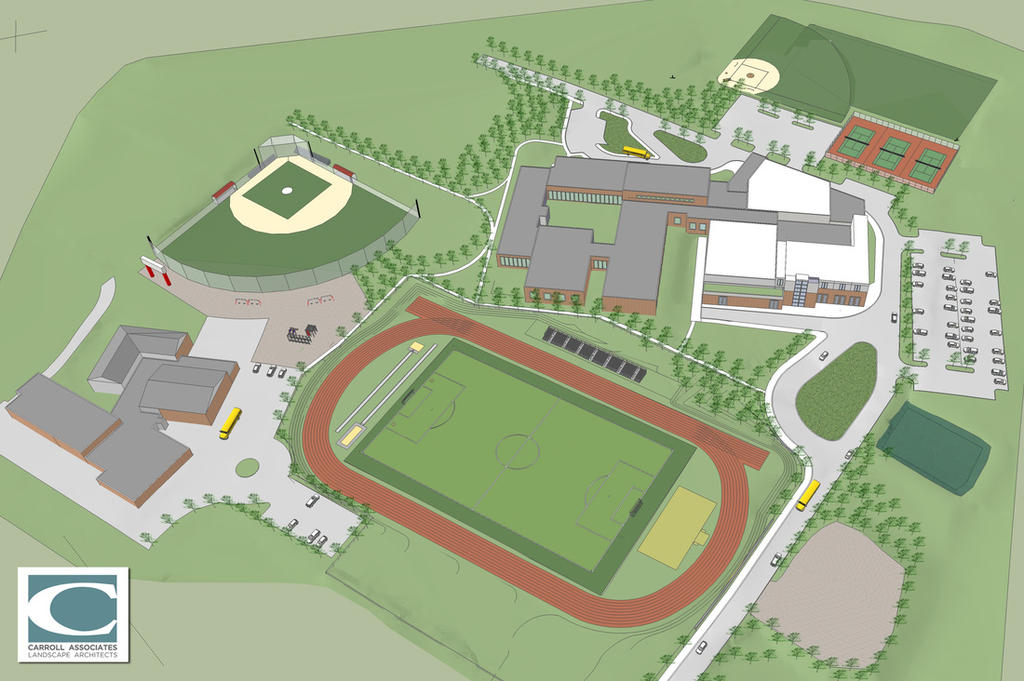
Here is a site plan for the Tritown Track & Field Project at Freeport High School.
Comments are no longer available on this story