
James Brown of Scarborough was one of more than 1,700 students to receive a diploma from the University of Southern Maine when the school celebrated its 136th commencement on May 14 at the Cross Insurance Arena in Portland.
Brown, who graduated from Scarborough High School in 2012, is the son of Kristine and Mitchell Brown and the oldest of three siblings. His sister, Kayla, is 19 and his brother, Austin, is 15.
At the University of Southern Maine James Brown was a voice major in the School of Music, which required that he study foreign languages, take four semesters of piano and four semesters of music theory, along with voice classes.
Brown is a unique vocal talent, singing in the countertenor range, which is defined as a type of classical male singing with a vocal range equivalent to that of a female alto or mezzo-soprano.
It wasn’t until he was a sophomore in high school that Brown fully discovered his love of singing, which led him to join the chorus and to perform in the annual school musical.
In addition, while still in high school, Brown began taking voice lessons with University of Southern Maine School of Music alumna Sara Sturdivant, who was the first to discover his special vocal talent.
Brown chose USM primarily because of Ellen Chickering, his current voice teacher, who not only runs the Opera Workshop Program at the college, but also runs Maine’s Emerging Artists program at PORTopera, as well.
Brown sang several opera roles at USM. He has also sung Bach’s “Erbarme dich, mein Gottat” at the White Mountain Arts Festival and Britten’s “Canticle IV: Journey of the Magi” with the Portland Rossini club. He was a recent prize winner at the annual Young Stars of Maine Bay Chamber Concerts competition.
This week Brown spoke with the Current about his singing and his plans for the future.
Q: When did you start singing and performing?
A: I sang in my church choir when I was a child and took a break from it when I entered middle school. I started doing the musicals in high school as a way to hang out with friends but fell back in love with being in front of an audience and performing, so I joined our school’s choir as soon as possible.
Q: When did you discover opera and what do you most enjoy about it?
A: I discovered classical singing in my voice lessons while I was in high school, but it wasn’t until I got to college that I was introduced to the mechanics of a production and the effect the human voice can have have on people.
What I have come to love about opera is that it is a truly human art form that requires you to be completely raw and vulnerable on stage. With no amplification system or ways to hide mistakes, the audience is reacting to moments that will never happen again and you helped create those moments.
Q: When did you discover you could hit impossibly high notes, and what do you have to do to keep your voice in shape?
A: What I do is not impossible, just a little unique. My voice type, as a countertenor, is a revival of a form of singing that occurred in the 17th century, which went out of fashion around the beginning of Mozart’s career.
It is important that I strengthen the falsetto and work to enhance the chest voice so I can sing the roles that were originally written for the castrati – boys castrated for the sake of preserving their voices – or for women playing boys.
Q: What are some of the roles you have played and what are some of your dream roles?
A: Ellen Chickering has created such a great learning environment that so many of us have been able to sing some fun roles in her opera workshop at USM. I’ve been able to sing Lichas, the forsaken servant, in Handel’s “Hercules” and a gender-bent Queen of the Fairies in a really fun production of Gilbert and Sullivan’s “Iolanthe.” In terms of the future I have a real desire to sing Oberon in Britten’s “A Midsummer Night’s Dream” and am working on that music to have it ready to go.
Q: What are your plans for the future and how difficult will it be?
A: My immediate future plans are to head up to McGill University in Montreal at the end of the summer to participate in the master program for opera and performance. While I’m up there I plan to audition for programs that are designed to build an arsenal of tools for young artists, such as language skills and master classes for musical interpretation.
Just like any program abroad you have little road bumps like paperwork and financing, but I have always been interested in the French language and don’t mind diving into some new cultural situations, as well.
Q: Is there any particular teacher, mentor or role model who has impacted you during your time at USM?
A: Like I said, Ellen has created a learning environment for students that are serious about pursuing this career. She has championed us and given us insight into the opera world so that we are completely prepared for heading into a professional environment. She instills a passion in her students that make the development of an internal instrument, our voices, completely worth the time and emotional struggle.
Q: What would you tell your peers or others who might not think opera is for them?
A: To those that don’t think opera is their thing, I say go and see an opera and prove it. Opera is an exciting form of entertainment that utilizes visual art, music and theater and that has the ability to satisfy many facets of interest. When done properly, it can express emotions that we can’t put into everyday language and elevate our understanding of each other as humans
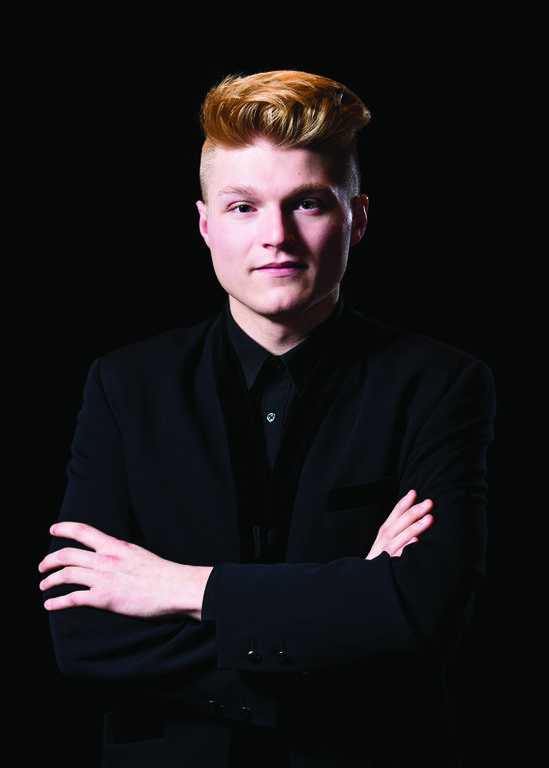
James Brown, of Scarborough, is pursuing graduate studies in opera and performance at McGill University in Montreal. He was one of more than 1,700 students to graduate from the University of Southern Maine on Saturday.
Comments are no longer available on this story