
Brian Beal, the University of Maine marine ecology professor, has learned a lot in the three years he has studied ways to preserve Freeport’s wild clam populations.
He will present some of his findings at a meeting of the Freeport Shellfish Conservation Commission, Thursday, March 10. The public is invited to hear one of the state’s foremost experts on wild clams speak at the Freeport Community Center, at 6:30 p.m.
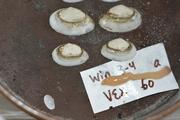
Beal, who will start his fourth year in Freeport in April, will delve into growth and survival results from netting studies he and his team have conducted along both sides of the Harraseeket River. He also will address the results of ocean acifidication studies at Little River and Winslow Park, and reveal the results of wild clam recruitment efforts.
Beal, along with students and members of the Freeport clamming community, began working together three years ago, when Freeport provided $100,000 to conduct studies along the flats of the Harraseeket. Beal and his crew were back in Freeport in 2014 and 2015, through a $200,000 University of Maine System grant, and they will return this April, not leaving until November.
“We want to learn more about wild clam recruitment,” Beal said. “We want to see about generating ways on small scales to combat predators, and to use the information to help groups like the Freeport Shellfish Conservation Commission help to enhance clam stocks.”
Doug Leland, commission chairman, said that the panel wants to hear Beal’s thoughts on conservation activities, and then pull together a comprehensive conservation plan.
“Brian Beal has a unique perspective,” Leland said. “He’s been on all parts of the mud flats and all sorts of experiments.”
Beal is the latest industry expert the Shellfish Conservation Commission has brought to its meetings, to gain insight into conservation techniques. Chris Warner, who is operating the state’s first privately owned clam operation, a 2-acre mud flat in Georgetown, spoke two months ago. Last month, it was Dan Devereaux, marine resource officer in Brunswick.
“We’re trying to get a variety of perspectives,” Leland said, “and Brian’s is one of them. All of this comes back to our primary responsibility: How do we sustain and enhance the shellfish resource in Freeport?”
By addressing the green crab menace, for one thing, according to Beal. He said there is no truth to the notion that the green crab’s impact on soft-shell clams has subsided. When he spent his second year in Freeport, Beal took notice that another predator – the milky ribbon worm – was causing more devastation than he might have thought.
“Predation is critically important in the soft-shell clam population and it’s mostly responsible for the decline of clams we’ve seen since 2012,” Beal said. “It’s not just green crabs, although green crabs are important, and they have not gone away. Between the milky worm and the green crab, you have a real menace.”
Despite that, wild clam recruitment – the survival of microscopic clams settling from the water table into the mud – has been “regular and abudant” in several areas along the Harraseeket, Beal said. In 2014, on the east (Wolfe’s Neck) side of the river, Beal and his crew discovered an area with an astounding 1,400 clams per square foot underneath nets they had placed there. Outside of the nets, there were 0.4 clams per square foot.
“So it’s pretty phenomenal that you can see this sort of wild clam recruitment in areas that are protected,” Beal said. “The reason that there are not many clams (elsewhere) is that predation has affected the survival of clams settling from the water column.”
Beal explained that female clams release eggs into the water by the millions. Males shoot their sperm into the water column under the same conditions, and fertilization takes place. Baby clams that settle into the mud can be one-fifth of 1 milimeter. Going from the water column into the mud is recruitment.
Last year, Beal built wooden boxes 2 feet by 1 feet, and 3 inches deep. Workers covered the tops and bottoms of the boxes with different-sized meshes of netting, then placed 60 on each side of the Harraseeket.
“We figured some small clams would go through the mesh into the boxes,” he said. “There was plenty of aperture. We put those boxes out and they filled with mud. One of them had 6,000 wild clams in it from April 11-Nov. 3. Some had none. The most clams were where we found the most the year before, underneath the netting. Some boxes had green crabs that had grown to nearly 2 inches and were feeding on the clams. They crawled in through the larger quarter-inch mesh.”
The largest clams in the boxes were 1¼ inches.
“That is unbelievable growth, before the clam even went into its first winter,” Beal said. “We found clams that were half an inch in some boxes. So they’re not settling in the same day, week or even month. Spawning is more protracted that even I’d imagined.”
Beal said his goals this year are to learn more about wild clam recruitment. He also wants to find ways to combat predators.
Beal said he would show the results on the screen at his March 10 talk.
“I want to put my talk in terms that help people trying to manage clam flats,” he said. “That’s been my goal for 30 years.”
Comments are no longer available on this story