
Walter Skold, Freeport resident, founder of the Dead Poets Society of America and a poet himself, will talk about his quest to visit the graves of American poets, at a program Friday, Feb. 26, at the Freeport Community Library. The event is entitled “Stories and Readings from the Poemobile.” It begins at 6:30 p.m.
The program is part of Freeport FebFest, which is winding up with nearly a dozen events scheduled through the end of the month.
Criss-crossing the country in his so-called “Poemobile,” a white van with those words printed on its side, Skold visited his 500th poet’s grave last summer. He founded the Dead Poets Society of America in 2009.
Skold, 55, grew up in York, Pa., and has lived in Maine since 2001. He has a master’s in library science, and has been working on filmmaking for five years. He is single, and the father of five children. In 2012, Skold produced a documentary on the Freeport Flag Ladies, entitled “One Tuesday Morning.” The Freeport Flag Ladies have waved the American flags in support of America’s soldiers every Tuesday morning on Main Street since the Sept. 11 terrorist attacks.
Skold answered questions regarding his career and the Dead Poets Society of America for the Tri-Town Weekly.
Q: You founded the Dead Poets Society of America in 2009. How much, or how little, were you influenced by the movie, “Dead Poets Society?”
A: While I greatly enjoyed the movie, I don’t think it had a big influence on the name I chose. By putting “of America” behind Dead Poets Society, it was intentional. Only dead poets can join the Dead Poets Society so I wanted to make clear that we were living fans of dead poets.
Q: How many poets’ graves have you visited? Do any stand out from the rest?
A: The first grave I visited was Robert Frost’s, way back in 2005. After my father died in 2007, my pilgrimage began in earnest, and now I’ve documented 570 graves. I have a list of my 15 favorite ones, but many of them are so fascinating that I think I need to upgrade that list to at least 30.
Q: Do you have specific goals, or is it all in the experience?
A: I am working on a documentary film called “Finding Frost,” and I’d like to write a book about my travels, but both are daunting tasks. The experiences I’ve had and will hopefully continue to have are the core pleasure of this project, however.
Q: Describe the feeling you get when you visit a poet’s grave. Do you do anything ceremonial?
A: It is a rather spontaneous process, actually. One thing I always try to do is have a poem or book of poems from the poet whose grave I’m visiting. I usually find great joy and surprise in reading poems from poets I’ve never heard of before. Other than that, on my trip to poets’ graves down South last summer, I brought a bottle of cognac along and tried to remember to pour libations at the graves. When I learned that pouring libations at graves was an African tradition, I liked that idea as a way to honor their memory.
Q: Are there any Maine cemeteries in particular that you like to visit?
A: I always enjoy visiting the little Cranberryhorn Cemetery, in Cundy’s Harbor. It is where the poet and Bowdoin professor, Robert Tristram Coffin, is buried, and his grave is one of the loveliest I have come across. While not in Maine, I also really enjoy visiting the grave of Edna St. Vincent Millay, at her old “Steepletop” home in Austerlitz, N.Y. Of course, her career was launched from Camden, so she certainly counts as a Maine poet.
Q: Your Poe Mobile is named after one of America’s great poets, Edgar Allan Poe. What did you love about Poe’s works?
A: It was a former poet laureate of the U.S., and Poe scholar, Daniel Hoffman, who urged me to use Poe as a way of marketing my project. His grave is perhaps the most-visited poet’s grave in the country, and I had the privilege of volunteering at the Poe House in Baltimore last fall. While meeting people from all over the world who came to make pilgrimages to Poe’s old house, I began to understand just how profoundly groundbreaking and influential his career was. Many people love his stories the most, but being a poet, I am moved by what I consider his best poems.
Q: Your son Simon is a well-known drama instructor at Freeport High School and member of theater group Freeport Players, and accompanies you on some of your trips. How much influence did you have on his career choice?
A: Our family is full of drama! Sadly, I’m the only member of the family that has not appeared in a Freeport production, so maybe Simon can help rectify that. But I think he came to that choice all on his own as he realized how talented he was in theater, and how much he liked plays and literature.
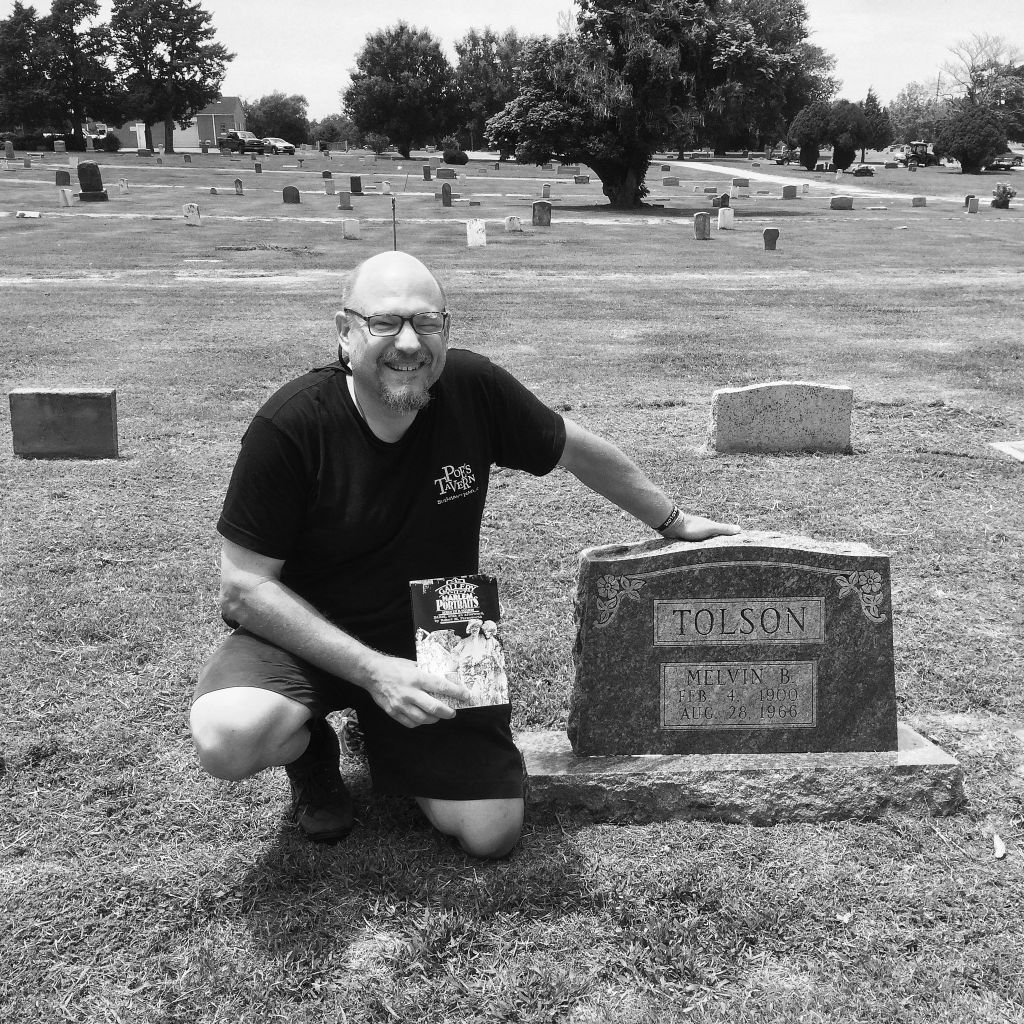 Walter Skold visits the grave of African-American poet Melvin B. Tolson at Summit View Cemetery in Guthrie, Oklahoma. He will talk about his travels to poets’ graves this week in Freeport.
Comments are no longer available on this story