
Mike Retelle, a Bates College climate scientist, will share insights from his trip to a Norwegian archipelago in the high Arctic on Friday, Jan. 29, as part of the L.L. Bean Lecture Series. Retelle will speak at 7 p.m., at the store’s camping department atrium.
Bill Yeo, retail manager for the L.L. Bean Outdoor Discovery School, said that Retelle is one of the most knowledgeable climate scientists in the Northeast. Those attending the lecture can learn “what is really happening in the Arctic, direct from the source,” Yeo said. Retelle will share the results of his climate change research on Svalbard, the Norwegian archipelago. His presentation will focus on the area’s environmental history, from the ice expansion during the Little Ice Age to the accelerated retreat of Alpine glaciers during recent decades.
“I was contacted by Bill Yeo about giving a talk,” Retelle said. “One of my students who is a member of the Bates Outing Club spent a semester at a Norwegian university in Svalbard and gave a talk at L.L. Bean, so I guess this is a followup.”
Retelle is a geologist trained in studying glaciers and glacial geology. He grew up in Massachusetts and gained his interests in natural history by hiking in the Alpine zone in the White Mountains as a kid.
“As a high school kid I followed around a geology field trip from some university and got hooked on the concept of glaciers once being in northern New England,” he said. “So I did my undergraduate degree in earth sciences at Salem State. After graduation I worked as a field geologist on the Trans Alaska Pipeline. I went on to do a Ph.D. and post doctorate at UMass Amherst, working on the glacial and sea level history in the northernmost Canadian Arctic (Ellesmere Island) and kept on working there after I got my position in the Geology Department at Bates, involving a lot of students along the way.”
In 2004, Retelle and some of his students started a project in the Norwegian Arctic, Svalbard, in coordination with colleagues at a Norwegian university center. They established a long-term monitoring site in a glacier valley on the west coast of the island of Spitsbergen.
Retelle answered questions regarding his Arctic experiences and climate for the Tri-Town Weekly.
Q: Simply put, what is climate change. Is it natural or something caused by humans?
A: When you look at earth history from a geologist’s perspective, you see that for the vast majority of earth history, climate and environmental change is normal and natural, but the key to understanding the recent change is being able to separate what is the natural variability and what is superimposed on the natural trend by human interference in the climate system. That has been only the most recent chapter of earth history, as late as AD 1850.
Q: Are you optimistic with the results of the Paris Climate Conference?
A: Climate policy really isn’t in my wheelhouse so I’m not totally familiar with the details of the Paris conference, but I think ideally they made steps in the right direction, getting countries to agree to agree. The next step is ratifying the agreement and then getting the plan into motion. That will be the tough part.
Q: What does data show? How can hard science be disputed? What is the position of the “doubters?”
A: There is a lot of data in many regions showing the impact of warming. Our own work in the Norwegian Arctic mirrors what is happening in Arctic and Alpine regions globally – glacier ice is retreating rapidly and as a result sea level is rising. I can see it with my own eyes. I guess I don’t know how someone could doubt that. One thing you could doubt is the reason why it’s retreating – natural variability or warming due to increased greenhouse gas due to humans.
Q: Green crabs and other warm-water invasive species are devastating local clam populations. Are they here as the result of climate change?
A: Not sure. You’d have to ask a marine biologist or Maine fisherman or lobsterman about changes that they are observing. There has been a lot of buzz about increased water temperatures impacting the lobster industry in southern New England and hopes that it doesn’t greatly impact Maine waters.
Q: Is there any good news?
A: Bad news first. Greenhouse gases have a residence time in the atmosphere but the good news is that research is focused on capturing and storage of CO2, which will reduce the impact faster than letting it ride out.
Q: What are college students saying about climate change?
A: On campus, students and faculty are engaged in climate change study from various perspectives, from climate policy and economics to environmental health and the physical and biological responses in the environment. Students in the geology department are working on monitoring changes seen in Maine lakes, they are monitoring changes in Maine beaches and salt marshes and with me as number of them are working in the Arctic on glaciers lakes and marine climate. This generation of students and their kids will see how this all plays out so that it’s important for them to understand how the earth system is working now and how it has worked in the past in order to be able to make sound decisions down the road.
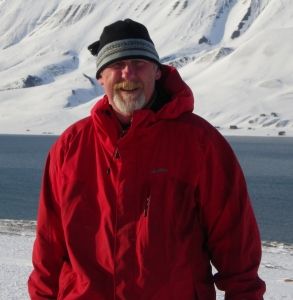 Bates College climate scientist Mike Retelle is shown during his trip to a Norwegian archipelago in the high arctic. Retelle will speak on climate issues during the L.L. Bean Lecture Series on Friday night.
Comments are no longer available on this story