
Steve Brown of Freeport was within the 90-hour time limit on Aug. 16 to officially finish the oldest bicycling event still run on a regular basis on the open road – the Paris-Brest-Paris Randonneur. And while the French event is an endurance test and not a race, Brown is pretty happy with that performance.
“It is often described as a grueling ride, to which I would concur,” said Brown, who owns Brown Goldsmiths Jewelers in Freeport with his wife, Judy. “I was quite pleased with the ride and my performance.”
In the Paris-Brest-Paris Randonneur, riders attempt courses of 200 kilometers or more, passing through predetermined controls, or checkpoints. Riders try to complete the course within specified time limits, and receive equal recognition regardless of their finishing order.
Paris-Brest-Paris begins on the southern side of the French capital and travels west 600 kilometers to the port city of Brest on the Atlantic Ocean and returns along the same route.
“Essentially, I began my quest to qualify and ultimately ride in PBP back in October of 2011,” Brown said. “Though I had known of PBP for a number of years, a long ride through part of the night from Freeport to Rye, N.H., made it clear to me that this kind of riding was a blast!”
In 2012, he said, “with some trepidation, I began to ride the New England Randonneurs series. On each successive ride I truly wondered if I would succeed. By the end of the season I had successfully completed all four rides. In 2013 both of my parents died so I had much less time to devote to riding, but was back in the saddle in 2014. Then 2015 was the year I had to qualify once again in order to be able to ride in PBP.”
Brown added a “little story” from his experience in France.
“One night, late on the return ride from Brest, it was pitch dark,” he said. “In the near distance I heard some clapping but could see no one. ‘Ici,’ (here), a voice said. I looked up in the direction of the voice, smiled and said, ‘Merci beaucoup.’ The assembled clapped louder and in a chorus said, ‘Bon Courage.’ It was for that simple human, might I say spiritual, connection that I rode PBP.”
He also said his ride “would not have been possible without there unflagging support of all of my staff at Brown Goldsmiths, who some days must have wondered, ‘Steve Brown, I have heard of him.’ They made it possible for me to train and actually make the trip to France. And a special thanks to my incredible wife Judy, her mom Virginia and her bothers Jim and Steve for all of their support in very tangible ways.”
Brown, 67, spent his early years in rural Pennsylvania, outside of Philadelphia. He grew up in Glastonbury, Conn., a suburb of Hartford. He married Judy in 1968, and has lived in Freeport since 1969. The Browns have two grown daughters, two granddaughters and one grandson.
Brown answered questions regarding his experience in Paris-Brest-Paris and his time in France for the Tri-Town Weekly.
Q: Tell us about the race? Are you satisfied with your performance?
A: Though often referred to as a race, the sport of randonneuring is best described as a style of long- distance, self-supported cycling that has been around for as nearly as long as the bicycle itself. Paris-Brest-Paris, or PBP as it is commonly called, consists of riding from St. Quentin-en-Yvelines, France (a Paris suburb), to Brest, 350 miles west on the coast, and then back. With around 6,500 participants the riders were started in waves of 300 every 10 or 15 minutes. My group started at 5:30 pm on Aug. 16. The time limit for successful completion is 90 hours to ride 1,230 kilometers or 764 miles.
Q: How are Paris-Brest-Paris and randonneuring related?
A: Paris-Brest-Paris is the oldest and most famous of the Grand Randonne?es. Randonne?e is a French term for “a long ramble in the countryside by foot, ski or bicycle.” Although these days there are a half a dozen 1,200K randonnees in the U.S. and others around the world, none have the history and mystique of PBP, which has been run since 1891.
Q: The night ride from Freeport to Rye, N.H., gave you a taste. Tell us about that night.
A: After reading about some of the details of randonneuring I decided to buy a really good light in order to safely ride at night. It fit on my helmet and allowed me to see quite well during a nighttime ride. Additionally, I added high-visibility tail lights to ensure that I would be easily seen from the rear. One night I headed out at 3:30 a.m. from Freeport, down Route 1, Route 88 and joined the Eastern Greenway just over the bridge in South Portland. The best word to describe that ride was “magical.” It was a dark night (no moon) and at points I rode through ground fog, which added to the mystery. In crossing the Scarborough Marsh, the sky began to lighten. By Old Orchard Beach, I watched the sun rise. From there the route turned inland. Hearing the early morning songs of birds breaking the night is something one can only experience during this time. I was hooked. I arrived in Rye a little after noon having stopped in South Berwick for breakfast and Portsmouth for lunch and had ridden around 95 miles. At that point I thought the day was young and perhaps I would keep riding, just to see how far I could go. Essentially I started doing laps between Rye and Exeter until I had racked up 160 miles and thought, “This is do-able.”
Q: In order to qualify for Paris-Brest-Paris, one must successfully ride 125 miles, 186 miles, 248 miles and 373 miles in the year of the event. When and where did you do that? Tell us about the New England Randonneurs series.
A: The sport of randonneuring has grown significantly in the past 10 years so randonne?es exist all over the country. I usually ride the New England Randonneur Series out of Hanscom Field in Bedford, Mass., or the Westfield series out of Westfield, Mass. Both are known for beautiful routes with significant climbing. Since this year was the year to qualify for PBP, I wanted to get a jump start on the series and my riding. One of the challenges of living in New England is that we get a late start due to the cold and snow. So I signed up for a week in early March at Desert Camp in Tucson, Ariz. The camp is run by the legendary Lon Haldeman and his wife, Susan Notorangelo, and would allow me to get an early start on this year’s training. Also, at the end of the week, I would be able to ride the first in the Super Randonneur series, a 200K. I rode the rest of the series out of Westfield. The final ride, a 600K, proved to be memorable and upon its completion on June 21, I knew I was headed to Paris.
Q: The Paris-Brest-Paris is the oldest bicycling event still run on a regular basis on the open road. How big a deal is this in France?
A: Interesting question. It is a very big deal to the local people along the route (in Brittany) and obviously to all of the participants from around the world. But I learned something interesting from a Parisian taxi driver taking us back to the airport. He said that while Tour de France is known far and wide both around the world and in his country, PBP was far less known. The simple reason is that the Tour de France is sponsored and is a very commercial event. PBP is virtually unknown because there is no money or sponsorship involved. It is pure and untainted, which is why I love it.
Q: Give us some examples of the camaraderie of randonneuring.
A: For the past three years I have been riding with a friend who has been randonneuring for decades. We ride about the same speed, and, to my great benefit, he has shared much of his experience with me. We have become fast friends and often email about equipment, tools and strategy. Randonneuring, due to its endurance nature, is a very complex sport and sharing ideas is a way to accelerate learning. The most recent example of camaraderie involved my time in France. When I arrived at the hotel I knew no one. I knew the place would quickly be filled with people from around the world and all would be putting their bikes together in the basement parking garage. During that time I became friends with some of the members of the San Francisco randonneuring group, sharing stories, ideas and strategies for the ride. Later on the route, toward the grueling end, it would turn out that some of us would help each other in important ways. Clearly when people endure hardships together, it forges close relationships.
Q: Have you been riding a bicycle continuously since you were a kid, or did you pick it up later on as an adult. If so, why?
A: I rode as a youngster on a Raleigh three-speed but after going to college, lost track of riding for years. Judy and I started our business while still in college and once we graduated we had our hands full for many years. Sometime in the ‘80s L.L. Bean had a bike sale. We bought one for each of us, theorizing that we would ride together. And we did some, but I was the one in whom the potential for great adventure was awakened. Over the years I have ridden to and from my home town in Connecticut, from the Catskills and numerous rides to New Hampshire and Vermont, often camping long the way. I learned what the Brettanian French along the PBP route seem to know also: Bicycles are a wonderful form of transportation and a symbol for free spirits everywhere.
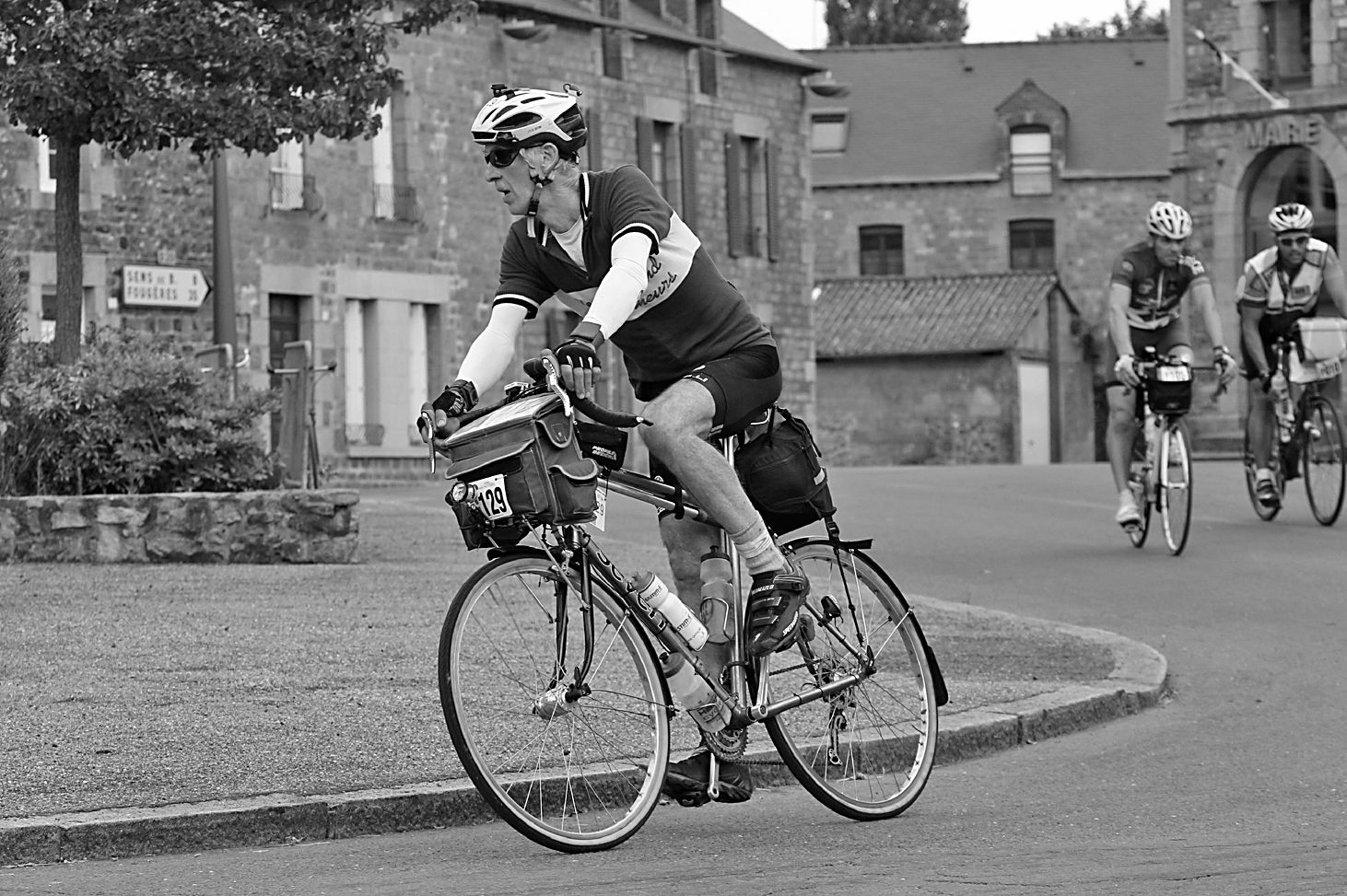 Steve Brown of Freeport competes in the Paris-Brest-Paris cycling endurance event, on Aug. 16 in Paris. Courtesy photo
Comments are no longer available on this story