
People who make their living digging clams, as well as everyone else living in Freeport, have the opportunity to weigh in on a draft shellfish ordinance amendment that could lead to private clam farming on the town’s mud flats.
A public hearing to discuss the proposal, revised last month by the Freeport Shellfish Conservation Commission, is scheduled for 6:30 p.m. on Thursday, Sept. 10, at the Town Hall. Commissioners will provide context on the proposed amendment, then allow up to three minutes for each member of the public to comment.
The Shellfish Conservation Commission has worked on the proposal for many months, trying to find a way for clammers to deal with a reduction in the soft shell clam population due to predation and climate change. A municipal aquaculture permit would allow clammers to seed and maintain a designated area for their own harvesting purposes.
“We anticipate the material at the public hearing will need to be studied, then decide if it’s sufficient to be voted on, up or down,” said Doug Leland, commission chairman. “We believe the draft is a solid framework from which to have a public hearing. I think it’s a pretty solid draft. We’re seeking feedback.”
Leland said the panel voted last month that the document now on the town website “is sufficient for public consideration, not for Town Council vote. Once we pass something on our end, Town Council public hearings and input from the Department of Marine Resources would be down the road.”
The commission is proposing a five-year pilot program for individuals to farm on the town’s mud flats. State law prohibits more than 25 percent of a town’s flats being used for aquaculture, in which the clams are farmed rather than gathered in the wild.
Statewide clam landings are less than half of what they were in 1980. Predation of soft-shell clams by green crabs, whose population many believe has increased due to warming ocean temperatures, is blamed.
The shellfish ordinance amendment in its present form would allow any holder of a Freeport commercial shellfish license to apply for a municipal aquaculture permit, “in a designated area in the intertidal zone to the extreme low water mark.” The permit would be for five years or less, and subject to renewal for subsequent five-year terms.
The total number of acres leased under the municipal aquaculture would not exceed one-quarter of the entire municipal intertidal zone that is open to the taking of shellfish.
Support for municipal aquaculture permits is hardly unanimous in Freeport – not even among members of the Shellfish Conservation Commission.
“There is some underlying resistance to doing anything different, then losing parts of the intertidal for clammers harvesting wild clams,” Leland said. “Maybe the intertidal will start producing again.”
Town Manager Peter Joseph said that the Town Council would schedule a public hearing of its own, if and when the commission votes to send a shellfish ordinance amendment its way.
“We’ve heard a lot of interest, both pro and con, on this one,” Joseph said.
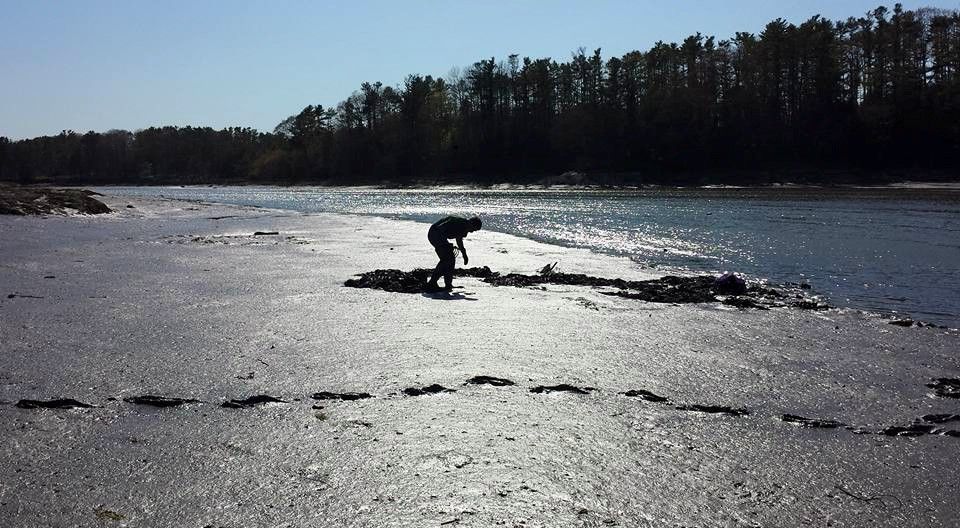 A clammer works the mud flats along the banks of the Harraseeket River in Freeport.Courtesy photo
Comments are no longer available on this story