
State officials have postponed controversial plans to temporarily install a picket weir on the Crooked River during salmon spawning season, citing concerns about inadequate staffing levels.
The Department of Inland Fisheries and Wildlife had planned to install the $17,000 portable weir, a fence that would block fish migration, on the lower portion of the river in the coming weeks. The 58-mile Crooked River, which extends from Songo Pond in South Oxford to the northern shore of Sebago Lake, passes through Naples and Casco and is prime spawning area for landlocked salmon in the lake.
The project came under fire this spring when 73 anglers signed a petition protesting the weir installation, warning that it would unnecessarily interfere with salmon spawning season. Earlier this summer, representatives of the environmental groups Trout Unlimited and Friends of Sebago Lake also raised concerns about the project.
According to Francis Brautigam, a regional fisheries biologist for the Maine Department of Inland Fisheries and Wildlife, the state plans to place the weir on the Crooked River in August 2016. The department is delaying the project, he said, because it needs a large amount of staff to remove invasive fish – golden shiners and brown bullheads – from Round Pond in Albany. Brautigam said the delay is unrelated to criticism of the project.
“The only reason it’s being postponed is that we have another project that we are concurrently working on and that other project is taking time and additional resources to the point where we didn’t think we had enough available staff and resources to concurrently manage the installation and operation of the weir,” Brautigam said.
The weir weighs about 6,000 pounds, and is about 80 feet wide and 6 feet high. It is composed of hundreds of pieces of pipe and angle iron arranged like a picket fence. The weir, which the department had planned to install in late August or early September and remove in early November, would prevent upstream and downstream salmon passage during salmon spawning season on the Crooked River. Department staff would temporarily capture the blocked salmon, collect information about their health, size and age and then place them on the other side of the weir afterward.
Critics of the project had warned that it would take a large-scale staffing commitment to operate the weir effectively and protect trapped salmon from predators, such as mink and otters. Doug Watts, an ecological historian and member of the Friends of Sebago Lake, said the staffing required would be considerable.
“In order to do this correctly they would basically have to have someone staffing that thing seven days a week,” Watts said. “That’s basically a whole seasonal staff position right there. It would take two people to operate this thing and do what they were hoping to do, which was to capture every salmon going up the river and weigh it and measure. It’s a lot of human labor involved.”
According to Brautigam, the weir was to be installed during the spawning season once every three to five years. Every 10 to 15 years, department staff would strip eggs from some salmon trapped at the weir in order to maintain the genetic vitality of the department’s salmon brood stock program, which stocks fish across the state, Brautigam said.
The Crooked River has been a popular spawning ground for wild salmon since the last ice age, but the construction of dams starting in the late 18th century progressively cut down the length of the river accessible to salmon, according to Watts.
Until a few decades ago, salmon only had access to the lower third of the river, limiting their ability to spawn. Since the 1970s, a number of dams have been removed from the river, re-opening full salmon access to the entire river, and causing a boom in the wild salmon population. The number of salmon traveling from Sebago Lake to north of Harrison during spawning season has doubled since the late 1970s, according to Brautigam.
To Watts and some Sebago Lake anglers, the department’s plans to install a portable weir will unnecessarily interfere with the salmon spawning season.
Stephen Sparaco, a longtime Standish fly fisherman who delivered the petition protesting the weir plans, said he is concerned that a number of salmon will die as a result of the weir installation. Some will die due to stress when handled by department staff, he said.
Another potential problem, Sparaco said, is that the weir will be cluttered by leaf buildup during fall foliage, and will become dislodged as water pressure builds up and forces it downstream. The weir will also block boaters, he added.
Watts said he would like the department to provide much more information on the weir plan. The only written public material on the plan is a one-paragraph summary included in the recommendations of the department’s September 2014 Sebago Lake Management Update.
“This all goes back to what the details are,” Watts said. “We were hoping to see some fairly detailed plans of how this was going to be done and that it was not going to be intrusive upon the run. People wanted more information and were hoping to get more information and then by the middle of July, all of the sudden, Francis (Brautigam) said, ‘We’re not going to do it this year,’” Watts said.
Brautigam said the department did not have time to formally respond to every issue raised by critics of the project.
“Obviously we’re going to work to our best ability to address those,” he said. “That doesn’t mean that necessarily we’re going to provide answers up front.
“There are a whole lot of ‘what ifs’ that are thrown out at you.”
Brautigam also characterized the public concerns raised about the project as “valid.”
“There’s been some, I think, public concern raised regarding the project,” he said. “There’s perceived concerns that those fish are going to be delayed in their movement upstream and that may in some way adversely affect anglers and their ability to catch fish where and when they ordinarily are catching salmon.”
“We’ve worked too hard over the years to rebuild the wild salmon fishery in the Sebago Lake-Crooked River drainage,” Brautigam added. “We’re not going to do anything that’s going to jeopardize the success that we’ve had there.”
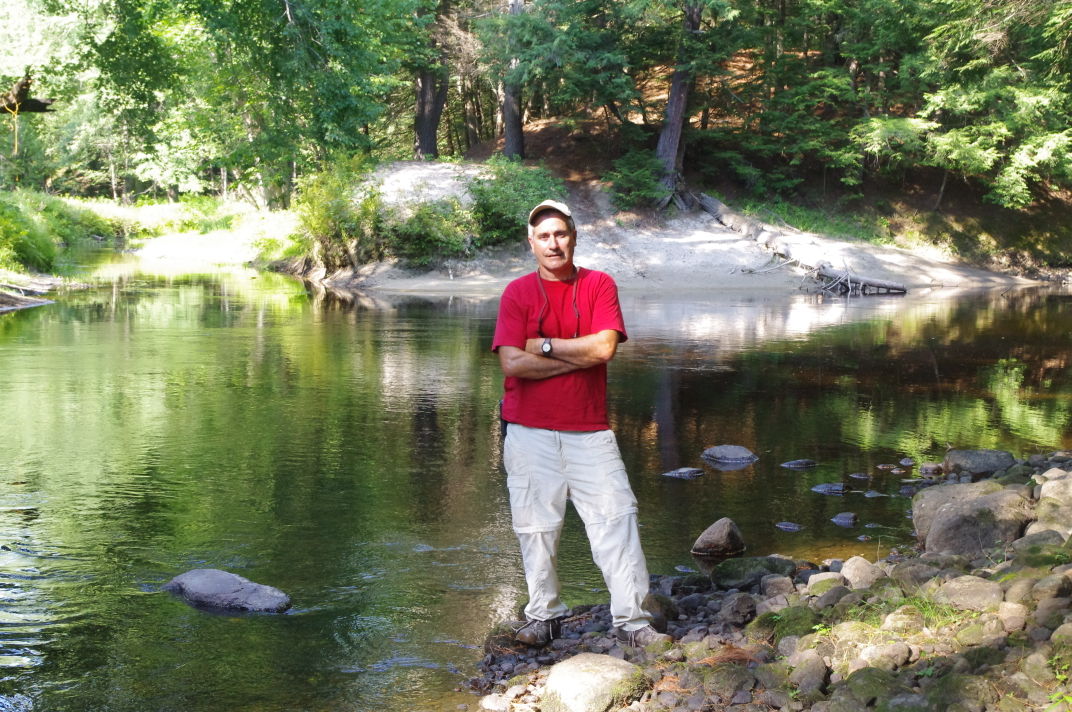 Stephen Sparaco, a Standish angler, stands in front of a section of the lower Crooked River off Route 11 in Casco that is heavily trafficked by landlocked salmon during the fall months. Sparaco opposes state efforts, which have now been postponed, to place a picket weir on the river. Staff photo by Ezra Silk
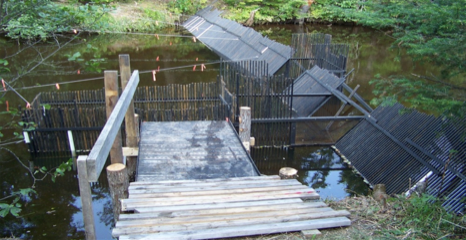 A portable weir like this one has been proposed for the Crooked River in Casco. Courtesy photo
Comments are no longer available on this story