
Having declared a “guarded victory” in its 11-year campaign to eradicate the invasive aquatic milfoil plant from the Songo River and Brandy Pond, the Lakes Environmental Association is now setting its sights on Sebago Lake.
Since 2004, the Bridgton-based environmental group has employed four to eight seasonal crew members in the summer to remove milfoil, which chokes freshwater ecosystems and spreads exponentially when boat engines chop up the plants into smaller, self-replicating fragments.
Five years ago, the Songo River was so infested that the group proposed shutting down the Songo Lock, in order to halt boat traffic and slow the rate of the milfoil invasion. But these days, it is difficult for the association’s seven-person milfoil control team to find much milfoil at all, according to Adam Perron, of Harrison, a Lakes Environmental Association staffer who has been working on the milfoil campaign since it began.
“As this summer’s winding down, we’re scraping for plants now,” Perron said. “These bags, these bushel-sized bags – we used to remove 50 to 60 of these a day from the river. And now, when we scrape one of these together, we feel very good about it. Throughout the Songo River system and through Brandy Pond, we feel very good that we can dramatically reduce the resources that we need to put into the river, and as long as we’re consistent and methodical, this river will stay at the state that it’s in now.”
Peter Lowell, the executive director of the group, said the milfoil control team is running out of meaningful work on the Songo River system.
“It’s like having a Navy SEAL group doing kindergarten lessons,” Lowell said. “This has gotten to the point where it’s ridiculously simple compared to what it used to be. These guys are tuned up and very efficient and very cost-effective.”
Given the guarded declaration of victory on the Songo, Lowell has begun to draw up battle plans for an even bigger target: Sebago Lake, which is just down river from the Songo.
While the roughly 10-acre Songo River and Brandy Pond milfoil invasion took 11 years to conquer, and about $400,000 in funds, Lowell thinks the Sebago milfoil explosion, which he estimates at 30-40 acres in total, could also be vanquished in about a decade. But it would take about $1 million, about 10 milfoil control teams, and massive collaboration by the lake’s various milfoil control groups, property owners, business and municipalities.
“We’re now looking at Sebago Lake and saying this place is a big mess,” Lowell said. “Every cove and bay in the lake has plants and some are very dense and, again, the lake is so big that it seemed unmanageable, but there’s a fledgling effort to get the towns and the landowners and the businesses involved. It’s achievable, and really what’s been lacking is the organization, a really strong organization and battle plan to get the job done. That’s what we’re looking at doing. We’re very seriously looking at putting those pieces together to try to make it happen.”
Since 2007, the Lakes Environmental Association has used Diver Assisted Suction Harvesters, which are boats featuring vacuum pumps, to remove milfoil from the Songo River system. The association has two harvester teams these days. The two groups that remove milfoil from Sebago Lake – the Raymond Waterways Protective Association and Save Sebago Cove – have three in total. Lowell believes it would take eight to 10 teams initially to take on the entirety of Sebago, and he believes the effort must begin next year.
“We need to start next summer,” he said. “Every summer you wait it grows exponentially. You wait one summer, then you’ve got twice as much work to do.”
According to Perron, milfoil was first discovered on Sebago Lake in the 1970s, but the extent of the problem was not widely recognized until the early 2000s. In recent years, as the problem has grown worse and worse, others have tried to rally the Lakes Region community around an effort to tackle the problem.
Diane Potvin of Raymond, who last year lobbied for a bill in the Legislature that increased revenues for the state’s milfoil sticker program, recently helped establish the Sebago Lake Milfoil Action Cooperative, which is focused on public education regarding the milfoil threat, as well as early detection. Potvin recently received a $14,000 grant from the Maine Department of Environmental Protection for the effort.
Potvin said she was not aware of Lakes Environmental Association’s plans.
“It sounds like similar concepts,” she said. “I don’t know where they’re getting money.”
Lowell said a significant amount of money could be raised from landowners on Sebago Lake. The money for the Songo River effort came from anonymous donors, association membership and the Libra Foundation, according to Lowell.
If the funds for the Sebago campaign do not materialize, Lowell said, the association would be forced to diminish its milfoil control team.
“I think it would be a tragedy to let this expertise and commitment go,” he said. “These guys are extremely dedicated. This is very, very hard work, long days, pretty unpleasant conditions. If you figure you’re underwater for more than an hour just looking at silt, it’s nasty work, but there’s something magical about it that’s inspired these guys and they’ve done a hell of a job.”
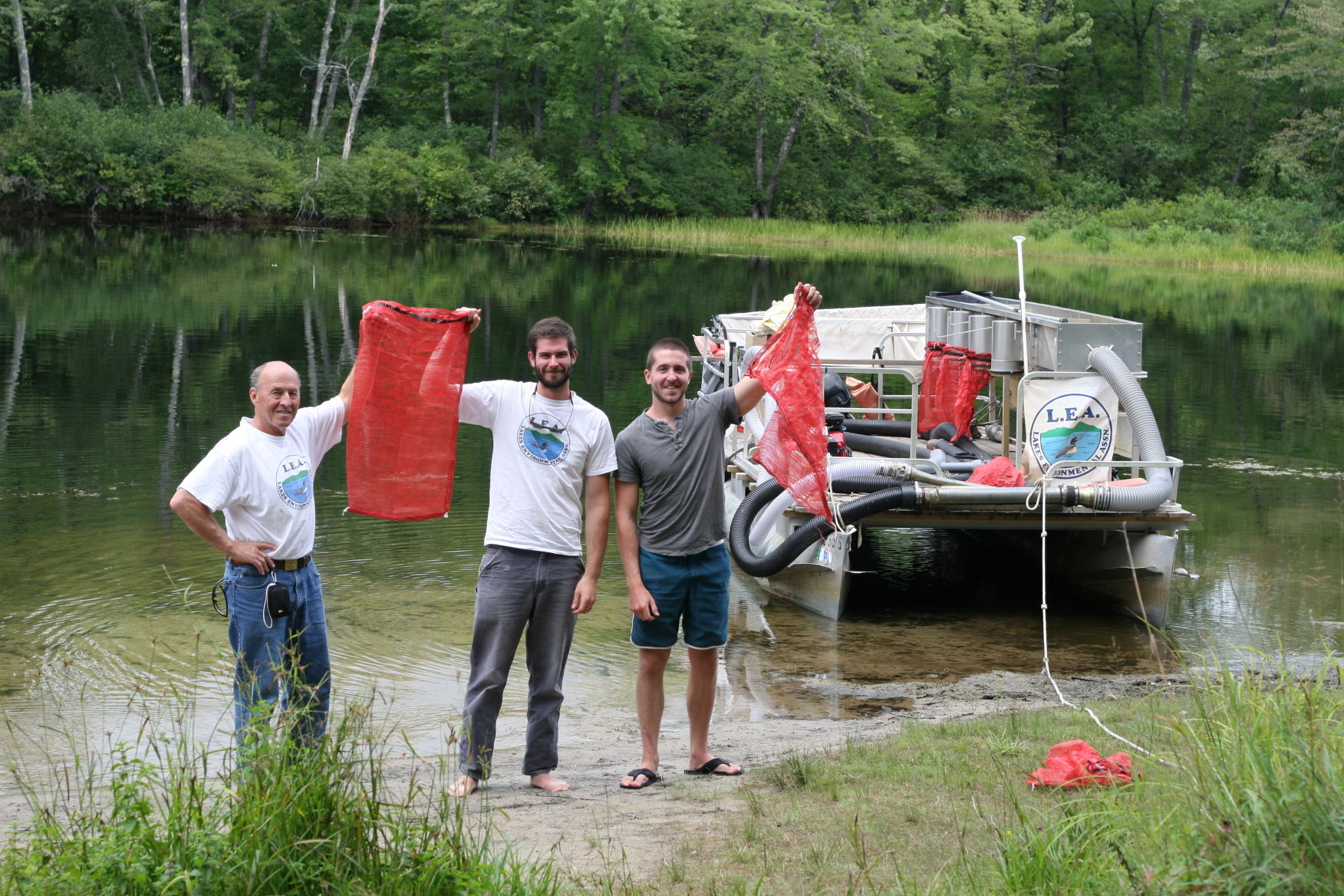 Peter Lowell, Lakes Environmental Association executive director, left, and employees Christian Oren, middle, and Adam Perron celebrate a “guarded victory” in their 11-year campaign to eradicate milfoil from the Songo River. Oren and Perron, here standing in front of a Diver Assisted Suction Harvester, have increasingly come up with empty bags in their efforts to remove milfoil from the river system. Staff photo by Ezra Silk
Comments are no longer available on this story