
Andrew Durgin is adjusting to the ebb and flow of his job as Freeport’s first marine resources conservation officer.
Taking the reins as Freeport’s newly named marine resource conservation officer in June, Andrew Durgin thrust himself into the middle of the clamming season. No “meet-and-greets” were arranged between Durgin and the clammers who would be under his surveillance. He needed to get to know them on the fly.
Durgin has done just that. As he makes his customary loop around the clam flats along the Harraseeket River, he usually knows the vehicles in the parking lots, what they’re fishing for (clams or worms) and their tendencies. Durgin issues few summonses – perhaps two a week – and that’s the way he likes it.
“It’s not just strict law enforcement,” Durgin said one misty morning last week. “Not once you get to talking to people in the flats.”
Durgin is the “new blood” local clammers hope will spend a significant time on resource protection, and a little less on enforcement. The Freeport Shellfish Conservation Commission on Jan. 8 recommended that the shellfish warden’s position should henceforth be called the “Marine Resource Officer,” later inserting the word “Conservation,” and that the duties of the person who holds the job should involve more resource protection and less enforcement. Many clammers felt that Tom Kay, the former shellfish warden who retired on Feb. 6, concentrated too much on the enforcement side of the job,
“They want policing to be minimal,” Councilor Andy Wellen said at a Town Council meeting last winter.
According to town statute, the marine resource conservation officer is responsible for defining, developing, implementing and coordinating projects and activities in support of Freeport’s marine resource conservation and shellfish programs. The officer is charged with developing, implementing and overseeing a conservation program “that satisfies standards of modern shellfish management.”
The Shellfish Conservation Commission and the Maine Clammers Association, concerned with the impact of green crabs on the soft-shell clam population, agreed that the municipal officer should be doing more conservation work. But right now, in the height of the clam harvest, resource protection means enforcement. Durgin says he’ll have plenty of time for field work during the cold months, when fewer clammers are on the flats. Besides, after the brutal winter, fishermen are seeing far fewer of the green crabs that decimate the clam population this summer.
“Right now, in the summer, I’m doing about 75 percent patrol, paperwork and testing water quality,” Durgin said as he made his rounds on a misty morning last week, when the tide came in at 9:50 a.m. Clammers were out before 6, leaving their boats at strategic spots along the shore and getting down to the backbreaking work of digging clams.
Durgin’s educational background serves him well in this job. The Biddeford resident has a degree in conservation law enforcement from Unity College, and a master’s in public administration from Anna Maria College in Paxton, Mass. He comes to Freeport from a job as deputy sheriff with the Cumberland County Sheriff’s Office.
“I’ve got a diverse background, which helps,” Durgin said. “The job itself fits right into the things I want to do. I get to work outside, and in the natural resources field. It’s not just strict law enforcement.”
By the time Durgin came on board, the heavy June rains had forced closure of the flats in the upper Harraseeket. Now, with those flats open, clammers are scurrying to that part of the river to get the clams that went unharvested during the closure.
Durgin began his rounds at 8:30 a.m. with a check of Bartol Island, which he accesses by driving his Dodge pickup from West Street to Torrey Hill Road – a quick commute from the police station. Looking at the vehicles in the parking lot, Durgin knew right off whose car was whose. The guy with the Subaru wagon is a wormer. The men with the red and black pickups were out clamming. You could hear them talking across the shore and playing the radios.
Durgin cross-checked their license plates just to make sure who was out there. He pointed to red stakes that are placed at points around the riverbed, which mark closed areas.
“The red stakes prohibit where they can fish for water quality reasons,” Durgin said. “I patrol the flats to make sure people aren’t in closed areas, then check the size of their clams, and their licenses.”
Durgin walked the Bartol Island causeway to see clammers on both sides of the island – on one end looking back toward Pettengill Farm and on the other side at the end of Randall Road to Wolfe’s Neck.
“You can tell the differences between wormers and clammers,” Durgin said, looking through his binoculars. “Wormers are chopping – not digging down. Clammers have snow sleds.”
Durgin said he does his rounds quietly.
“I try not to broadcast my schedule, because I don’t want them to know what I’m doing,” he said.
As he spoke, a Downeast Institute air boat whirred by the clammers, and the cottages on that side of the shoreline. The Downeast Institute, under the direction of Brian Beal, an ecology professor, is conducting studies on soft-shell clams and green crabs through a University of Maine grant.
“They know they can be loud for people,” Durgin said. “When they see me, they slow down.”
Fifteen minutes after checking out Bartol Island, Durgin heads to South Freeport Road, along Sandy Beach Road and finally the town landing at Winslow Park, a recreational area where visitors can see clammers at work from afar. Everything is fine.
“Right now they’ve been pretty good because they know I’ve been out and about,” Durgin said. “I’d prefer not to ever write a ticket.”
The most common violation is fishing in a closed area.
Durgin then drove along Cove Road and walked onto the wharf. He could see Bartol Island from the other end. The points on that end of the cove are closed.
“If we came here today and a guy’s digging,” he said, “he’s going to get a summons. But everyone’s doing what they’re supposed to be doing. No red flags.”
At Dunning’s Landing at Falls Point Marine on South Freeport Road, Durgin points to a rivulet the clammers use to get to the flats.
“They go right out there with their skiffs,” he said. “This fills right up with water. They leave their boats up high, then clam, then go back when the tide goes in. These guys work hard. When you get a 6 a.m. tide, you’re getting up at 3 or 4 in the morning to get out here. They’re making a hard living.”
The town has issued 46 residential commercial clamming licenses, five nonresidential commercial licenses, five student licenses and one nonresidential student license.
Right now, the price is good for the clams. Around the Fourth of July, clammers were getting about $180 a bushel, and now the price is around $120. They might get four bushels on a good day, Durgin said, but this is the time “to make hay.”
Durgin then checked the water gauges at the Freeport Sewer District. An inch of water in one day means closure of the upper flats.
A drive down Sandy Beach Road leads him to a long series of stairs, where Durgin points out a closure line from Nappi’s Cove to Bartol Island south.
“It’s the runoff from most of the town,” he explained.
The town wharf is always busy this time of year, with fishermen and tourists providing a scenic mix of boats in front of Harraseeket Lunch & Lobster Co. A wharf on the water, in front of the restaurant, contains an “upweller” where Beal and his crew are raising baby clams, which they later will place in the flats under netting to protect them from green crabs.
“Everybody who’s out and about say they’re seeing very few crabs,” Durgin said. “They think it might have been the winter, or it might just be a cycle. Ocean acidification makes shells soften. Is that a factor for predation? It’s kind of hard to tell.”
Durgin did not get onto his boat, which he uses once or twice a week, on this day. He went on to check out the situation on flats near the Harraseeket Yacht Club, Spar Cove, Winslow Park, Harb Cottage and Fogg Point, a small part of the Cousins River that stretches into Freeport, near Yarmouth. Peering off into Spar Cove, he saw wormers at work.
“When the upper river was closed,” he said, “all the guys were down here, trying to dig.”
Durgin finished his daily rounds on the other side of the river at Wolfe’s Neck.
Then, it’s back to Falls Point Marine, where clammers are coming in with their daily catch at around 11:15. Clammers wait in line in the rivulet with their waders on as, one by one, they haul their boats back up and onto the parking lot.
Lester Toothaker of Hebron had two bushel bags full of good-sized clams. Durgin measured them quickly, and gave the clams an OK. Toothaker said his clams averaged 12 to 14 to a pound.
“It ain’t that bad,” he said. “I ain’t a complainer. I’m a fisherman.”
Durgin reports to his boss, Police Chief Jerry Schofield, regularly. On some days, Durgin said, the chief has ideas for him.
Schofield says that Durgin has been “a quick learn” in the new position.
“I personally feel the new program is moving along well at this point,” Schofield said. “Andrew came on board when the clam diggers were getting busier. With the assistance of our past shellfish warden, Tom Kay, Andrew is quickly learning the basics of the job. The department and Andrew will continue to work closely with the chairman and leaders of the shellfish committee to define and refine the future tasks that we would all like to accomplish with this position.”
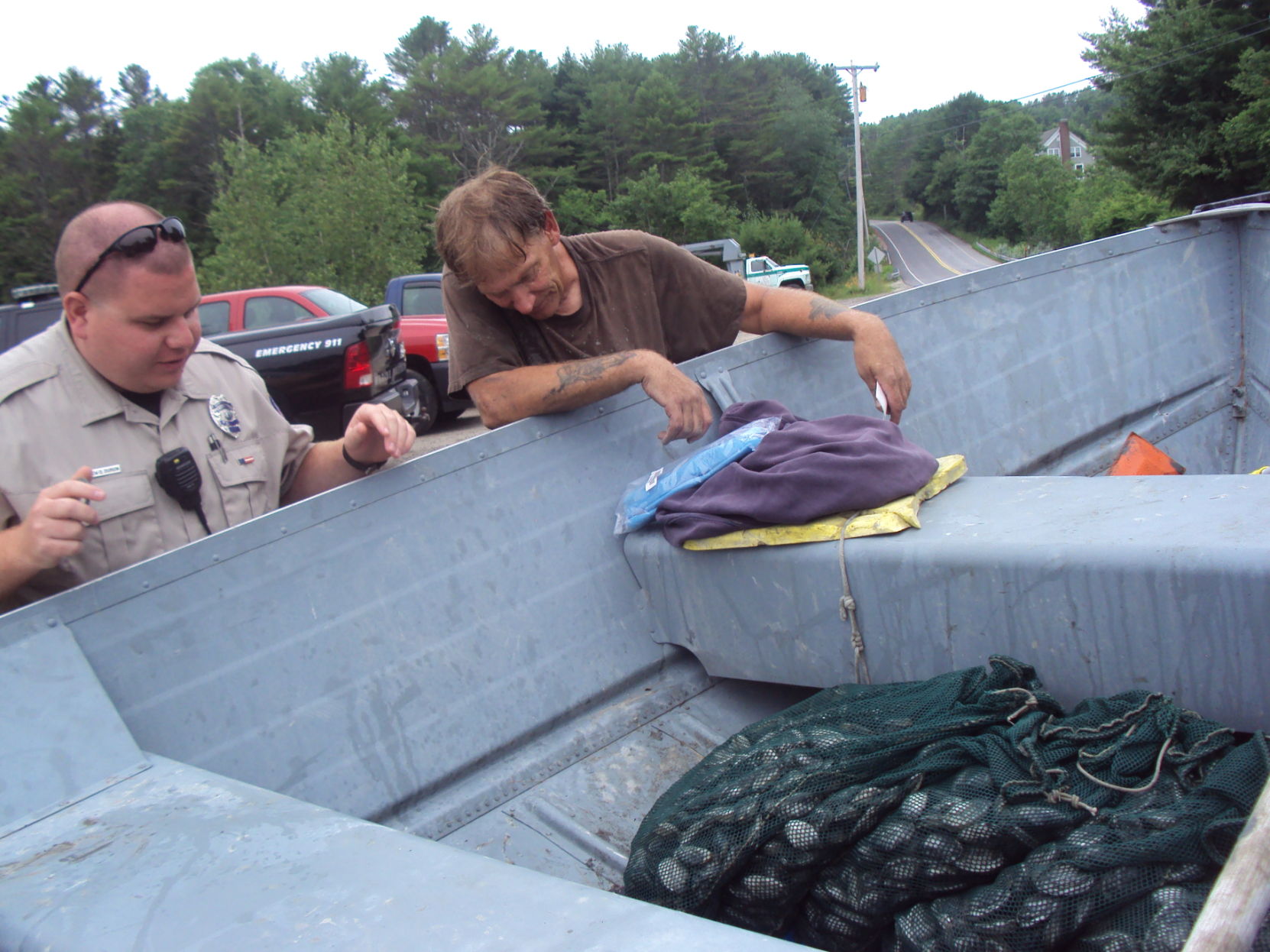 Andrew Durgin, marine resource conservation officer in Freeport, and clammer Lester Toothaker of Hebron look over Toothaker’s morning catch last week at Falls Point Marine. Staff photo by Larry Grard
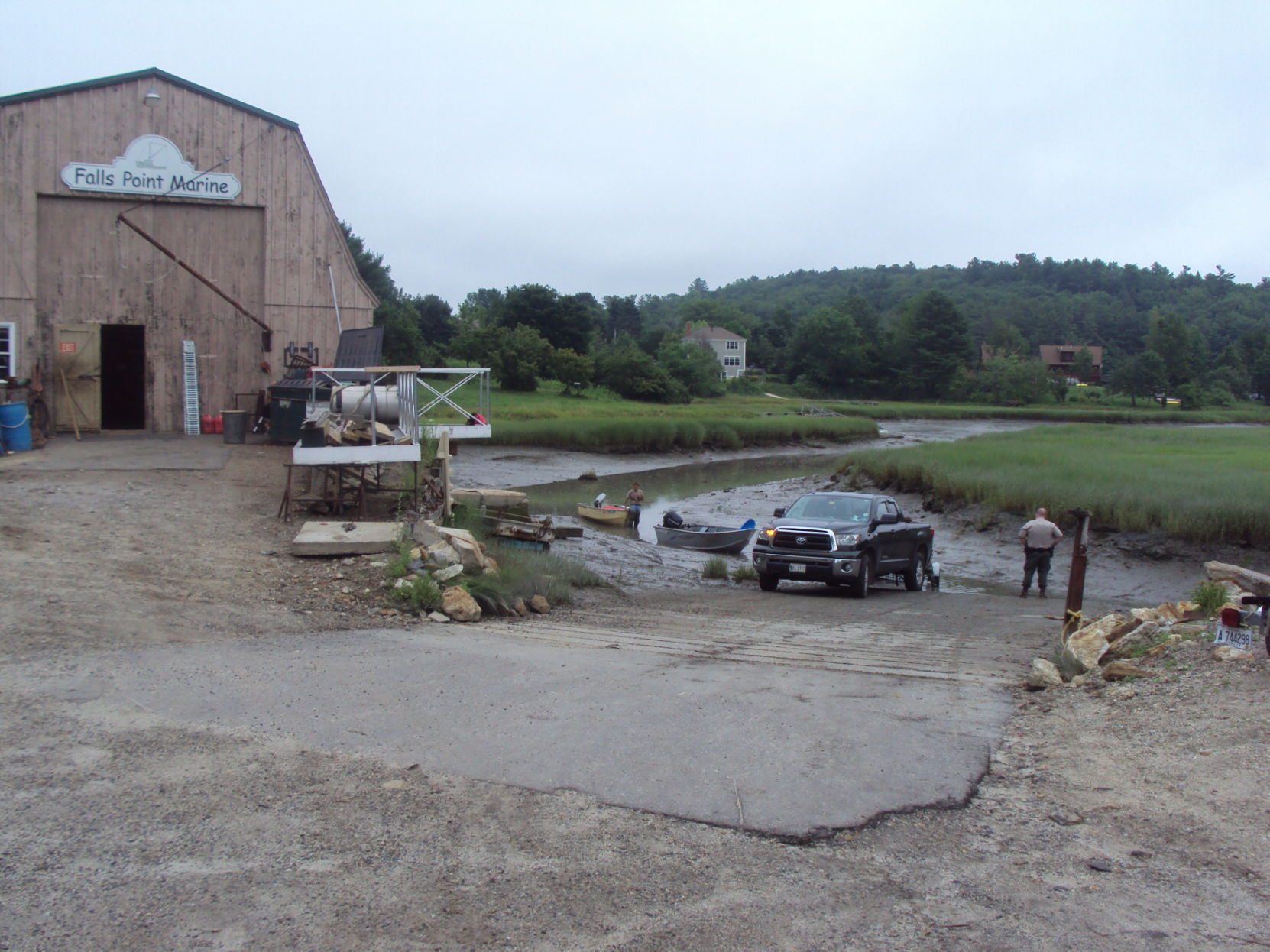 Clammers line up along a small estuary next to Falls Point Marine in South Freeport, with their morning catch. Andrew Durgin, the town’s marine resource conservation officer, was there to check licenses and the size of the clams harvested.
  Andrew Durgin uses binoculars to check on clamming activity near Bartol Island on a recent misty morning.Staff photos by Larry Grard
 Behind the sign outside Sandy Beach in Freeport. Andrew Durgin, marine resource conservation officer, is on his way to check conditions on the clam flats.
Comments are no longer available on this story