
Lake Region High School superstar Kate Hall – you never want to use that word, “superstar,” too willy-nilly, but in this case, it actually might be too feeble a description – is taking a break from track.
Don’t worry, though, fans; it’s just a little R&R. Hall, of Casco, will get back to training, competing and probably winning (to say nothing of setting new records) soon enough.
“I train, like, 11 months out of the year, so this is my one month where I don’t do anything,” Hall says. “It’s really just to let my body recover and calm down before I start up again.”
When Hall does return to her training, it will be with her high school career completely behind her, and her college – and Olympic – careers on the horizon.
Hall capped her four secondary years at the New Balance Nationals in Greensboro, N.C., on the weekend of June 19-21. There, to nobody’s surprise, she performed extremely well. But to some people’s surprise – not least her own – she didn’t just win the Long Jump, she shattered a long-standing record.
Inches matter in sports, and Hall jumped 22 feet 5 inches at Nationals, more than 11 inches further than the second-place finisher and two inches further than the previous record-holder, Kathy McMillan of Hoke City High School in Raeford, N.C., who jumped 22 feet 3 inches way back in 1976. Yes, 1976. McMillan’s record was more than twice as old as Hall.
Hall had a personal goal when she went to Nationals, but it wasn’t 22 feet. Not even close. “It was actually 21 feet – and I skipped over the 21s and ended up at 22. So I’ve still never been in the 21s,” she chuckles.
And of course Hall, also a sprinter, competed in the 100, where she won the prelims and took third in the finals.
How does she do it? She’s clearly built both to sprint and to jump; the power of her legs is obvious, even to spectators, when she competes. And she’s honed that build with her training, much of which is strength-training and running.
She’s not sure exactly what her college regimen will entail, but she can speculate based on her past. “Once it gets closer to the season,” she says, “I would start training pretty much every day, except weekends, and I would take maybe three days a week of strength training and maybe two days of running.”
“Once I’m in-season, Monday and Wednesday would be my hard days. So on those days, I would probably do some sprinting in the morning, and then right after I would go to the weight-room and do some strength training.
“Tuesday and Thursday would be easier days, where it’s just tempo runs and recovery – and maybe a massage after.”
Interestingly, while her regimen has traditionally included a plyometrics day, Hall doesn’t actually long jump all that much outside of competition.
“Probably three jumps on Wednesday,” she says, “and that would probably be it for the week.” But it does depend, she reiterates, on where she is in the season.
She practices her technique as well, naturally – and there’s a lot of that to practice. “It’s more than people would think of,” she says. “I try to focus on that in practices, because at meets I don’t want to have to think about it.”
For the 100 and the 200, Hall’s other sprint, she mostly works on honing her starts off the blocks. She wants her feet a certain distance apart to give herself an ideal angle in her set position; she wants to keep her head down when she’s in the blocks and coming out of them; she wants a bit of a forward lean; she wants to take a deep breath in and tighten up, when she’s in her set position; she wants to keep her feet as close to the ground as possible as she launches forward – maybe she even wants to drag them.
And so on: Drive the lead arm. Stride long and powerful. Keep the knees up.
“It’s really a lot to think about,” she says. “But once I get into the race, I pretty much focus on staying relaxed, driving my arms, keeping my shoulders down and keeping my knees high.”
Keeping those knees up is even more important for the Long Jump – so much so that the two running techniques are related, but far from identical.
“If you look at me sprinting in a race and you look at me doing my approach for Long Jump,” she says, “it looks like two totally different things. It’s actually really interesting.”
There are other requirements to reach the level Hall has reached, though. She’s careful about what she eats, and gets plenty of sleep.
She especially credits her physical trainer, Chris Pribish, with her improvement. She’s been working with Pribish since seventh grade. But she’s also received her share of instruction from Lake Region head coach Mark Snow as well as her dad.
“[As a freshman,] I was always hoping I would get better. But I can’t believe how much I got better,” Hall says. “I pretty much improved a foot every year for Long Jump, and this year I improved two and half feet – which is crazy to think about.”
All those efforts and their attendant successes add up to a rank of No. 9 female in the world. That’s not just ninth among high school girls, mind you; it’s ninth among all women, period. Among high schoolers, she’s No. 1.
While Hall has tended to view herself in the past as equal parts sprinter and jumper, she’s beginning, nowadays, to see herself as a jumper who also sprints.
“I’ve always seen myself, in previous years – I guess I still do – as a sprinter-jumper. And I still am. But when I started the whole recruiting process, a lot of coaches would tell me, ‘You’re a jumper who can sprint.
“I kind of doubted them, because at that time, I was pretty equal in both. I was like, ‘No, no, I want to become an Olympian someday, and I want to be good at both. That’s what I want to do.”
But as Hall began to invest more work in her Long Jump approach, she began to see much bigger distance gains, and she began to think maybe there was something to what those coaches had said, after all.
“I can kind of see what they’re saying now. I think I will continue to see improvement in my sprints, but I think they’re right in that, if I go to the Olympics, then I’m going to do better in the jumps than I will in the sprints. We’ll see, but I do think that’s how it’s going to be.”
So does that mean she’s ever tried the Triple Jump?
“It’s actually a funny story,” she says. “I used to do the summer track program, when I was little. I started Triple Jump in sixth and seventh grade. I liked it, I was pretty good at it. But it’s one of those events where, if you do it a lot, you’re going to have issues.
“I started to have issues with my ankles in seventh grade. At that point, I was like, ‘OK, I’m not doing this anymore, because it could affect my other events.’
“But last year, I kind of randomly decided that I wanted to try the Triple Jump for two meets – the Western Maine Conference Meet and the State Meet. I kind of knew how to do it, from doing it in Middle School. Not very well – I didn’t remember everything.
“But I picked it up, and I ended winning at the Western Maine Conference Meet and the State Meet. My distances weren’t very good on the national level, or anything, but they were pretty good for Maine.”
Inquiring minds wanted to know if Hall would continue with the Triple Jump this year, but she had a minor knee issue and didn’t want to aggravate that.
Also, Hall enjoys sprinting, and wouldn’t want to give up either the 100 or the 200 for the Triple Jump. “I love sprinting; I have so much fun with the starts. I love it just as much, but I’m realizing that Long Jump is where it’s going to be at, and I’m starting to like it even more because of that.”
Anyway, since she’s likely to join a relay squad in college, she simply won’t have room on her competition docket for the Triple Jump.
Speaking of college, Hall is heading off on a full scholarship to Iowa State in the fall. Pribish will coordinate with Hall’s coach at Iowa, Fletcher Brooks, to plan her regimen.
Why Iowa?
“Well, I had four visits, and Iowa was my last,” she says. “And it seemed like with the other schools, there was at least a negative. But when I visited Iowa, I couldn’t think of any negatives.
“I immediately bonded with the team – I didn’t realize how important that is. At the other schools, I didn’t at all. It was cool to visit and feel like I belonged.
“Also, the academics. They had the best option for me, because I’m going to be majoring in kinesiology.
“And also [Coach Brooks]. He seemed really individualized with all his athletes. That was good to see. I’m better in a setting where it’s individualized.”
Now, Hall has long been home-schooled – even though she competed through high school for Lake Region – which might make people wonder how she’ll fare in the big, wide world of college scholastics. Academically, she’s very confident, because she’s already taking college classes; she has been for two years. She travels to both University of Southern Maine and Saint Joseph’s College for them and has done well.
“I think it’s definitely prepared me for going off to college,” she says. “I did really well in those classes. If I didn’t do those classes, I’d be scared.”
Nor is she intimidated by the prospect of going away to a big university, or worried about being overwhelmed by the panoply of new social options. “I actually know my roommates now, and I think we’re a lot alike. I think spending time with them is going to help with that. I know it’s going to be an adjustment, but I think I’ll adjust fine.”
And while she acknowledges she’ll likely be homesick for a while, she already feels well connected to a number of other students at Iowa, which should help temper any loneliness.
“I know I’m going to be at least a little bit homesick, because I’ve never been away from home for that long…[But] I’m going to be busy.”
No doubt she’ll be busy, because she’ll have at least one thing on her plate that your run-of-the-mill college athlete does not: Olympic aspirations. Hall’s had the Olympics in her sights at least since her freshman year, because that was 2012, when the London games took place.
At the time, she was long-jumping 17 feet or so, and completing the 100 in roughly 12.2 seconds – marks that aren’t even close to the Olympic cutoffs. She knew as much, of course, but wasn’t deterred from the dream.
“I was thinking in my mind: ‘OK, four years from now; how much do I need to improve to at least make the Trials,’” Hall says. “So I went by the 2012 standards and thought it up in my head: ‘OK, my goal is to make the 2016 trials, maybe make the Olympics’ – I wasn’t really expecting to make the Olympics after four years – ‘and if not that year, then 2020 is definite.’”
Hall’s 22 feet 5 inches already qualifies her for the 2016 Olympic Trials in Eugene, Ore., the cutoff for which is 21 feet 11 inches. She’s not sure yet if the jump happened in the right time-frame – that requirement hasn’t been released yet – but she suspects that it did, and she’s optimistic about next year.
Hall is top-three across America in the Long Jump, at the moment, but recognizes that “people will probably be jumping further by the end of the summer. The top three make it, so 22 feet 5 inches would probably be on the border of that. It might not be enough, but it would be up there. I know I have a chance.”
But by the end of the summer, Hall will likely be jumping farther, too – and by July of next year, when the Trials actually take place before the Rio games in August, she’s almost certain to have set new PRs.
The 2012 qualifying standard for the 100 was 11.29, and Hall ran 11.37 at Nationals.
“Having another year for that is really going to help,” she says, “and I definitely think I could make the Trials for that. But making the Olympics – I’d have to improve a lot to do that, but I do think I have a good chance of at least making the Trials.”
2016 is right around the corner, but 2020 and 2024 are also in Hall’s view. At 23, she’ll still be in her prime for the Tokyo Olympics in 2020. Likewise for the games after that, the host city for which has not yet been decided – though, as we’re all perhaps aware by now, Boston is in the running.
“[2020] will just give me another four years of training,” Hall says. “And I’m still young. So, at that point, I’ll even be at a better age to go, and I should be competing better when I’m 23. And even [2024] should work out well, too.”
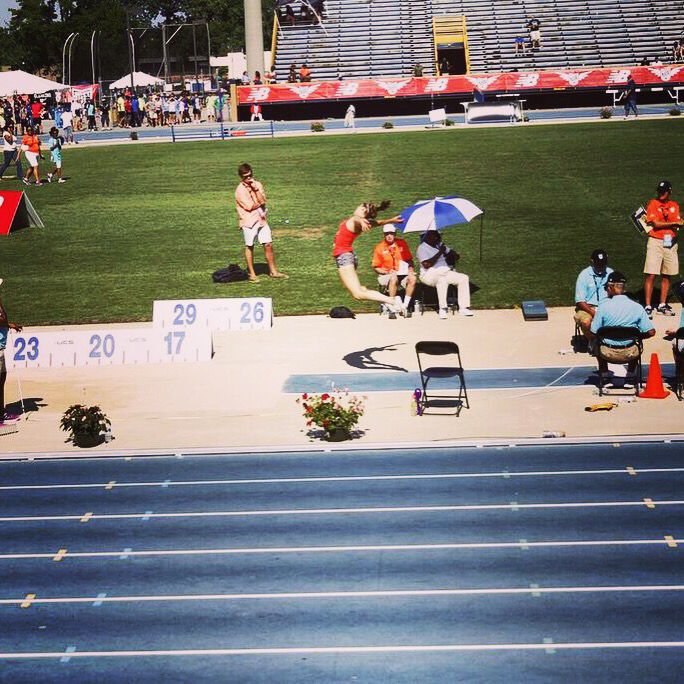 With officials at the New Balance Outdoor Nationals watching, Kate Hall jumped to a new national record in the Long Jump in late June, surpassing a 39-year-old mark. Hall is ready to take on the collegiate world and has aspirations for the Rio Olympics in 2016.
 Kate Hall stands next to the board with her winning mark in the Long Jump.
Comments are no longer available on this story