
With $10,000 in grant money in the bank, the four young Freeport men who make up Limbeck Engineering LLC are moving forward with their plans to market a remotely operated submersible robot.
College students Travis Libsack, Nick Nelsonwood and Liam Wade and Freeport High School senior Josef Buiberstein said last week that this summer they will initiate phase 2 of Project Roby Goby, a robot they hope to market by 2017. Limbeck Engineering recently won the University of Maine Business Challenge, which will provide them with $5,000 in cash from the Fournier Family Foundation, augmented by $5,000 in assets from the Maine Technology Initiative. They will use the cash to work on phase 2 of Project Robo Goby this summer, and the assets to access University of Maine resources.
“There are many resources on the University of Maine campus, which is just as valuable,” Libsack said.
Wade is a student at the University of Maine. Nelsonwood is at Princeton University; Libsack is at Massachusetts Institute of Technology, and Biberstein also plans to attend MIT next fall. The four of them spoke to the Tri-Town Weekly last week via conference call from their respective campuses.
In the summer of 2014, they began working on an inexpensive “submersible,” or submarine, that could be marketed for research purposes. They will seek a sale price of about $5,000 for each “AUV/ROV Submersible,” and have set up a limited liability company, Limbeck Engineering. An AUV is an autonomous underwater vehicle, and an ROV is a remotely operated vehicle. They hope to market a product that weighs less than 100 pounds.
Blaine Grimes, judging from the Gulf of Maine Research Institute, awarded the Maine Business Challenge prize to Limbeck Engineering and placed a lot of emphasis on the matching services from the Maine Technology Institute.
“Among other things,” Grimes said, “Limbeck will be able to benefit greatly by sharing its design application ideas and considering prototype adjustments with input from experts around the state. None of this would be possible if not for the Fournier Family Foundation donating the technology prize, and MTI generously matching with services. It’s great to see so many people coming together to help collegiate entrepreneurs.”
Once Wade, Nelsonwood and Libsack get home from college for the summer in the coming weeks, they will join Biberstein and will begin a redesign of Robo Goby. They will again work out of Libsack’s basement and at a space in Portland, and will test the submersible in an area pond.
“Our first beta version, a working proof of concepts, finished last summer,” Biberstein said. “It wasn’t perfect, but it did operate.”
Added Libsack: “We’re just kind of improving on the old one. We’re trying to make it simpler. It had too many parts to it.”
The plan, Biberstein said, is “to sell lots of them” by 2017. Until then, Limbeck Engineering will show Project Robo Goby to prospective buyers and try to determine what they’re looking for in terms of a submersible. Limbeck hopes to have 10 units ready to market by 2017, and 70 by its fifth year.
First, phase 2.
“There’s a lot of things that we need to fix or entirely redo,” Wade said. “Some of the money will go toward that – to the design itself. That will cost $3,000 to $5,000. After that, since we are going to try to make a business out of this, we’re going to need to make more than one.”
Wade, Nelsonwood, Libsack and Biberstein have been conferring by conference call every Sunday during the school year. They spent a significant amount of time, Biberstein said, competing in the University of Maine Business Challenge. This summer, they plan to work on the submersible just about every day.
“Much of it is computer design work,” Wade said. “Now, with the working model done, it will be 70-80 percent computer work.”
The hull in Project Robo Goby is made of PVC pipe, but they might switch that to aluminum, Wade said. The front is made of clear plastic. Computers, components and motors will be built inside.
“The motors must be made precisely, for cramped space,” Wade said.
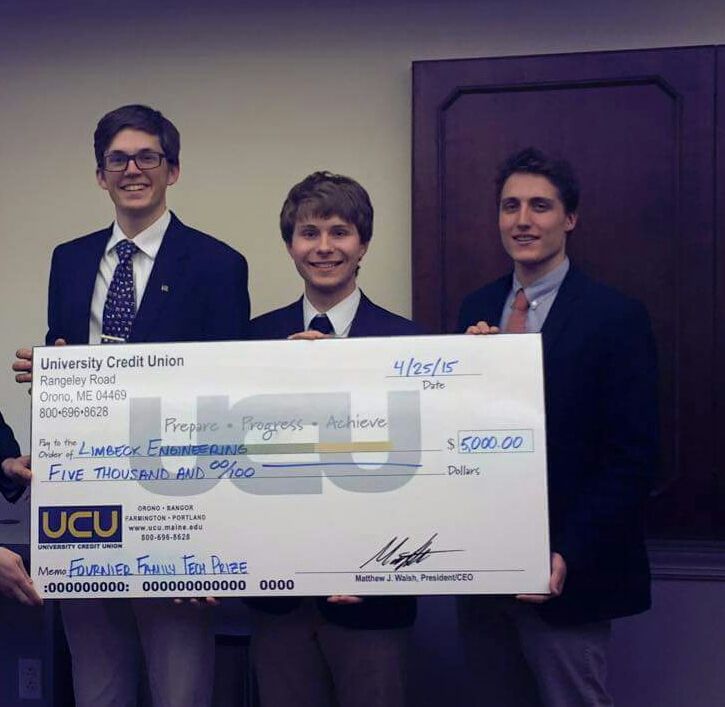 The proprietors of Limbeck Engineering accept a check for winning the University of Maine Business Challenge, April 25 at the University of Maine. From left are Liam Wade, Josef Biberstein and Travis Libsack. Nick Nelsonwood, the other Limbeck Engineering member, was not present. All are from Freeport. Courtesy photo
Comments are no longer available on this story