
Craig John of Freeport, a mountain climber and guide who has ascended the seldom-climbed North Ridge of Mount Everest, spoke this week at the Freeport Community Library as a fundraiser for the Sherpa people of Nepal, who lost their homes during the recent earthquake there.
John talked May 12 about his climb of the world’s highest mountain, and of the Sherpa culture. All donations will initially go to John’s employer, International Mountain Guides, of Ashford, Wash., and then will be distributed directly to the families in need. John spoke to how people can take what he’s learned on the mountain and apply it to everyday lives to become stronger, more competent individuals.
John began climbing in the Cascade Range and Olympic Mountains of Washington State. He has been a professional mountain guide since 1987, when he started working with renowned guide Eric Simonson. He has 198 ascents of Mount Rainier by 14 different routes to his credit and has done more than 50 high-altitude expeditions worldwide. He is a guide for International Mountain Guides and The International Mountain Climbing School in North Conway, N.H. He is a member of the American Mountain Guides Association and the American Alpine Club.
John answered questions regarding his experiences climbing mountains, and about the effects of the disaster in Nepal, for the Tri-Town Weekly.
Q: How familiar are you with the area where this disaster occurred, and of the people there?
A: I have done 12 expeditions to the Himalayas. I first went to Nepal in 1987. Though nine of my expeditions have been to Tibet, we always start them in Nepal, where we store a lot of our gear and pick up our crew of Sherpas. Usually we travel by truck through the Nepalese countryside to the border of Tibet. Each expedition lasts approximately two months so I figure I have spent about two years of my life in the region. I have spent a fair amount of time in the Kathmandu Valley, the Annapurna region and the Ganish Himal. I have never been in the Khumbu region where most of our Sherpa live, but I am hoping to go there this coming fall. One of the areas that was hit hard by the earthquake is Baktapur, where there are (or were) many old temples that were destroyed. This area is just outside Kathmandu and I have been there many times. Our company now runs many more trips in Nepal than in Tibet. We had an expedition on Everest when the earthquake hit, but thankfully everyone survived. Unfortunately, some other expeditions were not so lucky.
Q: Your appearance at the Freeport Community Library must have been part of a larger effort. Can you describe that, and how people can help?
A: The company I work for, International Mountain Guides, has put together a fund to help the Sherpas we work with rebuild their homes that were damaged or destroyed during the earthquake. Any donations we receive will be sent to our Sherpa-owned partner company in Kathmandu, Beylu Adventure Ltd., and the owners of that company will distribute it directly to the families in need. Nobody takes anything off the top and all donations go to where there is a great need.
Q: When did you first venture to Nepal? What can you tell us about their culture?
A: I first went to Nepal in 1987. We went to climb a peak named Annapurna IV. It was my first trip to a mountain range outside of the United States. Nepal has about 26 million people with close to 40 different ethnic groups or tribes. Close to 87 percent of the population is Hindu, about 8 percent is Buddhist and about 4 percent Muslim. That leaves about 1 percent as “other.” Evidence of the two major religions, Hinduism and Buddhism, are evident all through the country as shrines, stupas and temples are everywhere. Nepal depends a lot on income from tourism for both the government and individuals. Trekking and climbing are the main pursuits by tourists. Nepal is known to be a very friendly place to travel. Most Nepalis want you to enjoy your time there and come back as often as possible. The majority of people I have met there value ongoing relationships with the foreigners they meet.
Q: How old were you when you began mountain climbing? Can you trace your interest in mountain climbing from then to this day?
A: I was about 18 when I started climbing. I started by learning how to rock climb. That interest lead to wanting to get into the mountains so I started climbing on smaller peaks in Washington State and gradually worked my way up to the bigger ones. A series of events eventually led me to teaching climbing at Evergreen State College in Olympia, Wash. At Evergreen, I met someone who worked as a guide on Mount Rainier. He encouraged me to apply for a job. I was hired that spring (1987) and went to work for Rainier Mountaineering. While there, I met Eric Simonson, who took me to Nepal and Annapurna IV that fall. He is one of the owners of International Mountain Guides. I continue to work for IMG both internationally and on Mount Rainier in the summer. I work in North Conway, N.H., in the winter teaching ice climbing and leading winter ascents of Mount Washington. I am a full time professional mountain guide.
Q: How soon do you plan to return to Nepal, and what will you be doing once you get there?
A: I hope to be going back to Nepal this fall and lead one of our trips to a peak called Ama Dablam or guide a trek to Everest Base Camp. If I do go I hope to combine the trip with assisting relief efforts where there is still a great need.
Q: What do you know, other than what we see in the media, of the situation there? Do you know anybody who has perished, or families affected?
A: As of this moment all the people I know who live over there or were visiting there are safe. However, many of the Sherpa we work with in Nepal had the homes either severely damaged or destroyed by the earthquake. From what I understand, relief efforts have focused mainly on the Kathmandu Valley where it is logistically easier to get supplies and aid. But so much of Nepal is rural and roadless. It will be some time until the full extent of damage to the country will be known. Aid is just starting to get to some of the more rural villages. The magnitude of devastation has been hard to comprehend. For example, an entire village of 60 homes in the Langtang Valley was wiped out by a massive landslide. I mean to say that the entire village is gone. It doesn’t exist anymore.
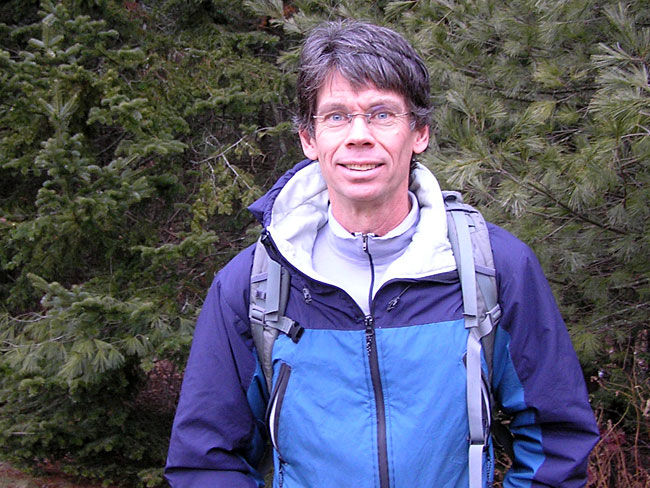 Freeport-based mountain climber Craig John is helping to raise money for the Sherpa people of Nepal. Courtesy photo
Comments are no longer available on this story