
Starting next year at the high school, letter grades will be eliminated and students will not progress until they have demonstrated mastery in subject areas.
A one-year extension to begin a proficiency-based education curriculum at Freeport High School has come and gone. Incoming freshmen next fall must be instructed accordingly, so that they can receive diplomas in 2019 according to the state mandate.
First-year principal Brian Campbell, hired in part because he is well-versed in the new methodology, and teachers at the school are straight out. They’re also working with principals at Freeport Middle School and Durham Community School, so that eighth-graders in those schools will be as ready as can be next autumn.
Since 1997, the state has had the Maine Learning Results as its standards for eight content areas. The Maine Learning Results were updated in 2011 to include Common Core standards for English language arts and math. Maine is one of 44 states to have adopted the Common Core standards initiative.
Maine law requires a student graduating after Jan. 1, 2017, to “demonstrate proficiency in meeting state standards in all content areas of the system of learning results established under section 6209.” For the most part, the manner in which these standards are taught and the method by which proficiency is assessed is a local decision, according to the Maine Department of Education.
Mike Lafortune, Regional School Unit 5 co-superintendent, said that Common Core is based on “realistic standards” of knowledge that should be expected of students. The national standards are for language/arts and mathematics, Lafortune said.
“It’s important knowledge that can be applied,” Lafortune said. “They’re what a student should be able to do by a certain grade.”
Lafortune said that proficiency-based education takes Common Core a step further.
“With proficiency-based knowledge, you have to demonstrate your knowledge now,” he said. “You have to be proficient. Now you have to have evidence of that. You could actually have proficiency-based knowledge without Common Core.”
Proficiency-based education “rests on the belief that all kids should have access to a more challenging curriculum,” said Campbell, who came to Regional School Unit 5 from Searsport District High School, where the program was in place. “It’s a quality-based learning system. It’s about establishing what proficiency is for a particular standard, and then as the students produce work, you judge it based on a scoring criteria, which we’re in the process of developing now. Common Core plays a role. But the two aren’t interchangeable by any means.”
With proficiency-based education, the traditional grading system is gone. No more As, Bs and so forth. Students do not progress through the curriculum until they have demonstrated proficiency in the subject area. Each grade is a descriptive qualification, rather than a letter.
For most teachers, this is breaking new ground, and it’s not easy. Social studies teacher Charlie Mellon and mathematics teacher Maddie Soule are taking lead roles in helping Campbell develop proficiency-based education at Freeport High.
“Even with that extension, it’s very hard,” Mellon said. “It’s complicated. It’s large changes, and unfortunately, it feels like the hardest part about it is having enough time. This takes up all of our professional development time. It’s a hard process to go through. It’s not progressing smoothly, because of the amount of time the state is allotting.”
Campbell said that students will benefit from proficiency-based education, in part, because it crosses subject disciplines. Students will learn something about science in math class, or even in English class.
“That’s what we want,” he said. “We want kids to make connections. Proficiency-based education, I believe, is the vehicle to do that.”
Campbell said that Searsport High School, Searsport Middle School, Hall-Dale High School, Poland High School and Casco Bay High School are among the Maine schools to have the new curriculum in place.
“Those people who pushed for that change felt it was best for kids,” he said. “In a traditional grading system, kids can underperform with a ‘D’ and still graduate. This encourages rigor, and equity.”
Proficiency-based education works equally as well for fast learners, and for students who struggle, Campbell said.
“Learning doesn’t happen necessarily when it’s supposed to,” he said. “Learning is the constant. Time is the variable.”
Another view
The Maine Education Association – a professional organization that advocates for teachers – opposes proficiency-based learning as it is being presented in Maine, mostly on logistical grounds, but also from a philosophical point of view. Lois Kilby-Chesley of Durham, president of the Maine Education Association, who taught for 26 years at Mast Landing School in Freeport, elaborated on the philosophical departure.
“There are inequities for high- and low-level students,” Kilby-Chesley said. “The expectation that all kids are going to meet all standards is not something we can support. It’s the inequities of fitting everybody into the same equation. It goes back into the round-peg-into-the-square-hole sort of thing. There are some students who are not going to reach mastery, and we don’t know what we’ll get. Could they continue to stay in school until they’re 20? Yes, they could.”
The Maine Education Association also has issues with the logistics of proficiency-based education as it is being implemented in the state. The association opposed proficiency-based diplomas until there is adequate time for its development and for public feedback.
“There are none, or too few, resources now,” Kilby-Chesley said. “If we don’t get it done right, it’s going to implode, and we know that. Three of our objections are based on finances and time, but the last one is the way we set up this operation.”
Kilby-Chesley also expressed misgivings with Common Core itself.
“Common Core was not developed by educators,” she said. “It was developed by the National Governors Association, Bill and Melinda Gates and others. There is a perception that it was developed by the corporate world. The Maine Learning Results were developed by educators.”
Meanwhile, Campbell and the teachers at Freeport High are working every day on the new standard. Teachers are meeting in small groups and attending workshops.
“Even though I’ve been doing this for a decade,” Campbell said, “to some teachers it’s new. Everybody’s getting there. It’s gaining strength because people realize it’s good for all kids.”
Soule credited the Department of Education for granting flexibility to school units.
“The state is giving a lot of freedom in how to design this,” she said. “We’re designing without really knowing the outcome.”
Mellon said that teachers also must communicate with parents.
“We’re changing everything from daily scheduling to grading to grading requirements,” he said. “A lot of these changes are very philosophical changes that take time to buy into.”
At the middle schools
Will Pidden, principal at Durham Community School, and Ray Grogan, the Freeport Middle School principal, are working to prepare their students, as well. Campbell said that proficiency-based education will be a grades 6-12 initiative next year.
“We’ll have more uniformed instruction across grade levels,” Campbell said. “Windham will have K-12 in a couple of years. We’re going to roll it out incrementally.”
Grogan further explained the relationship between Common Core and proficiency-based learning.
“Common Core Standards are K-12, so proficiency-based learning is not just a high school thing. Common Core are the standards to determine if the student is proficient or not.”
Grogan said that Freeport Middle School teachers are looking at those standards, and lining up their instruction accordingly.
“We have aligned to the Common Core for a couple of years now, for math and language arts,” he said. “Common Core requires kids to think and to be able to do things, not just regurgitate knowledge. It’s best practice, to make sure everyone is proficient before they move on. We’re meeting both high and struggling learners where they’re at. If a kid needs to take twice as long with a concept, we stick wth them.”
He believes next year’s freshmen at Freeport High will benefit from what they have learned at the middle school.
“The high-end kids will like the challenge,” he said. “The challenged kids will ‘get it.’ It’s much more individualized education.”
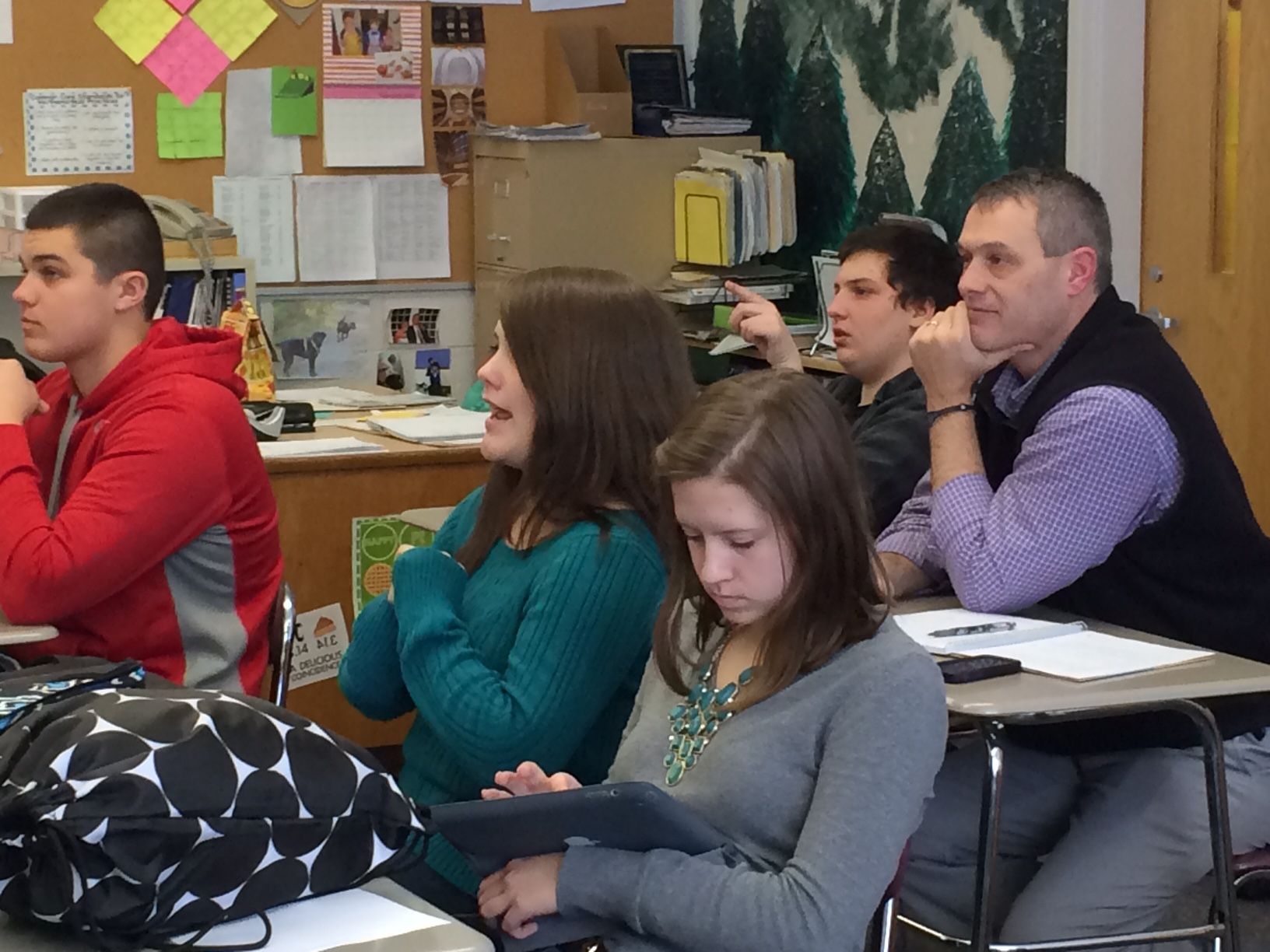 Brian Campbell, principal at Freeport High School, observes a mathematics class. Courtesy photo
Comments are no longer available on this story