
Eight Saint Joseph’s College students, one skipper, two professors and their assistant set sail for Monhegan Island on Wednesday.
The group’s departure from Portland Harbor marks the beginning of the end of the Environmental Science Semester, a new immersion program designed to teach budding scientists inter-disciplinary research and fieldwork skills in the disciplines of climate science, geology, marine ecology and oceanography.
For two weeks, the crew is set to ride the “Begheera,” a 90-year-old, 52-foot schooner from Casco Bay to the mouth of the Kennebec River and Muscongus Bay to the vicinity of Monhegan Island and back. They will camp on islands, cook their own food, and write research papers on laptops.
“It’s not for the sake of going for a sail,” said Johan Erikson, an associate professor of natural sciences who is leading the trip. “There are a number of programs around the country which use time at sea as a way to foster personal growth. This has an element of that but that’s not the prime focus here.”
Erikson and Greg Teegarden, another St. Joe’s professor of natural sciences, will teach the eight sophomore and junior science majors the basic techniques of oceanographic field research, deploying probes to collect water samples at different depth profiles. Alden Colby of the Portland Schooner Co., which owns the “Bagheera,” will captain the boat.
“We can do the kind of measurements that professional oceanographers do,” Erikson said. “We can start to see how the biological, chemical, physical and geological processes all interact with each other, whereas on campus you might read about interaction or you might have a two- or three-hour lab.”
The oceanographic schooner journey is the third component of the immersion semester. In mid-August, the group traveled to Washington County in eastern Maine as well as New Brunswick and Nova Scotia to study climate change and glacial geology. Then, they headed to the central and southern Maine coast – from Damariscotta to Wells – to study how organisms find ecological niches in mudflats, salt marshes, and rocky coastlines. Each student receives four course credits for the semester, one for each component, and another for field research methods. When the schooner returns to Portland Harbor on Oct. 16, the students will return home, having spent nary a day on campus for the entire semester, Erikson said.
Erikson, who has taught at Saint Joseph’s for eight years, participated in an immersion semester for geology at Dartmouth College in the 1980s. When he proposed the idea of an environmental science semester to college administrators, they agreed to invest the substantial resources necessary to establish the program.
Michael Pardales, the college’s vice president and chief learning officer, said the school would likely hold the program every other year.
“This is a bit of a groundbreaking program for us,” Pardales said. “This is the kind of thing we want to support and do. We see this as a part of the future for environmental science and hopefully other majors as well.”
Junior Erin Wright-Little, 20, decided to double-major in environmental science in order to become eligible for the semester. She said she looks forward to the schooner journey.
“It’s going to be definitely interesting,” Wright-Little said. “I’m excited to know what it’s like to say I lived on a boat for a week and stopped on islands to camp. Not a lot of people can say that. I am a little nervous, but definitely more excited.”
In Erikson’s view, Wright-Little and her classmates are fortunate to do field work off the coast of Maine and New Brunswick, given its biological complexity.
“The waters of the Gulf of Maine are a particularly good natural classroom because there’s so much happening,” Erikson said.
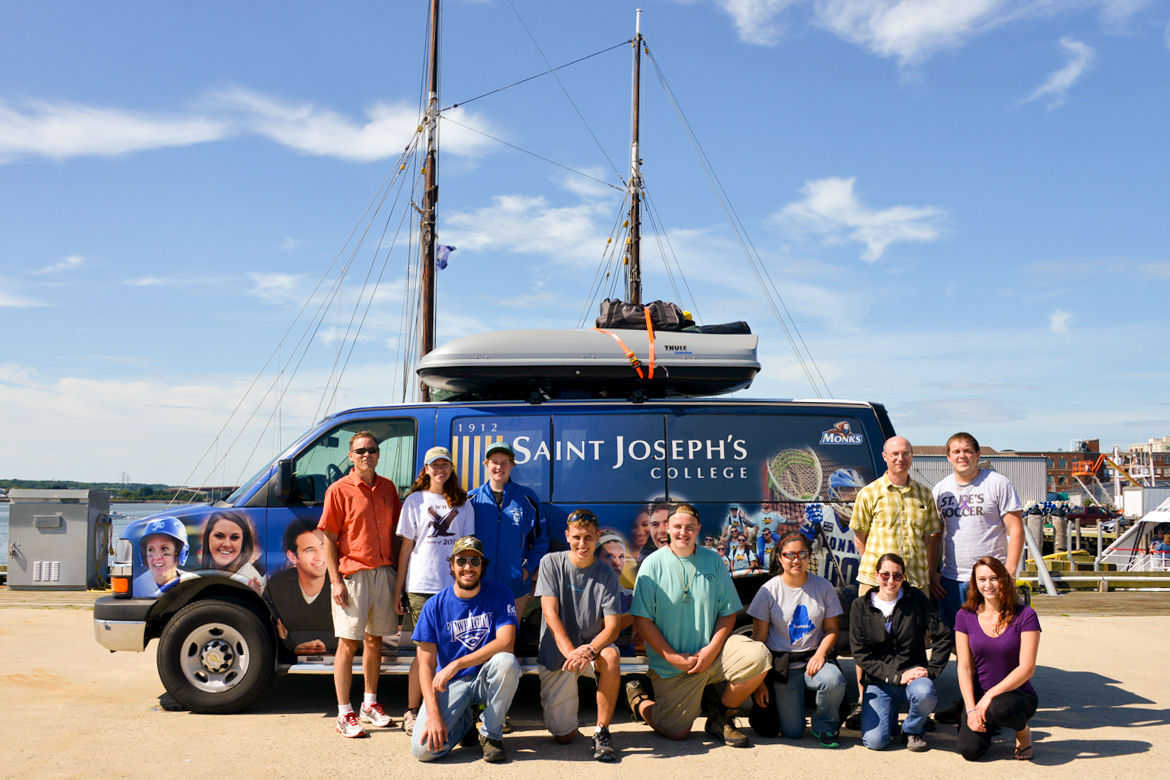 Participants in the Saint Joseph’s College Environmental Science Semester at the Maine State Pier, preparing to do field work.
Comments are no longer available on this story