
BRIDGTON – In 2012, Frederika and Wardner Gilroy, an elderly Bridgton couple, contacted Glen Niemy, a local attorney. They wanted their wills amended.
Frederika Gilroy, a Dutch immigrant who lived under the Nazi occupation of Netherlands, had harbored a lifelong interest in American Indians. When she told Niemy, a native New Yorker of Jewish descent, of her desire to have some of her inheritance passed onto American Indians, his initial instinct was to seek charitable causes outside of Maine.
“I had no idea that there were Wabanakis,” Niemy said, referring to Maine’s American Indian population. “I had asked her before she died, where do you want this to go to? I said, ‘There’s native Americans all over the place.’ And she said she didn’t really care. ‘Figure it out,’ so to speak. I had a conversation with my wife, and she said, ‘You know there’s native Americans here in Maine.’ And I actually didn’t know there were. That’s how ignorant I was.”
By 2013, both Frederika and Wardner Gilroy, an American-born engineer for the Rand Corp. who met his wife during his military service in World War II, had died. Wardner Gilroy had earmarked nearly $800,000 in the “Frederika Gilroy Trust for Native American Education,” and Niemy had been named the trustee. Niemy had quickly proceeded to distribute hundreds of thousands of dollars in education grants to the members of Maine’s four tribes, who are mostly located in the northern parts of the state.
Meanwhile, in Bridgton, he set out to build a Wabanaki cultural hub.
In May, Niemy opened the Maine Native-American Center on Main Street. It is the only museum in southern and western Maine to present the history of the Wabanaki people.
For a director of the center, Niemy hired Sikwani Dana, a student at the University of Maine at Farmington, whose father, Barry Dana, is a former chief of Maine’s Penobscot Nation.
“Glen contacted my dad for some advice on the center, and also buying my dad’s baskets and other things that he makes,” Sikwani Dana said. “I guess when he was meeting with my parents at their house, he just saw a picture of me when I was in fourth grade and said, ‘Hey, who’s that?’ They explained, and he was like, ‘I’d like to hire her.’ ”
Niemy and Dana have set out to tell the unvarnished truth of the Wabanaki, an ancient people who suffered catastrophic population decline – approximately 75 percent – during a three-year period in the early 1600s known as “The Great Dying,” following contact with an unknown disease carried by European settlers and traders.
Museum displays tell the story of Maine’s native population. It also features contemporary Wabanaki art (such as clubs, dream catchers, and paintings), as well as exhibits about the charitable giving enabled by the Frederika Gilroy Trust.
While there are exhibits on the history of the Wabanaki tribe, the museum also contains information on the present-day circumstances of Maine’s American Indians, as well. One exhibit, entitled “Health Alert,” informs visitors that the average life expectancy of the Wabanakis is 25 years less than the state’s general population. There are approximately 8,000 Wabanakis in Maine.
“Remember the last time you read an obituary of a person who died at the age of 62 and thought, ‘How sad, he was so young?’” the exhibit reads. “Well, statistically speaking, if you are a citizen of the United States, your life expectancy is about 78 years. So, it is sad. Statistically, how long do you think a native American in Maine will live? 78 years, maybe 70?”
“The answer is between 52 and 55 years of age,” the exhibit continues. “In fact, only 1 percent of the Maliseet Tribe exceeds 55 years of age. The life expectancy of an entire people living within our country is roughly that of a resident of the Congo. Many Wabanaki are so adversely affected by high rates of diabetes, heart conditions, and cancer that they are old by the time they are in their late 40s. The reasons are complex but all stem from the centuries long dislocation and marginalization of the tribes.”
According to Dana, Niemy drafted the exhibits, and she proofread and edited them. Dana said she is proud of their stark tone.
“I think we’re definitely a lot more blunt,” Dana said. “Before we had opened this place up and we were putting stuff together, Glen and I were discussing, ‘Should we kind of make this a little lighter or should we just give it all to them,’ and we just decided that it really does need to be blunt. We shouldn’t sugarcoat it, because far too many people have already done that. If this stuff is too heavy for someone, they can leave. Because this needs to get out there.”
Dana, who describes herself as generally “mellow,” said that most of her interactions with people in the museum – it is primarily visited by tourists, she said – have been pleasant, with a few exceptions.
There is no entrance fee for the center, which will remain open on weekends after Labor Day. Dana, who commutes more than three hours daily to Bridgton for her job, said she hopes the center can hang on, despite the faltering finances of the Frederika Gilroy Trust, which has dwindled to several hundred thousand dollars, according to Niemy.
“I hope it’s open for a really, really long time,” Dana said.
So far, the center is a money-loser – a fact that shouldn’t change anytime soon, Niemy said. But for Niemy, who refers to himself as a “crazy old leftist” and has represented death row inmates held in California’s San Quentin prison, his work for the trust and the center have taken on great meaning, far beyond any short-term pecuniary interests.
“This became a passion of mine, rather than any sort of job,” he said. “Being Jewish, we share, I feel, at least, a certain amount with the native Americans. The whole genocidal aspect of the whole thing. I just felt a natural affinity toward it. It’s not a 1-to-1 correlation by any means, but we felt a natural affinity toward it.”
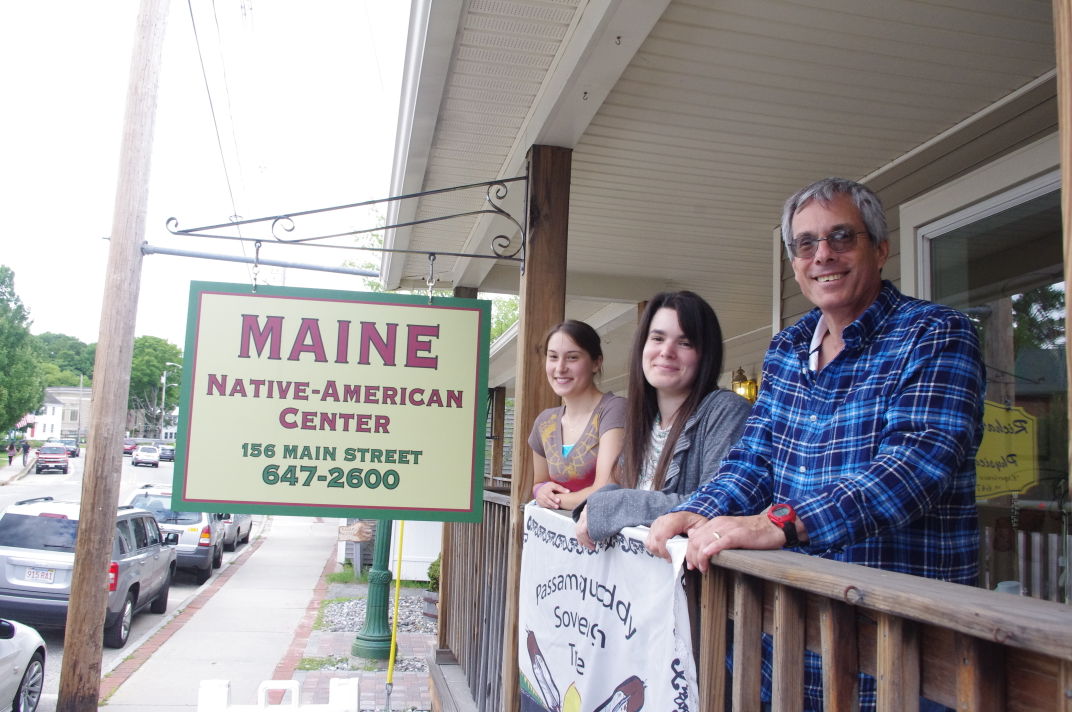 Glen Niemy, his daughter Tess, middle, and Sikwani Dana, left, staff the new Maine Native-American Center in Bridgton, which features exhibits recounting the history and present circumstance of Maine’s American Indians.
Comments are no longer available on this story