
On Sunday, July 20, the Maine Cancer Foundation’s annual Tri for a Cure, a three-event sprint that this year has drawn more than 1,400 registrants – including 200-plus survivors – will once again kick off.
At 7:30 a.m. sharp, the first batch of yellow- and pink-capped racers plunges into the sea at Southern Maine Community College in South Portland for a 1/3-mile swim, followed directly by a 15-mile bike ride and a 3.1-mile run.
The Tri – an all-women’s affair now in its seventh flourishing – has grown by leaps and bounds since Julie Marchese, herself a victor over cancer, established it in 2008. That growth has allowed new women to enter each year, while also providing bib numbers for returners to relive a profound experience.
“For me, it’s another year for survivorship, and another year for celebration,” Marchese says. “We’re resilient, we do survive, we do move on. But the majority of people there are not cancer survivors, and they’re there to maybe celebrate another year of loved ones who have passed. It’s their celebration of remembrance.”
Deb Erickson, 51, of South Portland, is prepping for her fourth go at the course. “Five years ago, I heard about the Tri for a Cure and thought it would be a good challenge for me,” Erickson says. “I had never run and I hadn’t done any real biking or swimming in years…As soon as I finished I knew I wanted to do it again.”
“This event has been life-changing,” Erickson continued. “I’ve had family and friends who had cancer. Some have survived, and some have not. It means a lot to me to be able to raise money for such a good cause and at the same time do something that is healthy and positive for myself.”
Cape Elizabeth resident Brigid Runyon, 51, first entered the Tri after moving to Maine in 2012.
“We lost two very close friends to cancer within 24 hours of each other, right before we moved,” she says. “We were at one of our friend’s bedside when he died. I also lost my dearest friend to ovarian cancer.”
Runyon’s trainer at the Cape Elizabeth Community Center encouraged her to join, even though Runyon had never learned to swim. With the help of her trainer and a SheJams “Swim Angel,” Runyon swam the full 1/3-mile for the first time on the weekend before her first race.
Judy Heggeman, 63, of Standish, joins the Tri for her second year. She feels a deep sense of honor in contending alongside hundreds of cancer survivors. “There is a tremendous feeling of love during the entire three phases of the Tri,” she says. “We all encourage each other whether we are swimming, biking or running. There is strength in numbers…None of us want to see anyone else die.”
Amanda Manson, Heggeman’s youngest daughter, is 38 and also lives in Standish. The two have been working out together and will compete side by side. Manson notes their shared connection to cancer: Her maternal grandmother, Heggeman’s mother, died of the disease before Manson ever came to know her. That deprivation lingers in Manson’s heart.
“It’s such a wonderful feeling to know that I could be helping to find a cure,” Manson says. “It’s thinking about that that gets me through the ocean swim every year.”
Shawna Meserve, Manson’s niece and Heggeman’s granddaughter, is 18 and resides in Standish, too. She was inspired by her grandmother’s involvement last year to join this year. “When I went to cheer her on last year, I couldn’t believe how the atmosphere of a race could be so supportive and loving,” she says. “It’s an event like no other!”
Not everybody involved with the Tri is a participant, of course. Hundreds of volunteers man the start and finish points and line the route to cheer athletes on and, for instance, hand out drinks. Mary Baumer, 52, of Durham, has completed three previous Tris, but this year opted out to give someone else – any other eager woman – her bib.
Baumer is named after her mother’s late friend, who passed away from breast cancer “at the premature age of 28, in 1952. She did not tell anyone, including doctors, that she had breast cancer until it was too late; she didn’t complain, she was too ashamed. Moving forward to 2014, we’ve just come so far. Whenever I take part in the Tri, I think of her.
“I think of my father,” Baumer adds, “who lived 16 full years with cancer…The most emotional part is when all the ladies come forward with their pink caps; they’re survivors.”
However the women fall in love with the Tri, they all have to train to perform their best. Some train with family, others work with personal trainers, and many join SheJams, the all-women’s fitness group that Marchese helped found.
Heggeman says she “was never athletic when I was younger. I started running at age 62 for my first Tri (which I mostly walked). This year I joined SheJams and have attended all their training classes, which have really helped. When I started running I couldn’t even run once around the gym. Now I am able to run more and walk less. If I can do this, anyone can.”
Windham’s Lisa Lekousi is 45 and taking part in the Tri for the first time, despite struggling with a different ailment – Crohn’s disease – for more than two decades. “I’d just come off a flare up in January when I signed up for the lottery,” she says. “I was so excited to be chosen. This is such a great way to show my kids not to be afraid to try new and challenging things, even in the face of adversity.”
Lekousi also joined SheJams, and has trained with the group for three months. “I’m not a biker, swimmer or runner by nature, so to take on all three was a little nerve-wracking, to say the least.”
During the course of those 12 weeks, her physical abilities improved dramatically – and she made new, important friends. “I’ve never felt better and am so glad I accepted this challenge. I’m so impressed with the women I’ve met, and amazed at their dedication to the cause and their wonderful attitudes. We come in all shapes, sizes and ages!”
“I can’t say enough how much SheJams has made this such an awesome experience,” Lekousi says. “I feel so well-prepared, I have signed up for two other tris this summer.”
It’s the hundreds of fresh faces, like Lekousi’s, that keep the Tri for a Cure eternally young, according to Marchese. “There really haven’t been any changes this year,” she says, “as far as course. And we’re expected to raise the same amount of money – we’re hoping for more, and we are on target for that – but from a logistics standpoint, nothing’s changed. But you’ve got 600 new people; that’s what makes it new. Still half the field has never done Tri for a Cure before.”
“[The Tri] is inspiring,” Erickson says. “It’s amazing how many women survivors, including my sister, participate in this event. I feel honored every year as I see that group of women in the pink bathing caps, and I think maybe some of the money I raised has helped them to be there and may help others participate in the future.”
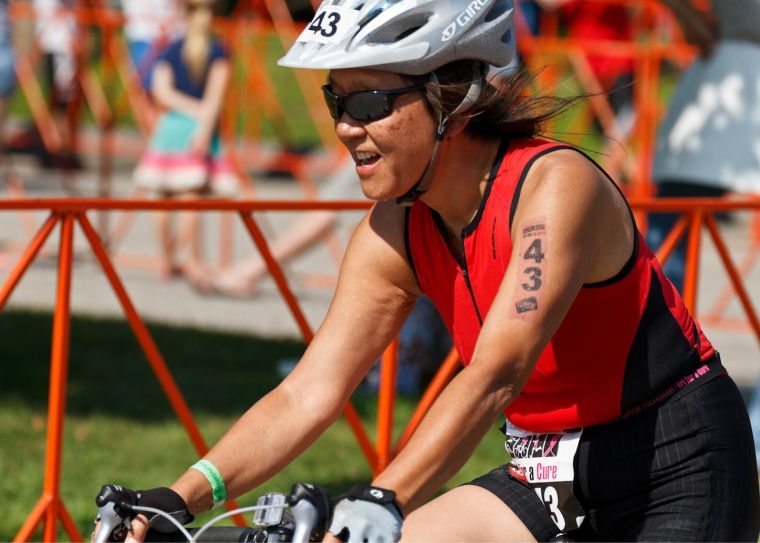 Mari Miya of Pownal jets through the bike leg of the 2013 Tri for a Cure.
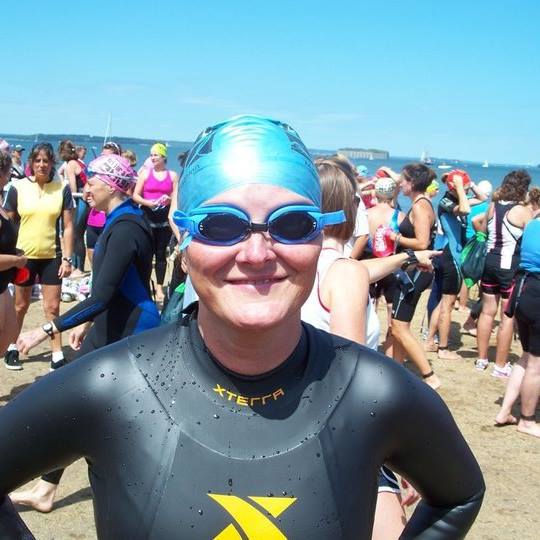 Durham’s Mary Baumer during the swim portion of a previous Tri for the Cure. This year, Mary will volunteer at the race, rather than compete in it, giving up her chance in the entry lottery so someone else can savor the same experience she’s savored three times now.
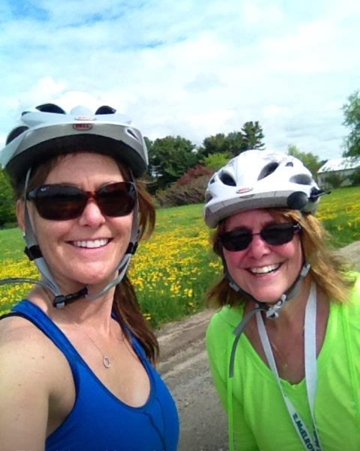 Judy Heggeman and her daughter Katherine bike their way to preparation for this year’s Tri for a Cure.
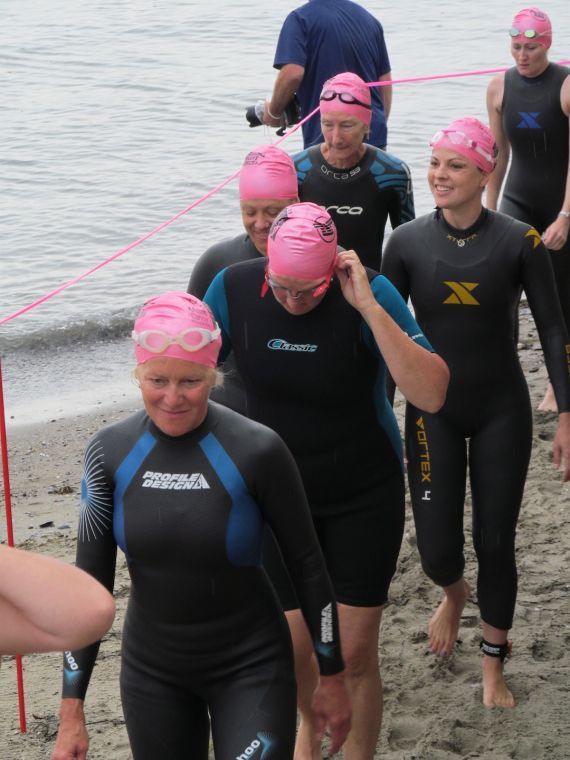 Participants in the Tri for a Cure come out of the water during last year’s event. This year’s triathlon is set for Sunday, starting at 8 a.m., at Southern Maine Community College in South Portland.
 The “Tri for Liz” team consists of Cape Elizabeth resident Brigid Runyon, her daughter Kathleen Runyon, 23, and sister-in-law Janet Goodrich-Spear, 63.
Comments are no longer available on this story