
NEW GLOUCESTER – Overseers of the Sabbathday Lake Shaker Village in New Gloucester are crying foul regarding state regulations that will remove their two signs on the Maine Turnpike within the next five years.
According to Shaker Village director Michael Graham, the small brown-and-white signs, located under the larger Gray-New Gloucester exit 63 signs on I-95, have been up since 1995 at no charge to the religious group. But in response to requests from the Legislature’s transportation committee and the federal government, the Legislature passed a statute on April 16 that generally aligns Maine’s interstate signage statute with Federal Highway Administration standards.
While the new statute overhauls the selection process regarding which groups and destinations qualify for turnpike signs, it dooms the existing Shaker Village signs. And once the Shaker Village “supplemental guide signs,” which are free and advertise destinations, are removed due to noncompliance with the new law, the historic community located on Route 26 would only be eligible to rent “logo signs,” which advertise “services.”
The Maine Turnpike Authority is responsible for signage on 109 miles of the interstate from Kittery to Augusta. Under the turnpike authority’s contract with the company Maine Logos, Shaker Village would need to pay $3,000 annually to rent logo signs on either side of the interstate.
At a June 19 public hearing on a set of proposed logo sign regulations at the turnpike authority’s headquarters in Portland, Graham said the annual cost of the logo signs are prohibitive for the village, which operates on a $280,000 annual budget.
“We have been told that we will lose our brown-and-white turnpike signs and that we will qualify to receive new logo signs that will cost us $3,000 annually,” Graham said. “Quite simply, Shaker Village cannot possibly afford this exceptionally high, annual expense in order to retain our presence along Maine’s most heavily traveled roadway. Over a 10-year period, that sum amounts to $30,000, which Shaker Village needs for historic preservation and the continuation of educational programs.”
Graham then asked the turnpike to figure out ways to reduce the cost of the logo signs.
“I ask today that the Maine Turnpike Authority strives to pursue every strategy to significantly reduce the unreasonably high cost of logo signage, or even better, establish criteria and a process of evaluation for which fees will be waived altogether for publicly valuable organizations, destinations, and attractions,” he said.
But, according to Peter Mills, executive director of the authority, the plan all along has been to reduce sign costs through a renegotiated contract with Maine Logos. The turnpike’s 10-year contract, which expires in January 2016, charges organizations $1,500 annually to rent a set of “logo signs” at a given exit on one side of the highway. Mills said that under the contract, which was negotiated before he became executive director, $1,200 of each annual sign rental goes directly to Maine Logos, and the remaining $300 goes to the turnpike.
“I got here three years ago and I raised questions about the contract right after I got here,” Mills said. “We’re going to talk to them about the costs, about whether we can renegotiate the price, and we’re going to think about bringing the management of these signs in shop. We certainly have the capacity to do that. The turnpike has its own sign shop, for example. We make most of our signs.”
According to the state signage legislation, L.D. 1831, the turnpike authority is mandated to remove non-compliant signs within five years. For now, the Shaker Village signs will stay where they are, he said.
“I’ve told Mr. Graham we don’t intend to take his sign down until we’ve had an opportunity to renegotiate the logo contract and possibly take it over ourselves,” Mills said. “In the meantime he’s not losing his sign. He should not be creating a false sense of crisis about this because the sign isn’t coming down tomorrow.”
Mills characterized the old interstate signage regime as disorderly and “helter skelter.” The new law, he said, will rationalize the system, and ultimately reduce the total number of signs on the turnpike.
“The Legislature’s transportation committee was fed up with having their fellow legislators come down with a bill to require the DOT or the turnpike to put up a sign for some constituent organization,” Mills said. “Sometimes they were built on the expense of the agency, and on occasion the agency was reimbursed, but there was no consistent policy.”
Yet the turnpike may meet further resistance as it moves ahead with the new signage law and regulations. Portland-based Maine Narrow Gauge Railroad is slated to lose “supplemental guide signs” off exit 48 on I-95 and exit 7 on I-295. The railroad is expected to build a new museum in Gray in the coming years. According to Mills, the railroad should not expect to qualify for a free supplemental guide sign at exit 63, although it will likely be eligible for the $1,500 logo signs.
Donnell Carroll, the executive director of the excursion railroad, said he ran into Graham at the Maine Wildlife Park over the weekend. After discussing the new signage rules, Carroll said he is prepared to oppose them, as well.
“I understand the whole federal government issue where everything should be consistent, but it makes no sense to curtail tourism in Maine by imposing a fee on particularly small historic landmark sites that don’t have that kind of money to promote it,” Carroll said. “I told him if they need some political help, I’d be more than happy to work with them. I empathize with their position.”
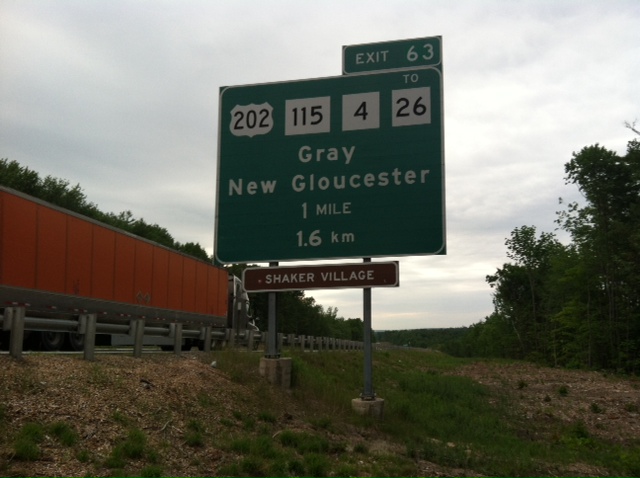 The Sabbathday Lake Shaker Village sign directing Maine Turnpike travelers to the religious group’s historic site on Route 26 in New Gloucester will be removed in the near future due to new regulations governing turnpike signage.
Comments are no longer available on this story