
SCARBOROUGH – For many, the brick archway that can be seen at the edge of the tree line off Route 1 in Scarborough, between the Big 20 Bowling Center and Tim Hortons, is a mystery.
Why is it there? What was it built for? Odder still, anyone curious enough to wander across the field and take a look would discover something even more incongruous tucked in the woods just beyond the archway – a large stone fountain, like the kind people throw pennies into at city parks.
The arch and fountain are all that remain of Den Danske Landsby – in English, “The Danish Village” – one of America’s first motels. In some sources, it’s actually touted as “the first.”
Last week, Scarborough’s ad hoc Historic Preservation Commission named the remnants of The Danish Village to its list of eight “currently endangered” sites in town. The “preliminary list of places of significance in Scarborough,” delivered to the Town Council Feb. 19, also includes 10 “future endangered” sites, 14 historic houses, 10 “unmarked sites,” and four “at-risk” cemeteries.
The list, culled from more than 300 deemed to be of cultural, historic and architectural significance in town, represents Phase I of the ad hoc committee’s charge. Phase II, set to begin with a March 4 committee meeting, will involve editing local ordinances to create incentives for property owners to maintain their landmark locations.
“The idea is to use the carrot, rather than the stick,” said Councilor Jessica Holbrook, who lobbied nearly four years to create the committee. “The direction from council was to try and identify what we have left and try to encourage and promote preservation, but there was no direction to try and enforce that something has to remain.”
“As much as we would like to set a process up that does make it easier for individuals to get on historic registries, we also need to appreciate that it might not be what the homeowner needs, to have that extra level of regulation,” said Holbrook.
The March 4 meeting with Town Planner Dan Bacon is likely to include the option for a bonus development credit, said Holbrook. Similar to the bonus given for construction of affordable housing units, a developer could get more housing lots than normally allowed in return for agreeing to keep and maintain a historic property.
“One other thing we’ve talked about is the idea of similar allowances within the commercial zone, for property that would be challenged to redevelop without some incentives,” said Bacon. “We’ve also talked about variances, and making it so historic homes don’t have to make a trip to the Zoning Board of Appeals for setback issues, when changes are being made that are in line with the historic nature and look of the property.”
“One thing we want to accomplish with all of this is education, so that people actually know they have a home or building or property of historic significance,” said Becky Delaware, president of the Scarborough Historical Society and member of the preservation committee. “Beyond that, how can we tell a property owner what they can or can’t do with their own property? We do need to honor personal property rights.”
History of preservation
Although Holbrook asked three years running to make historic preservation an annual Town Council goal, the preservation committee was not created until April 2013, and only after destruction of the historic “Widow’s Walk” home on Pine Point Road, which created a sizable public outcry.
Even so, the committee did not hold its first meeting until July and struggled at first with membership turnover. The first goal, to create an inventory of all historic sites in town, was made less Herculean when Delaware joined the committee early last fall. As president of the historical society, she knew an inventory of more than 1,200 properties was completed in 1993, thanks to a grant from Greater Portland Landmarks.
“That’s 10 volumes of 4-inch-thick binders with I can’t even fathom how many pages in each one,” said Holbrook. “Unfortunately, what was considered significant or important then is gone.”
Although Scarborough was the sixth incorporated municipality in Maine, it was largely rural farmland well into the 20th century. When it took off beginning in the 1970s as a prime development spot with subdivisions sprouting up seemingly everywhere, Scarborough gained a reputation as the fastest growing community in Maine and much of its history was lost as old buildings came down for new homes and businesses.
According to Delaware, about 15 percent of the buildings on the 1993 survey considered to be historically significant have been lost in the past two decades. Of them, just 308 remain, said Holbrook, from which the committee narrowed down the hot list released last week.
Meanwhile, the losses mount. One endangered site was the Benjamin Farm at 302 Pleasant Hill Farm. The Scarborough Land Trust recently optioned the property and the home itself is not considered to be architecturally significant. However, a barn on the site was thought to be unusual. It was on the committee’s first draft, but Holbrook and Delaware say it collapsed during the six months the committee took to work though the old survey information.
“Initially, it was a matter of just finding out what was left in town,” said Holbrook on Friday. “Everything up until now has just been the research phase, which took hours and hours of work.”
Once a list of recommended ordinance changes are complete, Holbrook says Phase III of the committee work will include digitizing its records, to avoid a repeat of the 1993 survey.
“We want to keep the committee’s work alive where anyone can access it easily and not have it sitting on a shelf where eventually only a few people remember that something was done,” said Holbrook.
One option to make sure data doesn’t get lost, she said, would be to “flag” properties in the town’s online accessing database with historic information.
A final phase item also could be a recommendation that, when all else fails, the town dip into its $2.3 million land bond fund to buy and maintain certain properties. Although bond money approved by voters on three separate occasions in recent years is largely thought to be for purchase of open space, the bond language does allow the money to be used to buy and maintain buildings, much as the town keeps up the oldest home in town, the Hunnewell House, built in 1684.
At Scarborough’s 300th anniversary celebration in 1958, the home, then in use as a chicken coop, was purchased by local service groups and donated to the town. It was moved across Black Point Road and is maintained today by public works crews and the community garden club. However, Delaware says rot was recently discovered in its foundation timbers.
“The possibility exists to have money for a purchase and maintenance if there is something we consider to be really, really important,” said Holbrook.
The preliminary list
According to Holbrook, the “endangered” sites are in peril not just because of physical condition, but in many cases simply because they are for sale. A prime example is the seasonal Dunstan School Restaurant, at 591 U.S. Route 1.
“That’s in great condition, but could sell at any time and, because of its location, it could get torn down and who knows what might go up?” said Delaware.
Other members of the five-person committee are former Town Councilor Carol Rancourt and Donald Leeman, along with Craig Frederick, who serves as chairman.
One site in poor condition is the Danish Village. Now a 5-acre wooded lot but for the fountain and archway, the property is under contract by the Boulos Co., which did not return requests for comment Tuesday.
“The fear is that the buyer could be someone who does not value the historic nature of the property and just wants it because of the amount of land, or the location,” said Delaware.
Built in 1928 by hotelier Henry Rines, the man responsible for Portland’s Eastland Hotel, the Danish Village served as a way station for well-to-do motorists and families traveling Route 1, then known as the Boston Road. However, while the Eastland was renowned for its Danish Tea Room, the village went a step further, featuring 100 cottages designed by Boston architect Peter Holdensen, with no two exactly alike. Modeled after the medieval Danish village of Ribe, the cottages were clustered around a three-story Raadhus, or “Town Hall,” which housed offices and a restaurant for the popular tourist camp. The brick archway marked the start of the sidewalk at the village entrance, while the fountain stood in the center of a crushed-stone courtyard.
“Throughout the 1930s, business flourished,” wrote Frank Hodgdon, for a historical society feature. “At our Willowdale Road home, in the shadow of the Town Hall spire, I remember the familiar sounds of dishes being washed, trash being dumped, and the help on the kitchen steps conversing as they had a quick smoke.
“All of the employees were outfitted with period costumes. Even the groundskeeper, [who] wore a brass-buttoned and gold-braided cutaway coat and broad-brimmed black felt hat, giving him the role of ‘burgomeister’ or mayor,” wrote Hodgdon. “As a 5-year-old in 1936, I recall seeing him alight from his Model T in this regalia as he reported for work.”
The village was taken over by the federal government during World War II as workforce housing, with each cabin split into three and four apartments. In 1947, fire swept through the Town Hall restaurant, destroying the towering spire. The building was then converted to a gift shop, but the complex never returned to its prewar luster. In 1967, the village was purchased by The Milestone Foundation, an organization for recovering alcoholics. However, within a year, another fire claimed 22 of the cottage units and, by 1970, the remaining units followed.
The remaining most-endangered properties include seven different homes and business properties.
The Dr. Bacon/Dr. Roy house at 626 U.S. Route 1, was actually home to seven different doctors, including Dr. Rice, who began construction in 1798, Dr. Bacon, who bought and completed the home in 1800 and Dr. Roy, who moved the building back from Route 1 when there were plans to widen it to five lanes. It is said to be haunted by a “tall, old man dressed in fashionable 1800s clothing.” The home was a hotel called The Be-Witch Inn during the 1950s and 1960s.
The building at 678 U.S. Route 1 was erected as a one-room schoolhouse in 1860, which closed in 1923. It later became a meeting hall for the AMVETs, who added an addition on the side facing Old Blue Point Road. More recently, it has hosted a series of businesses, including a hair salon.
“That’s not an ideal location for a business, so anyone who bought that corner for retail would probably tear down the building and put up something more to their liking,” said Delaware.
The Mulberry Milliken home at 720 U.S. Route 1 was built as a tavern in 1815 with corners aligned to the points of the compass. The wooden house that preceded it was a stagecoach stop where President John Adams stayed when he was a young attorney. However, despite this, it’s actually the barn on the property, now reeling under a sway back, that is most significant of an architectural and historical nature, said Delaware.
Little is known about the Beech Ridge School at 190 Holmes Road, other than that it was built in the 1880s.
Meanwhile, one of the most documented homes is the Southgate House at 577 U.S. Route 1. Built in 1805 by Dr. Robert Southgate, who came to town in 1771 with nothing but the contents of his saddlebags and later married the sister of Maine’s first governor. Originally known as Dunstan Abbey, the home boasted eight fireplaces and a 25-by-40-foot ballroom. For a time it was a restaurant, and it is split into apartments.
A 3-foot wide boulder on the site is said to be a meteorite that fell in a local sheep pasture at some point in the 1930s.
Finally, the building at 79 County Road, whose owner, Ralph Temm, died early last year, is thought to date to the 1700s. It is also for sale, leading to concern that it could be replaced by something else, given its location at the hub of North Scarborough.
A CLOSER LOOK
The 10 “future endangered” sites, “are probably OK until they change ownership,” said Delaware.
Scarborough’s ad hoc Historic Preservation Committee will meet at
6:30 p.m. on Tuesday, March 4, at Town Hall, where it will begin work on ordinance language designed to help aid the maintenance of landmark properties in town.
The history of Den Danske Landsby (The Danish Village), one of America’s first motels, built in 1928, will be covered in a presentation at 7:30 p.m. on Wednesday, April 2, at the Scarborough Historical Society, 649 U.S. Route 1. What remains of the 100-cottage village – a courtyard fountain and a brick archway – have been placed on the “currently endangered” list of sites by the Historical Preservation Committee.
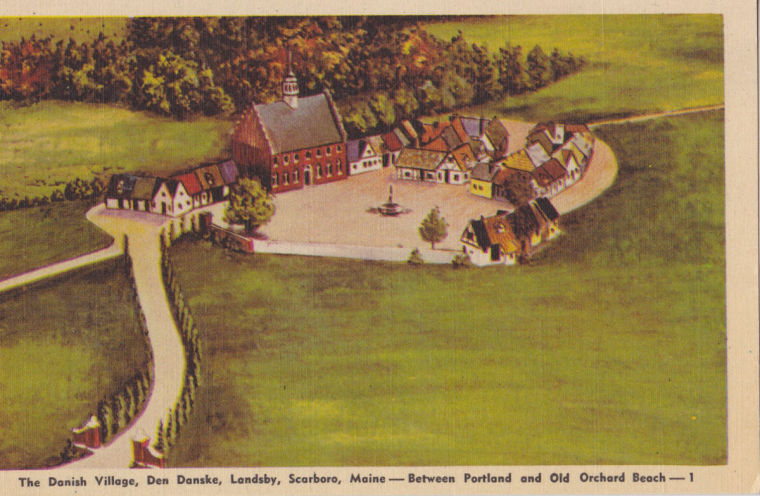 This undated photo shows Den Danske Landsby, or The Danish Village, off Route 1 in Scarborough, at the height of its popularity in the 1930s when it was one of America’s first motels.
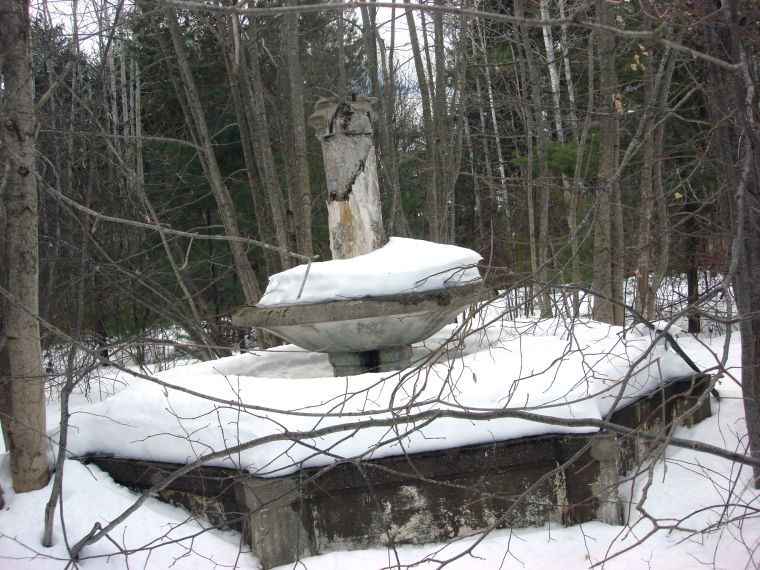 Hidden in the woods, the fountain once in the center of The Danish Village courtyard, along with a brick sidewalk arch at the site entrance, are all that remain of the complex today. The site has been named one of the town’s eight “currently endangered” places by the ad hoc Historical Preservation Committee. The property is under contract and committee members fear this last historic vestige of the site could be bulldozed.
 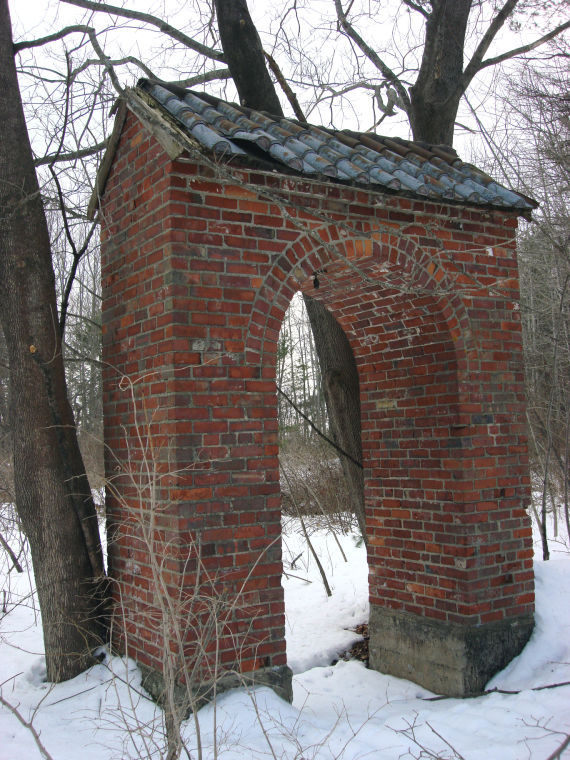 This brick archway is barely visible at the edge of the tree line off Route 1 in Scarborough, between the Big 20 Bowling Center and Tim Hortons. As one time, it marked the beginning of the sidewalk at the entrance to Den Danske Landsby, or The Danish Village, one of America’s first motels, built in 1928.
 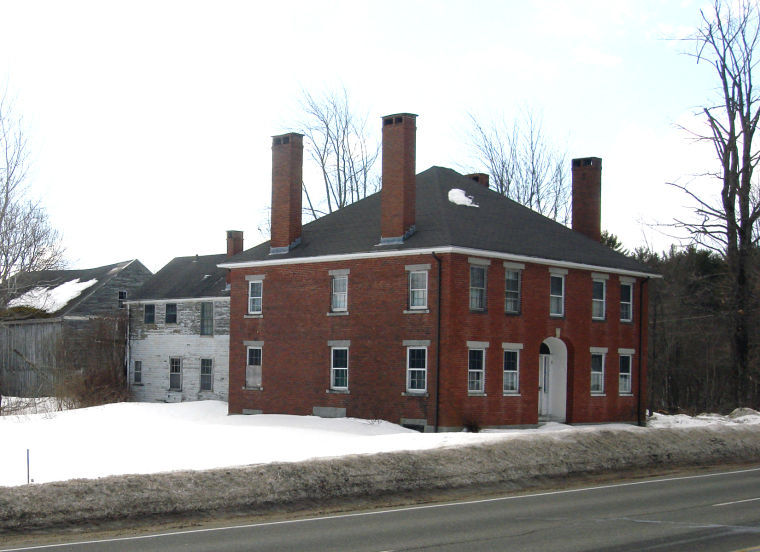 The Mulberry Milliken home, 720 U.S. Route 1.
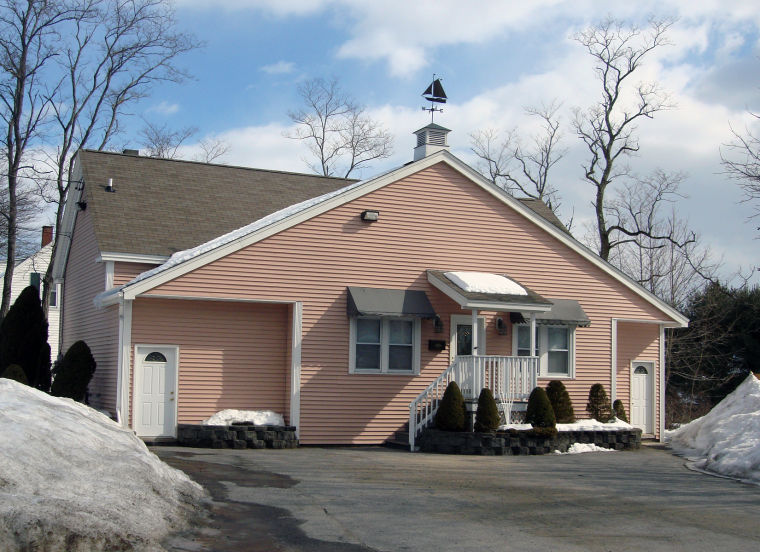 Old Dunstan School/AMVETS building, 678 U.S. Route 1.
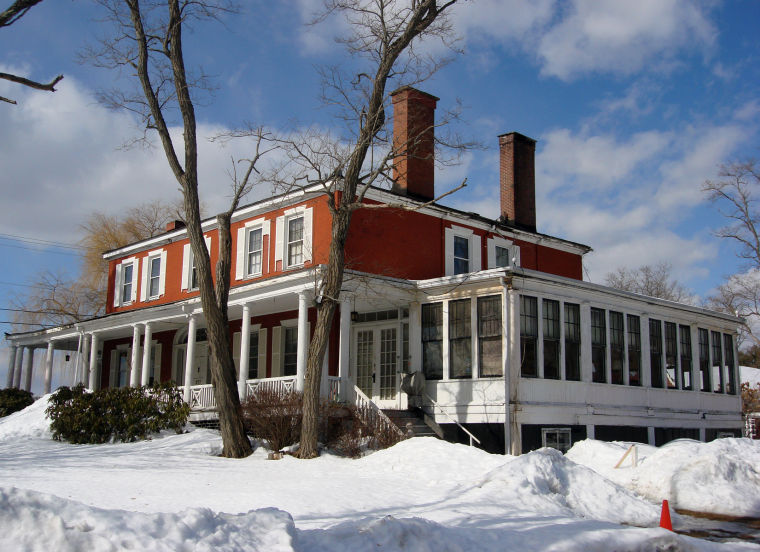 Southgate House, 577 U.S. Route 1.
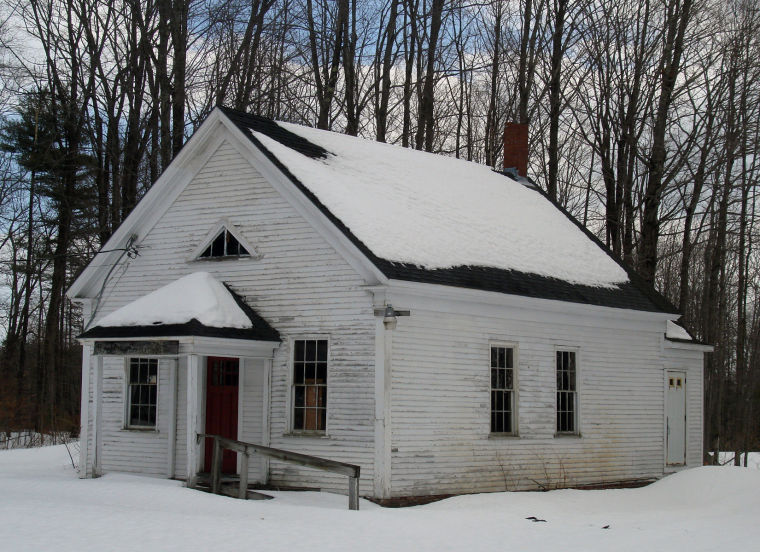 The Beech Ridge School, c. 1880s, 190 Holmes Road.
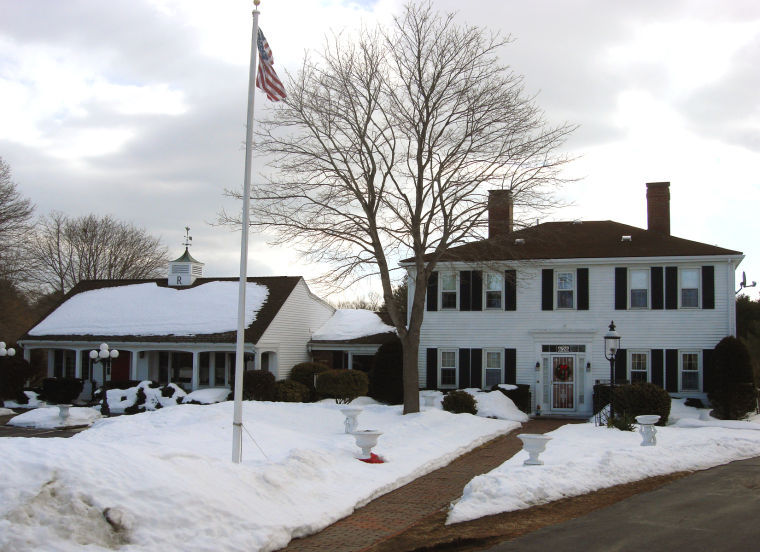 The Dr. Bacon/Roy House, 626 U.S. Route 1.
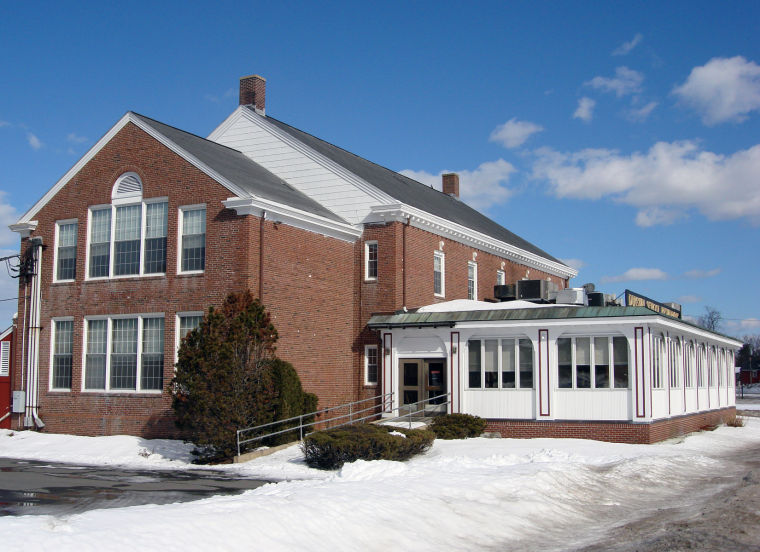 Dunstan School Restaurant, 591 U.S. Route 1.
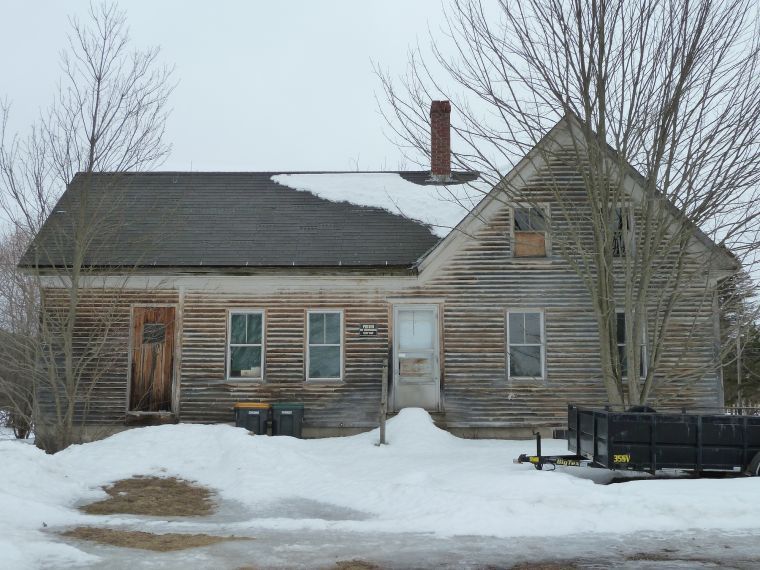 Ralph Temm place, 79 County Road
Comments are no longer available on this story