
SCARBOROUGH – Young people have been the topic of conversation lately around the Scarborough Fire Department. It’s easy to see why, given the 25th anniversary this year of its live-in student partnership with Southern Maine Community College’s fire science program, and the recent launch of a new Explorer program aimed at introducing teens to the fire service.
But the lessons now being taught to young and potential firefighters were often hard-won lessons for veteran firefighters. Scarborough has two men on its roster Bruce Bell and Clayton Skillin who have logged 55 years of active, continuous service. As such, they’ve seen the full evolution, from the days of the gung-ho smoke eater to modern, professional standards.
Bell, 72, joined up in 1957, just three months after his 16th birthday. He’s retired now from a 39-year career in public works, the last 29 as operations manager in Portland, where he launched the city’s recycling program and supervised the crew that built the stadium at Hadlock Field. But he’s still a firefighter, a captain at the Dunstan Corner station, where he serves as safety officer.
Recently, Bell took time to share how the fire service has changed during the past half-century in Scarborough, what lessons he’s learned along the way, and why, because of a night he’ll never forget, he continues to serve.
Q: What made you want to be a firefighter?
A: When I was 14 years old, they had a bad woods fire off the Ross Road down to Pine Point. On the second day the fire really took off. It “crowned” in the trees, went over the railroad tracks and went toward the ocean, right behind what was Snow’s canning factory. The whole marsh, as far as you could see, was all ignited. So, they asked for volunteers. They drove up with a rescue vehicle it was like a bread truck van and asked who wanted to help. A bunch of us just climbed in the back of it and they took us down where we fought fire just like I’m dressed now, in jeans and a T-shirt. I went down and went to work without even asking my mother.
Q: Did it surprise you to be taken out to fight a woods fire without any training?
A: Well, let’s just say, it’s not the way things would be done today. But it did get my interest up and I joined as soon as I was able. You had to be 16 at the time. Eventually, we smartened up, but it was that way all over at the time. I also worked for the masons’ union as a tender when I was 16. You can’t do that today. The 16- to 18-year-olds just can’t do the things now that I did when I was 16. Back then, the day you joined and became a probie [probational member] was the day you started fighting fires. If you showed up for a call and there was room on the truck, you were going and you worked the fire. Most of the training back then was on the job.
Q: Looking back, how do you feel about that?
A: I can understand young people being frustrated. For some of them, they go through all this training and yet they’re still not allowed to do what they really want to do. That was one of the things that kept my interest up, I was allowed to fight fire. But really, no kid should be allowed to do what I did at that age. There were things that we were doing then where it was only a matter of time before something was going to happen.
Q: With so many young people and so little training compared to today, were there ever any accidents?
A: Nothing that was dramatically serious, at least not with the kids. We did have a death in 1980, when two fire trucks came together at an intersection. That incident is one of the reasons that I have stayed as long as I have, because I made a commitment to myself that I was going to do everything I could to see that we operated more safely.
Q: How did the trucks collide?
A: It was an intersection that was semi-blind. An engine that actually had the right of way came in and the ladder truck drove in front of it. When they hit it rolled the ladder truck over and, back then, the guys rode on the outside of the truck. It rolled over two of them and one died.
Q: And that was a life-changing moment for you?
A: It’s the reason I’m still here at 72, because of that one night way back when that I’ll never forget. I was captain on this company and had to identify the firefighter that was killed. His name was Bill Quinton. He was 21. I wasn’t on the truck, but that’s no excuse. I missed something that was so obvious. Camaraderie was great, everybody was working hard, there were a lot of people in the department. The companies ran good, but that accident didn’t need to happen. It just didn’t need to happen, period.
Q: How have things changed to prevent accidents like that?
A: It’s just a whole different attitude. With today’s standards I’m not saying something like that will never happen again but everything we do now, because of the SOPs [Standard Operating Procedures], rules and regulations, and guidelines were written, and everything we do for training, certification and recertification, it’s all geared to making people understand that getting it to the fire isn’t the most important thing you can do. Ultimately, it isn’t about the fire at all, it’s about getting the truck back into the station safely so those guys and gals can all go home. That’s the bottom line, and that’s why I stay involved, because of the safety side of it. I don’t want to see anyone ever go to a firefighter’s funeral ever again.
Q: In what other ways has the fire department changed? Certainly, the equipment must be much different.
A: Well, there’s more of it. When I joined the fire department, there were six pieces of turnout gear on a truck, which then included a helmet, a long rubber coat, and what I call clamdigger’s boots. If you didn’t get there in time to get one, you went without. For me, I did without anyway. Nothing fit me. The biggest pair of boots was a size 10, I was 13. The biggest jacket they had was a 46, I was a 52. The helmet forget it. Nothing would fit. I fought fire just the way you see me today, in jeans and a T-shirt, for many, many, many years.
Q: You mentioned riding on the outside of the fire engine. That must have been an experience.
A: On the trucks, there was room for only two in the cab. Everybody else rode behind somewhere, usually on what we called the beaver tail a long extension platform on the end. There was a bar across the back of the truck and the older guys would stand on the tail, holding onto the bar with both hands, with one of the younger kids corralled in front of them to make sure they were safe as we drove over these roads that were, well, let’s just say nothing like they are now. More than once we hit a bump and my feet came off where I had to pull myself back on by the bar. If I’d lost my grip I would have fallen right off. The sad part is we used to brag about it more than be scared about it. What goes on now compared to back then, it’s day and night.
Q: In what other ways has firefighting changed so dramatically?
A: Radio communication then was one mic in the truck on the dash. Everything else was all about who could holler the loudest. And it was the late-’60s or early-’70s before we got into SCBA [Self-Contained Breathing Apparatus], but even then we only carried two on a truck. Consequently, if those two guys went into a building and got into a situation, you didn’t have any backup to go in and get them. If you look at our trucks now, every position except the driver was a seat, with an SCBA built right into it. And then, of course, the fires themselves are different.
Q: How do you mean?
A: Well, we do go to a lot more calls now than we ever used to, but the actual number of structure fires has gone way down. We just don’t fight anywhere near as many house fires as we did years ago. We used to have a lot of structure fires that started from chimney fires, because there were no rules or codes people just put things together wherever and however they wanted. We also used to get a lot of spontaneous combustion fires in barns because of how hay was stored. And we used to get real infernos from the combination of propane heaters and fast moving chickens kicking up shavings. Scarborough doesn’t have a lot of barns or chicken farms anymore. And people are a lot more conscious they do a lot more to protect themselves, with fire alarms, or monitored systems, and sprinklers. But there are new construction methods that scare the heck out of us, whether it be roof trusses that are held together with metal plates pressed into the wood, or just plain glued together. The collapse possibility scares us more than it ever used to. And then there are all the modern materials used in homes today that can dramatically change the atmosphere inside of a building during a fire. You can gain a higher heat level a lot quicker in these environments and there’s so much more smoke from the hazardous materials, with a lot of it that creates gaseous clouds. I used to be able to survive inside of a burning building without an SCBA on, but today, if I took two steps into a structure fire, my respiratory system would probably shut down.
Q: What was the closest call you ever had as a firefighter?
A: When the old Scarborough Downs clubhouse burned in the late ’80s, I had crews on the roof doing ventilation. We didn’t have any idea what was going on below us but it developed to the point where we couldn’t see each other, so I said, it’s time to get out. I was the last one down the ladder and when I got down three-quarters of the way it blew out the front door, which the truck happened to be backed up against. The fire made a column and came right up through where I was. So, my way of coming down the ladder was not anything I’d want other people to do, but I put hands and feet to the outside of the rails and slid right down to the bottom. I no more than got on the ground when the roof caved in.
Q: You’ve touched on how attitudes about teenaged firefighters have changed. What was it like when women began to join the department?
A: That was a change I think we needed, because it calmed some of the language and behavior down. It was a boys club in the sense that it was very physical. And each company and its senior guy, he was the king. He controlled everything and he had his subjects below him who were all in agreement with him. And then there were the probies. They got every [crap] job you could think of and if there wasn’t one, they’d create one. You always had that understanding that you were at one level and you had to pay your dues before you got to the next level. And moving up a level was not about skill or aptitude. It was about personal stuff. I’m not saying none of that happens now, but it doesn’t anywhere near to the degree it used to. So, I think, when you look at that changing, when you go back and see the department becoming more professional, you also are looking at the same timeframe as the incorporation of females. A lot of people got into trouble along the way because they wanted to maintain the same old-fashioned dynasties. That’s all changed now, and I think it’s changed for the good. And, of course, the females have to pass the same tests the men do, whether it’s lugging a 160-pound rescue dummy, dragging the hose or climbing the ladder. All of those things they have to do the same as the men do. So, it’s equal.
Q: In what other ways has the culture of the fire department changed over time?
A: Well, it’s different in a lot of ways because, back then, each company had 30-some-odd badge members, and as many reserve members. To become an actual member of the company, you basically had to wait for someone to move out of town, to quit, or die. With so many people involved, I think there was more excitement, more social aspects at the time. The firemen did a lot of things socially and had a lot of events throughout the year that incorporated all of the families. And in many families you had grandfather, father and son all on one company.
Q: It sounds like it was a very large community within the town.
A: It also was a huge voting block in the town. Think of it six companies with six engines, each with 35 badge members, plus reserve members and all the families. You can do the math, and that’s not even counting the rescue crews, just the fire engines. If the fire department didn’t like something in town, it didn’t happen. And, even after we went to the council form of government, they all knew they needed our votes to get on the council and to stay there. But the fire department doesn’t have the influence it used to.
Q: What changed?
A: A lot of the social aspect went away mostly because the participation numbers have gone way down. Now, if we have active in a company, say, 10 people, we’re lucky. That’s not to say there isn’t still a great deal of camaraderie, but it’s all much more business-like now. People still get together, but around the station it’s more about doing the job you’re supposed to be doing than being part of a social club. The dynasties and cliques are gone and it’s a professional department now very, very much so.
Q: Why do you think fewer people volunteer for the fire department these days?
A: That’s a difficult question. A lot of the change is in the attitude of people. Many think, I pay my taxes and that takes care of that for me. That’s not just a problem for the fire department. The Town Council is always looking for people to be on various committees. But people just have a different attitude today about volunteering and committing themselves to the betterment of the whole. They’d much rather work their job then go home and do their thing, and come the weekend they want to do other things mountain climbing or skiing or whatever. And then, as I see it, schools offer so much today. The amount of extra-curricular activities is huge, whether it’s athletics or dramatics and other stuff, and that all takes interest away from the fire department as something that is attractive to the young people. That’s been a big change because the young people used to be our life-blood.
Q: With more calls and fewer volunteers, what is the future of the Scarborough Fire Department?
A: I think it’s going to go to a full-time fire department. A lot of people think that’s what we have now, but that’s because they don’t drive by the station at 2 in the morning and see it dark. They drive by at 2 in the afternoon and see people here. But they are not all, in fact very few of them are, full-time town employees with benefits. Most of them are per diem or call members who have other full-time jobs. As it is, there have been times when there’s been a call and the truck has not moved. And that’s happening more frequently. That bothers every one of us, but especially, I think, amongst those of us who have hung on and are still in the department. There’s a lot of pride. We are very proud of our department, and we don’t want to see it go down the tubes. So, we need more volunteers people who are willing to step up to the plate, to take the training that’s required and then be able to go on runs. The Chief has written and written and written articles saying we can use people, but people don’t read, I guess.
Q: What do you think will happen if the call company system fades away for lack of volunteers?
A: When we do have to go to full-time firefighters, if you think the school department is expensive well, let’s just say people are going to be really upset. But, people don’t see it coming. So many of them think we have a full-time fire department now, and we don’t. We’re trying to put it off as long as we can. I mean, I pay taxes in this town just like everyone else.
Q: What do you think of the Explorer program, and the SMCC live-in program?
A: Starting with the Explorer program, there’s a real career opportunity for young people, with natural transitions and evolutions. These people who are manning fire stations across the state full time, that’s where they are coming from. And, by the time they get into a program like at SMCC, where they live in the fire stations and go with the truck on every call, these guys, and the gals, too, they’re as good at firefighting as I ever was.
Q: As you look back on your firefighting career, what is your proudest accomplishment?
A: I guess just that I’ve lasted this long. There’ve been a lot of things that have given me a lot of pleasure to have been involved in, in the fire department, but I think my proudest accomplishment is just being around, among the men and woman who answer the call. The fire department is a community. It’s people who have willingly stepped up and offered something, not because they expect anything from it, but because it makes you feel good to be there when somebody is in need.
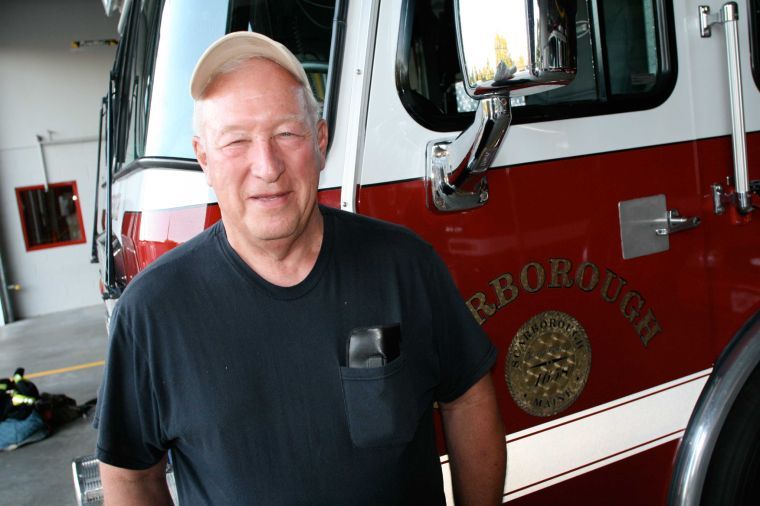 Bruce Bell, Scarborough firefighter since 1957.
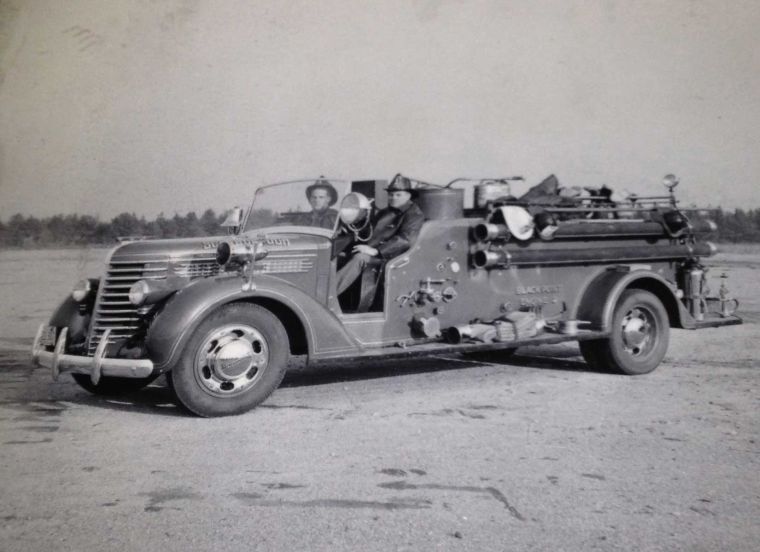 This fire engine, photographed in 1954 at Scarborough Downs, is typical of what served the town in the middle of the last century, when Bruce Bell started his career.
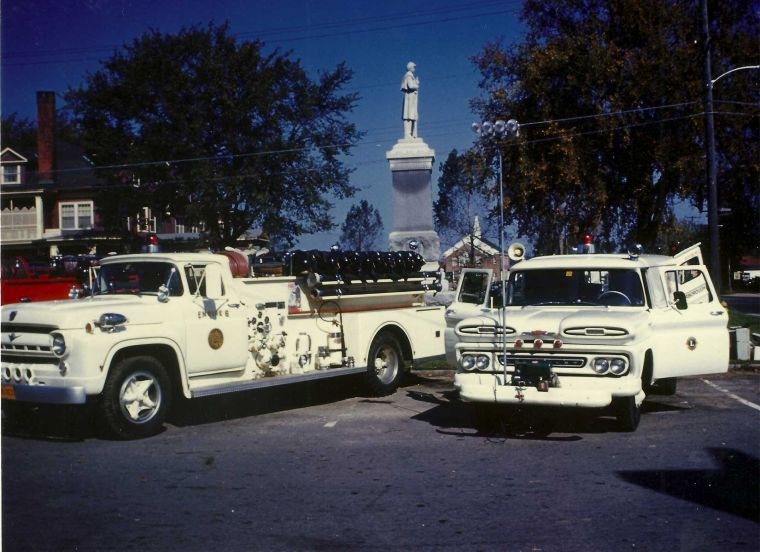 Scarborough’s Engine 6 and Rescue 1, parked at Dunstan Corner in 1968, an era when the rage was for white fire trucks and ambulances.
Comments are no longer available on this story