
GORHAM – Two Gorham officials, Clerk of the Planning Board Barbara Skinner and School Superintendent Ted Sharp, witnessed events in Washington, D.C., that unfolded 50 years ago following the Nov. 22, 1963, assassination of President John F. Kennedy. They recently shared their memories with the American Journal.
After lunch with a friend 50 years ago to the day next Friday, Barbara Skinner was returning to her job in the Executive Office Building in Washington, D.C.
The uniformed guard at the door revealed the shocking news: “They’ve just shot the president,” Skinner said this week, recalling the guard’s words. “He had tears running down his face.”
President John F. Kennedy was fatally shot on Friday, Nov. 22, 1963, in Dallas.
Skinner, a political appointee who had once met Kennedy, was an administrative assistant for the director of the Office of Emergency Planning, which was housed in the Executive Office Building, a historic structure near the White House.
“In our building it was complete chaos,” Skinner said, adding that she didn’t learn that Kennedy had died from his wounds until an hour later.
Skinner, daughter of a career diplomat, was among a number of people in the Washington building who had crowded into the director’s office to watch TV coverage. She recalled seeing TV commentator Walter Cronkite “crying,” and then she knew – Kennedy was dead.
Skinner said a fear gripped the city, as people worried about what might happen next.
Within a short time after the president was shot, Skinner said, uniformed troops carrying machine guns were on the ground in Washington. “They were Army,” Skinner said.
On that dire day, Ted Sharp, a college junior, was walking on campus at Gettysburg College in Pennsylvania when he heard a college staffer with a walkie-talkie say, “Oh my God, that’s awful.”
Sharp and his roommate, whose mother had been in charge of Kennedy’s election campaign in Pennsylvania, traveled to Washington for the funeral. Sharp stood in line with thousands for nearly five hours waiting to enter the Capitol’s rotunda, where Kennedy’s body was taken to lie in state. The casket was guarded, Sharp recalled.
“Absolute silence,” said Sharp describing the atmosphere in the rotunda. “There was a reverence, a profound sadness.”
Three days after Kennedy was shot, the funeral was held at St. Matthew’s Cathedral. Because of Sharp’s well-connected roommate, they attended the service inside the cathedral. Mourners were “stunned,” Sharp said.
“He was just taken, no time to prepare yourself to grieve,” Sharp said.
News accounts reveal the impact of the assassination on people.
“City, Neighbors Are Shocked, Grieved” – the headline in the Westbrook American read on Nov. 27, 1963. On the Monday (Nov. 25, 1963) of Kennedy’s funeral, Westbrook’s Main Street was deserted as businesses and schools were closed beginning at 11 a.m., the Westbrook American reported.
Church services were held in Westbrook, Gorham and around the region.
“In honor of President Kennedy, people flocked to church services on Sunday,” a Westbrook American article said.
In Washington, D.C., both Sharp and Skinner stood among what she called “hundreds of thousands” of mourners to see the funeral procession pass by, with Kennedy’s casket transported on a horse-drawn caisson.
Skinner recalls that armed guards were posted on rooftops.
Sharp stood on a bridge as the funeral procession passed, and he said people wept.
“The only thing you heard on the bridge was clip-clop of the horses,” Sharp recalled, “and the shutters of cameras.”
Skinner commented about the reverence.
“You could hear a pin drop,” Skinner said. “His funeral procession was dreadful.”
The casket, Sharp said, was followed by the Kennedy family, and then a contingent of world leaders. Sharp recalled seeing Charles de Gaulle, president of France.
She endured the chill with no thought of leaving.
“You paid respects to the man,” Skinner said.
On one occasion before Kennedy became president, Skinner was with her date at the movies and passed Kennedy and his wife, who were leaving. She attended his inauguration and recalls that it had snowed. She stood outside for nearly five hours with a hot chocolate and wrapped in a blanket. Later, she met the president.
Skinner, who had a top-secret clearance and a NATO clearance, gathered and locked up top-secret material each day in a safe, which was in her office, a makeshift one in a hallway with marble floors. There, in the Executive Office Building, Skinner briefly met President Kennedy at what she called a meet and greet.
She recalled Kennedy’s smile.
“He had a charismatic personality,” Skinner said.
From the office building where she worked, Skinner could view the young Kennedy children – John F. Kennedy Jr., popularly known as John-John, and his sister, Caroline – in a playground outside the White House. She also could see Caroline’s pony.
Sharp recalled that the pony was named Macaroni.
“John-John could barely walk when I saw him,” Skinner recalled.
President Kennedy was buried at Arlington National Cemetery and, according to the cemetery’s website, Kennedy’s wife lit the torch at the grave.
Sharp, who attended the burial, recalled that Kennedy’s famous words – “Ask not what your country can do for you, ask what you can do for your country” – have been inspirational for him as an educator.
“He was full of hope,” Sharp said. “It was a challenge to us.”
The Kennedy era inspired Skinner, who in effect had worked for the president.
“I was there,” she said, “I was on the fringes, but I was there.”
She said her office building was known as the old, gray grandmother. “Everyone was enthused with what they were doing,” she said. “It was a time in my life I’ll never forget. I felt alive.”
But the nation, its people and the world changed 50 years ago.
“It’s not the same,” Skinner said.
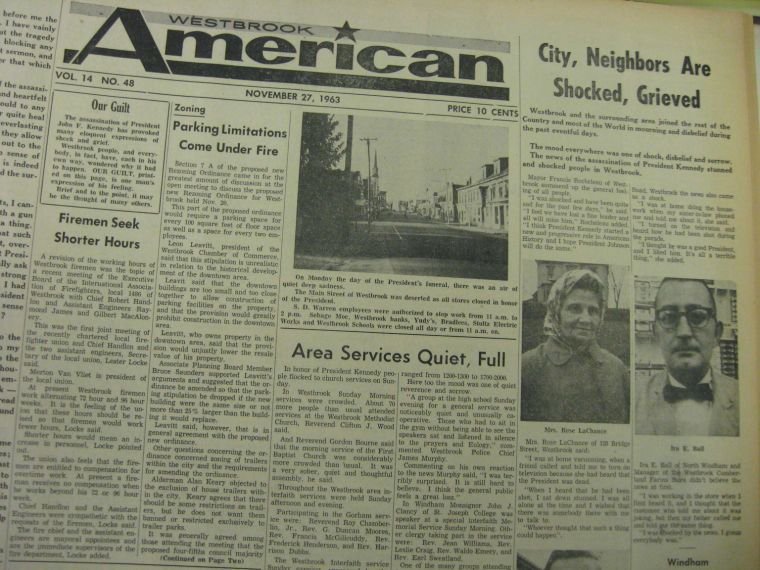 A Westbrook American front page photo shows a deserted Main Street in Westbrook on the day of President John F. Kennedy’s funeral. The headline reads, “City, Neighbors Are Shocked, Grieved.”
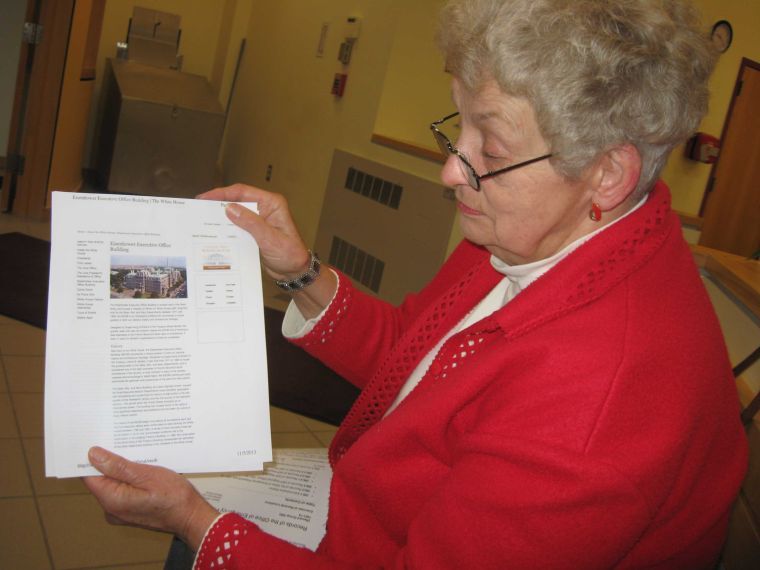 Barbara Skinner of Gorham displays a depiction of the Executive Office Building where she worked near the White House 50 years ago when President John F. Kennedy was assassinated in Dallas. Skinner had met Kennedy.
Comments are no longer available on this story