
Take growing commuter traffic that exists year-round, throw in summertime tourists, and it’s imperative that the Maine Turnpike Authority (MTA) build a new access route to Route 1 somewhere between Saco and Scarborough, at least according to a new study commissioned by the two towns.
At its meeting on Nov. 6, the Scarborough Town Council unanimously approved a preliminary, interchange justification report, which asks the MTA to conduct an official interchange study. That action followed unanimous approval by the Saco Town Council on Nov. 4.
“This is something we’ve been working toward for a year,” said Scarborough Town Council Chairman Ron Ahlquist. “With the volume of traffic in that area, certainly, this needs to be addressed.”
“A project like this is going to take many years, so why not get started,” he said.
The goal of the two councils is for the MTA to eventually build a new interchange either near Flag Pond Road in Saco or just north of the Saco city line in Scarborough.
The justifications for the new interchange include increased regional mobility, alternative routes for emergency vehicles and extending the life of back roads in both communities, the report states.
The report adds, “Both Saco and Scarborough support the project because it will: enhance public safety; encourage regional traffic to use I-95 while enhancing local mobility and access, and preserving capacity along Route 1; enhance the pedestrian and (bicycle) environment along U.S. Route 1; avoid future costs and physical limitations of future Route 1 corridor improvements; support local and regional economic viability and growth; comply with the vision and strategies identified in the Saco and Scarborough comprehensive plans; and allow for strategic investments in the community and region.”
A traffic forecast completed for the communities by Kevin Hooper Associates, which is based in Falmouth, said that by 2035 the daily traffic volume for the proposed new interchange, at least during the summer months, would be 17,000 vehicles.
This is comparable to the traffic forecast for the existing Exit 42 interchange, which connects Payne Road and Haigis Parkway in Scarborough to the turnpike. The forecast for this interchange, in 2035, is 17,300 vehicles a day in the summer.
“With the level of traffic (forecast),” the interchange justification report states, “there is sufficient demand to warrant further study (by the Maine Turnpike Authority).”
In addition, according to the report, such an interchange would reduce congestion along Route 1 in both communities by between 5 and 10 percent.
Rick Michaud, the city administrator in Saco, said even with the strong support of Saco and Scarborough for the new interchange, the turnpike authority would likely take up to two years to conduct its own, more in-depth analysis of the need.
Tom Hall, Scarborough’s town manager, said the turnpike authority is well aware of the push by the two communities for a new interchange, and he expected the justification report to be “fairly well received,” especially with the potential ridership and toll revenues the report shows it would generate.
“The next council will have the decision as early as next spring as to whether we want to go to the next step,” he said, referring to the next round of lobbying for the project.
He said one of the reasons Scarborough supports a more formal interchange study, along with the eventual construction of new access to the turnpike, is that the town “needs a long-term strategy to reduce traffic on Route 1, as well as the back roads that have now become commuter routes.”
He said even with the Route 1 intersection improvements that Scarborough has made during the past several years, including at Dunstan Corner and Oak Hill, “there are only so many vehicles that can go through.”
Hall called the Saco and Scarborough approach to getting a new turnpike interchange “a good example of communities working together on regional issues.”
The interchange justification report states the goal of the project “is to explore alternatives to achieve an enhanced transportation system with a more balanced distribution of traffic, resulting in a greater ability to maximize potential development along the Route 1 corridor.”
The report states that the new interchange would also improve public safety, especially since there are three, high-crash intersections on the Route 1 corridor between the two communities.
The interchange would also improve safety along Route 112 in Saco and from the I-195 overpass to Industrial Park Road. Such turnpike access would also reduce delay for residents in neighborhoods in Saco that are west of North Street and the Route 1 corridor, and it would improve the transportation connections within Saco, Scarborough and other communities, such as Buxton and Hollis.
According to the report, a new interchange would also encourage tourism through “convenient access to key regional destinations for visitors, including Old Orchard Beach, other nearby beaches, Funtown Splashtown USA and other such destinations.”
Finally, the interchange could provide “improved highway access to northeast Saco and the southern reaches of Scarborough, which are ripe for additional commercial, mixed use and residential development,” the justification report states.
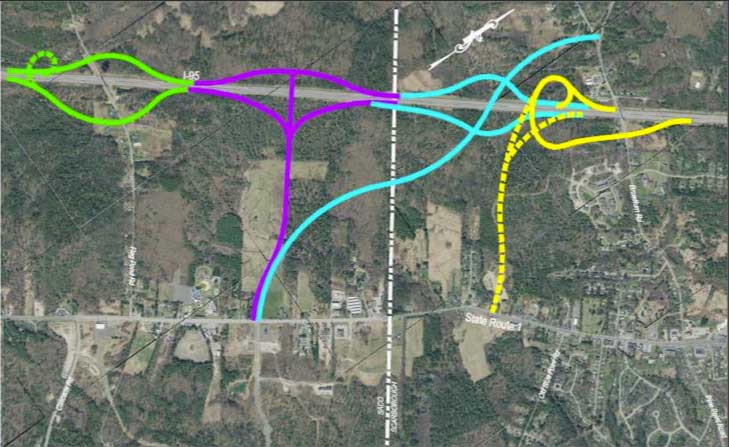 This image shows the possible layouts of a new interchange that would link Route 1 in Saco to the Maine Turnpike.
Comments are no longer available on this story