
SOUTH PORTLAND – People who have been fighting against the Waterfront Protection Ordinance, on the Nov. 5 ballot in South Portland, fearing it could cripple the city’s petroleum industry, may lose by winning.
During a workshop session Monday, the City Council agreed to hold another workshop on Nov. 6 – should the zoning proposal be rejected by voters – for the purposes of debating a moratorium on waterfront development.
“It would be a moratorium on development in the waterfront district, the same one impacted by the Waterfront Protection Ordinance, that whole area,” said Councilor Linda Cohen, who called for the Nov. 6 meeting.
If adopted, the Waterfront Protection Ordinance would ban the enlargement, expansion or construction of petroleum storage or distribution facilities anywhere in South Portland’s shoreland area, or in the city’s shipyard and commercial districts. According to Willard Beach neighborhood resident Natalie West, who drafted the ordinance, land-use limitations were deemed the best way of blocking diluted bitumen, better known as “tar sands,” because new equipment would be required to reverse the flow of the 236-mile-long, Portland-to-Montreal pipeline, which now pumps crude oil from Maine to Canada for refining.
In June, grassroots activist group Protect South Portland gathered 3,779 signatures in support of its zoning proposal – nearly four times the number needed to force the measure onto Tuesday’s ballot. In September, the group followed that up by unveiling a list of 216 small businesses that pledged to support the new rule.
Chief among their concerns is the potential for two 70-foot smokestacks needed to burn off the chemicals, including benzene, added to tar sands to make the goopy substance thin enough to flow through a pipeline. Larry Wilson, president of Portland Pipe Line Corp., has said his company has no proposal on the table to import tar sands, and last week surrendered an air-quality permit left over from 2009, when it did have such a deal in the works.
On the side of industry, many fear that the attempt to leave no loophole in the ordinance for petroleum companies to exploit has actually drawn a noose around all waterfront businesses. Although the Protect South Portland crowd claims the ordinance, as written, allows all current uses to continue, others fear city officials, now or in the future, could read the ordinance strictly enough that not even maintenance or safety upgrades would be allowed at the 29 properties in South Portland dedicated to oil operations.
While Protect South Portland activists have decried the spending by “Big Oil” during the campaign, big local names have also come out against the WPO, most recently former Gov. John Baldacci and the Maine State Chamber of Commerce.
On Monday, Thomas Dobbins, gubernatorial appointee to the Board of Harbor Commissioners, said the ordinance could even handicap recreational activities in Casco Bay.
“The WPO would impact marinas and boatyards that handle fuel as the proposed ordinance states there ‘shall be no expansion of facilities for the storage and handling of petroleum,’” he said. “One facility recently asked the commission to defer their permit application for the expansion and upgrade of their dock lines until after the November vote. This expansion would upgrade their operation and improve the environmental safety of the entire operation. It is hard to understand how any ordinance that precludes this type of upgrade could be perceived as ‘Protecting the Waterfront.’”
Last month, with the WPO looming, Sprague Energy canceled a $4 million upgrade of its existing line, because the ordinance, if adopted, would be retroactive to May. Protect South Portland co-founder Rob Sellin called that move a stunt designed to needlessly fan fears and stoke voter anger, but that hasn’t stopped some from worrying about their jobs.
“I’ve been coming to work in South Portland every day for 41 years. I’d like to continue doing that,” said Pipe Line employee Tom Hardison, on Oct. 26, as he held a “NO WPO” sign at the Highland Avenue transfer station and waved to residents who drove by and gave thumbs up, or a quick honk of support on their car horns.
“It’s a highly charged and passionate issue on both sides,” said Hardison’s co-worker Randy Hughes.
Lost amid all that passion regarding the dangers of tar sands – whether from additional chemicals in the air, or the potential for a toxic spill – is the ordinance itself. Despite dueling demonstrations, vandalized campaign signs, and talk about town of how the debate has pit “neighbor against neighbor,” downtown resident Anjoli Matthews says what everybody is fighting over remains vague to many voters.
On Saturday, she and her son Matthews Germana, 3, were feeding the birds in Mill Creek Park while members of the environmental group 350 Maine staged a rally across the pond. Hung from the park gazebo was a large banner emblazoned with the words, “TAR SANDS KILLS.”
“It’s very vague what they are talking about when they say ‘tar sands,’” said Matthews. “Obviously, when you hear the word ‘tar’ it sounds scary, like an environmental issue. But I don’t know, realistically, if this thing is written up in a way to really clarify what the environmental issues are as opposed to the impact to the economy.
“That’s where my concerns are, trying to figure out where the balance is, environmentally and economically,” she said.
If the council agrees to proceed with a moratorium, it would need to pass first and second readings at subsequent regular council meetings, at which all seven councilors must be present. State law would allow the temporary ban on development to last six months, with a potential renewal period possible, if, according to City Manager Jim Gailey, “we make substantial progress.”
That progress, according to Councilor Gerard Jalbert, would be on a new version of the WPO, one designed to allay the fears of its opponents that the current version restricts too much, while still blocking the flow of diluted bitumen, or tar sands, through South Portland.
“One thing you can’t help but notice is that everyone on the City Council and everyone on the Planning Board who voted against the WPO because it goes too far, all of them have said they don’t want tar sands,” said Jalbert, in a Tuesday interview.
Indeed, Planning Board member Rob Schreiber said as much during an Oct. 21 Working Waterfront Coalition rally in Mill Creek Park.
“As a pro-union, tree huggin’, Obamacare lovin’ liberal Democrat, I can tell you that voting no does not mean that you are in favor of tar sands,” said Schreiber, introducing himself to the United Steelworkers Union. “This is an emotionally charged issue. Let’s put that aside and look at the facts. There is no imminent threat of tar sands. We have time to vote no and write an ordinance just as we did to protect Sawyer Marsh and Willard Square.”
According to Cohen, her moratorium proposal will buy the city time to do just that.
“I want a cooling-off period,” she said. “I think the public is expecting us to protect them from whatever might be coming down the road. I think this is a good way to stop things and see if we can’t craft something that works for most.”
“Our take on the moratorium idea is that it’s a temporary measure, and who knows what could come out of it,” said Sellin. “It’s great that everyone is finally getting on board, but they’ve let themselves get confused to this point with intentional misrepresentations and bogus economic reports. We have the solution already in hand and it’s the only initiative that will absolutely keep tar sands out of South Portland.”
 Members of the environmental group 350 Maine and other proponents of the Waterfront Protection Ordinance on the Nov. 5 ballot in South Portland, rally in Mill Creek Park Oct. 26.
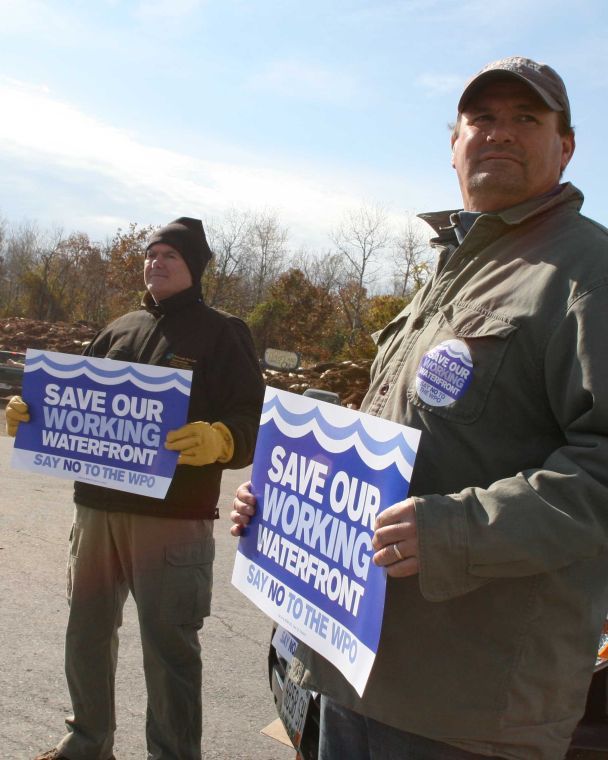 Tom Hardison, left, and Randy Hughes, both longtime employees of Portland Pipe Line Corp., try to rally South Portland voters against the proposed Waterfront Protection Ordinance during an Oct. 26 vigil at the transfer station on Highland Avenue. Both men, natives of the city but now living in Scarborough, feel their jobs are at risk if the effort to block tar sands trips up other forms of development at their company.
 South Portland resident Anjoli Matthews and her son Matthews Germana, 3, feed the birds at Mill Creek Park on Saturday Oct. 26 while supporters of the Waterfront Protection Ordinance, on the ballot Nov. 5, gather across the pond for a demonstration. Matthews, an undecided voter, said that, despite rhetoric brandished by both sides, it still is not clear to her what precisely is at stake.
Comments are no longer available on this story