
SOUTH PORTLAND – At dueling press conferences this week, groups who have made it their business to influence public opinion on a comprehensive zoning change aimed at binding “big oil” in South Portland took a new tack, arguing its impact on small businesses in the area.
How the local economy might be affected depends entirely on how one interprets the proposed Waterfront Protection Ordinance (WPO), but the debate has also blossomed into a battle over competing visions for South Portland, and whether it’s worth sacrificing some jobs today for the presumption of a greener tomorrow.
On Sept. 18, grassroots activist group Protect South Portland, which in June gathered 3,779 signatures in support of its zoning proposal – nearly four times the number needed to force the measure onto the Nov. 5 ballot – held an event at JP Thornton’s Bar & Grille on Broadway. At that rally, City Councilor Patti Smith accepted a list of 216 small businesses that pledged to support the new rules, which are designed to block diluted bitumen, more popularly known as “tar sands” oil, from being piped into the city from Canada for worldwide distribution.
“We believe that everyone in South Portland has the right to drink clean water, breathe clean [air], and enjoy our special places like Willard Beach, Bug Light and Casco Bay,” read a letter signed by the business owners, including many of the city’s most popular restaurants. The presence of a plant built to process tar sands would chase away customers and depress property values, they claimed.
“South Portland’s future is a clean, healthy community with a diverse economy,” said JP Thornton’s owner Tom Howard. “There is no place for tar sands in our city.”
According to South Portland tax assessor Elizabeth Sawyer, the companies that signed up to support the zoning change represent nearly 10 percent of the businesses in the city, but less than 1 percent of the taxable value for business equipment. That’s proof, said Protect South Portland spokesman Barry Zuckerman, of the “David versus Goliath” nature of the fight.
The flipside came on Monday when the Maine Energy Marketers Association sponsored a gathering of petroleum industry employees at the Sprague Energy terminal on the Fore River. Combined, the 29 properties dedicated in South Portland to oil operations have an assessed value of $84.6 million and pay $9.4 million in state and local taxes. Moreover, they’re spending $7 million per year on capital improvements while pumping $37.6 million into local cash registers – enough to support 250 non-industry jobs – according to economist Charles Lawton, of Portland-based Planning Decisions.
Hired by Maine Energy Marketers to assess what might happen if all of that went away, Lawton produced an 11-page report, at a cost of $15,000, which predicts a statewide loss of 5,600 jobs representing $252 million in salaries and wages and $30 million in lost tax revenue through a 10-year period.
If adopted, the Waterfront Protection Ordinance would ban the enlargement, expansion or construction of petroleum storage or distribution facilities anywhere in South Portland’s shoreland area, or in the city’s shipyard and commercial districts. According to Willard neighborhood resident Natalie West, who drafted the ordinance, land-use limitations were deemed the best way of blocking tar sands, because new equipment would be required to reverse the flow of the 236-mile-long, Portland-to-Montreal pipeline, which now pumps crude from Maine to Canada for refining.
Chief among the concerns of local environmental activists is the potential for two 70-foot smoke stacks needed to burn off the chemicals added to diluted bitumen to make the substance thin enough to flow through a pipeline. Larry Wilson, president of Portland Pipe Line Corp., has said his company has no proposal on the table to import tar sands, but that it would entertain any offers. Local approval granted for such a project in 2009 has since expired. However, an Aug. 28, 2012, letter from the Maine Department of Environmental Protection intimates that a pipeline reversal project is still alive in some form.
In the letter, Lynn Cornfield of the Bureau of Air Quality advises Portland Pipe Line’s Engineering Manager Kenneth Brown that the company’s air emission license was renewed for an additional 18 months. It now expires on Feb. 24, 2014.
Potential build-outs notwithstanding, industry officials say the Waterfront Protection Ordinance, as written, would also prevent them from maintaining and upgrading existing equipment, or from installing new facilities needed to comply with environmental regulations or to process greener fuels as yet unforeseen. That, they say, would be the “death knell” of the petroleum industry in South Portland, as it would leave them unable to adapt to changing times.
“This ordinance is not about tar sands, it’s about the elimination of these businesses here behind me,” said Maine Energy Marketers President Jamie Py during Monday’s event, as he gestured to the waterfront. “The proponents of the WPO have relied on misleading voters with emotion and fear in order to generate support for what we feel is a misguided ordinance.”
Lawton’s study is predicated on the assumption that the industry – which includes seven companies with 85 workers and a combined $8.9 million annual payroll – might actually shut down.
“That’s not going to happen,” said Protect South Portland co-founder Rob Sellin. “For 71 years they’ve been unloading oil tankers, and that will continue to be an accepted use. It’s only loading tankers that will not be permitted. We have no problem with them improving a pier or making other enhancements to their existing business.”
“For them to say that they are totally frustrated just by the prospect of this ordinance is really disingenuous,” said Sellin. “It’s designed just to create fear and confuse voters who frequently vote no on something.”
Still, the specter of ordinance restrictions on new equipment, which would be retroactive to May if adopted, has already had an impact. On Monday, Burt Russell, vice president of operations at Sprague Energy, announced that his company has canceled a $1.5 million, four-year project, now half complete, to install new pipelines from the dock to its terminal.
“With the risk of this WPO looming in the wings, there’s too much risk for us to continue that,” he said. “Any work we did now, if the WPO passed in November, it would preclude that.
“This ordinance is a threat to our business, our jobs and our way of life. Everyone claims it’s all about tar sands. It’s not. It’s in pursuit of a reckless oil agenda that impacts everybody. I challenge anyone to read the ordinance and find the words ‘tar sands.’ You will not. What you will find is the word ‘petroleum.’ ”
Eric Johnson, who owns Portland-based Phoenix Welding, said Monday that about 35 percent of his family business is based on the South Portland waterfront, for which he spends “$100,000 plus” annually on materials at both American Steel and Maine Oxy, two local companies.
Just the latest phase of the Sprague dock line upgrade would have occupied 12 of Johnson’s 60 workers for up to three months, he said.
“There’s an awful lot of work here,” he said. “If we don’t find something to replace that fast, it could jeopardize their jobs. Nobody wants to get laid off.”
However, Mayor Tom Blake said Russell and other industry executives “are deliberately misinterpreting the ordinance in order to scare businesses into supporting them.”
“The ordinance does indeed restrict growth and development within 250 feet of the shore, but it clearly says the petroleum industry can continue to do what they are doing now,” he said. “There’s no question about it. If any company wants to upgrade, modify, tweak, fix, or meet state, federal or local standards, they can do that. That’s clearly allowed in the ordinance. But upgrading is not the same thing as growing and expanding.”
Blake was not at last week’s Protect South Portland event, having placed the highest bid on a Casco Bay cruise at the historical society’s annual fundraising auction. He spent the day instead on the bay and along the river, reviewing the South Portland waterfront.
“That really gave me an interesting perspective of our waterfront,” he said. “I’ve walked it, I’ve biked it, I’ve kayaked it, but to do it in a boat at my leisure, it was pretty interesting and verified a lot of what I already know, that we don’t have an incredibly diverse mixed waterfront. We have basically petroleum and marinas. All the way to Freeport we did not see another oil tank north of Portland. Why is it that South Portland has to have all of these? That just reinforced my position in support of the WPO. ”
Matthew Marks, chief executive officer of Associated General Contractors of Maine, spoke at Monday’s event and called the Waterfront Protection Ordinance “risky, reckless and wrong for South Portland.”
Moreover, he said, it’s part of an agenda that is not only anti-tar sands, but anti-oil, a “devastating” goal at a time when Maine has “clawed its way back” to just 5,500 unemployed construction workers, from a high of 8,000 at the peak of the recession.
“We cannot afford to slide back,” said Marks. “Mayor Blake told me that his vision, and that’s supported by others who share his cause, is to replace these important fuel terminals with green energy like windmills and biomass facilities. We support green energy, too. Many of our members build those facilities. However, local tax-paying businesses deserve better than to be run out of town.”
For his part, Blake claimed Monday that the Waterfront Protection Ordinance will actually help to diversify the waterfront and improve the local economy, which, he predicted, is otherwise headed for a dead end that not even the potential advent of tar sands can prevent.
“Looking down the road, the petroleum industry has to change the way they do business. That’s a national fact, because we do not have an unlimited supply of petroleum,” he said. “That change is going to be, in fact it needs to be, to clean energy. That’s what many people have been talking about for decades. That’s not my vision, that’s reality.”
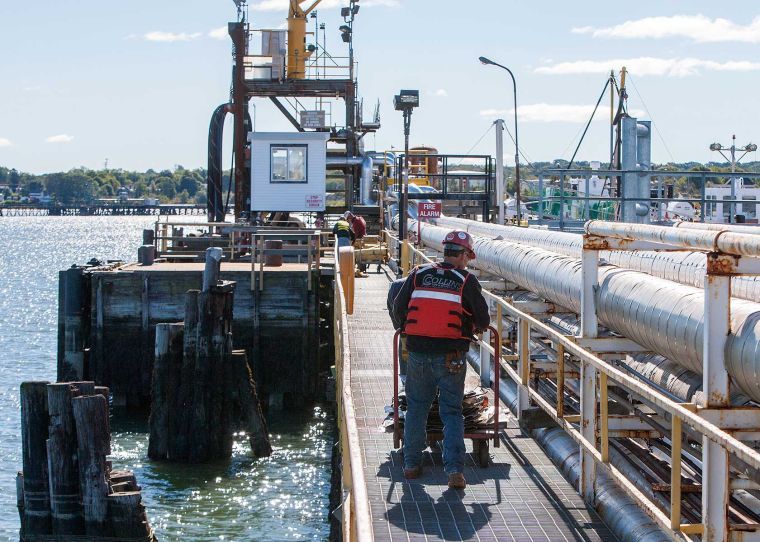 On a day with no oil tanker off-loading at the Sprague Oil Terminal in South Portland, contractors are at work on the miles of pipes that course through the facility. The proposed Waterfront Protection Ordinance, which would affect future operations at the tank farms, is drawing a sharp line between proponents and opponents of oil-related activities in the city, each of which held press conferences in the last week.
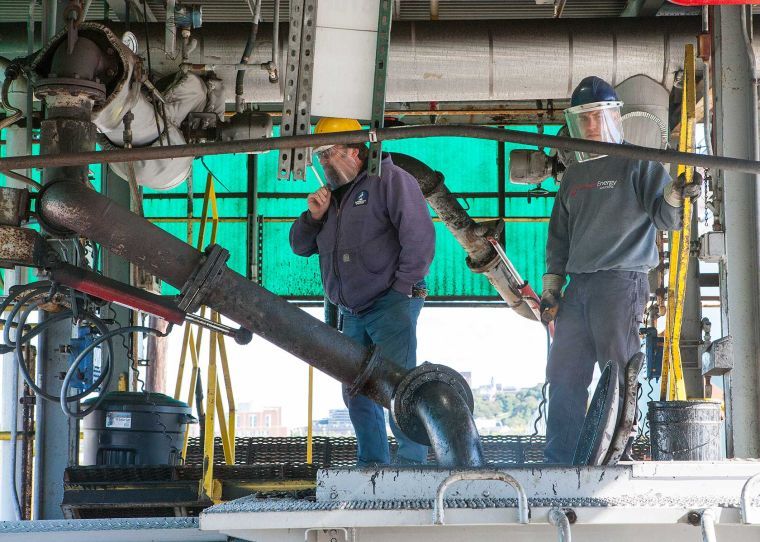 Two Sprague employees monitor the loading of an asphalt truck at the facility.
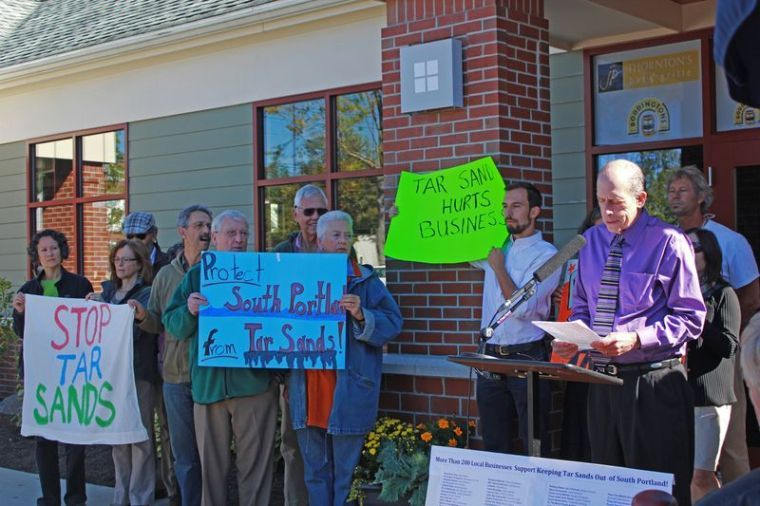 During a Sept. 18 press conference outside JP Thornton’s Bar & Grille, Protect South Portland spokesman Barry Zuckerman, at the podium, unveils a list of 214 city businesses pledged to support passage of the Waterfront Protection Ordinance, a comprehensive zoning change bound for the Nov. 5 ballot that aims to keep Canadian “tar sands” oil out of South Portland.
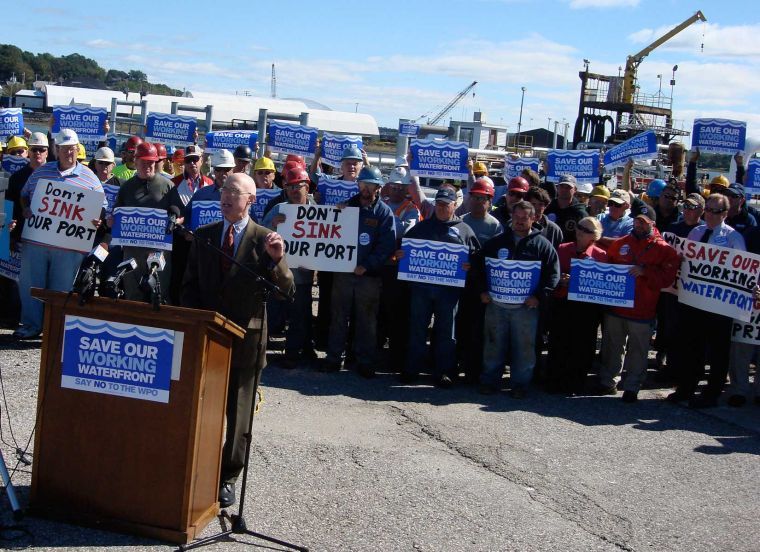 Economist Charles Lawton, of Portland-based Planning Decisions, speaks before petroleum industry employees at the Sprague Energy terminal in South Portland on Monday, citing the potential statewide loss of 5,600 jobs representing $252 million in salaries and wages, and $30 million in lost tax revenue if the South Portland oil industry shuts down following adoption of the proposed Waterfront Protection Ordinance at the polls in November.
Comments are no longer available on this story