
CAPE ELIZABETH – More than a year after resisting an invitation to mediate a dispute between the Spurwink Rod & Gun Club and its neighbors in the Cross Hill subdivision, the Cape Elizabeth Town Council on Monday hired an attorney to find common ground.
Kenneth Cole III, of Portland law firm Jenson Baird Gardner & Henry, was charged with interviewing leaders of the club and local residents in hopes of hammering out a compromise between the two groups, which have been, at times, bitterly opposed over noise complaints and accusations of errant bullets. Cole is scheduled to report back to the council at its Dec. 2 meeting and may bring at that time a draft ordinance designed to regulate sound and safety at the 57-year-old club, located at 1250 Sawyer Road.
Monday’s council action followed a two-hour workshop session last week attended by a standing-room-only crowd of nearly 120 people, which kicked off with a protracted debate regarding whether Councilor Jamie Wagner should be part of the discussion.
Although complaints about noise at the shooting range have been commonplace since the 1990s, when homes began to sprout up in Cross Hill, things took a more dramatic turn in 2009 when residents began to find bullets lodged in their homes. At least three complaints were filed. Police were never able to verify that any bullet came from the gun club and some of its 300-plus members have claimed the offending slugs were “planted” to drive public opinion against them.
Then, in March 2012, Wagner, in his role as an attorney, came forward claiming to represent a Cross Hill resident, whom he never named. Having been retained by the resident a year earlier, Wagner said he had tried to work with the club’s lawyer on a mutually agreeable solution, to no avail. Lack of progress, he said, “compelled” him to seek intervention by the Town Council. However, gun club president Mark Mayon called Wagner’s overture to the council, “laced with alarmist statements and untruths.” Wagner’s true goal, he said, was to “shut the club down.”
The Town Council rebuffed Wagner’s call that it take a direct role in the dispute, which he proffered would serve to prevent a costly legal battle. It asked instead that the two sides work together to pay for an acoustical analysis and safety inspection of the club property by a neutral third party.
Last fall, Wagner won election to the Town Council and, last week, said he had since divested himself of all personal and professional interest in the gun club, severed his relationship with the unknown client, and could consider the issue impartially.
“I appreciate that Councilor Wagner feels he would remain objective,” said Councilor Jessica Sullivan, “but I‘m not sure the public of Cape Elizabeth would feel he was objective, given his past activities.”
Sullivan said Wagner has shared with the council several news articles related to the gun club since his swearing-in as a member, attesting to his continued interest in the dispute.
“We have to think of the town as a whole and any potential [legal] challenges in the future,” said Sullivan. “Any vote we take really needs to be as clean and above board as possible.”
“I think the town should be more concerned with actual bias than perceived bias,” said Wagner.
“I know I’m not biased in this situation among the other council members who have much more serious biases than I do in situations,” said Wagner, citing votes cast on the town budget this past spring by Council Chairman Jim Walsh, who has said publicly he should have bowed out of the debate because his wife works for the school department.
Despite what Walsh may have done – and a number of councilors have said in the past that he has no legal conflict of interest – the council ruled that the prudent course of action would be to recuse Wagner from all future action on the gun club.
Wagner then argued that his peers could not vote to recuse him during a workshop, at which formal votes are not allowed. However, Town Manager Michael McGovern said the council’s usual attorney, Tom Leahy, has advised, “The council really has no choice but to decide the issue at the beginning of public review.”
The council then voted 4-2 to recuse Wagner, with councilors Sullivan, Walsh, David Sherman and Katharine Ray in favor. Councilors Frank Governali and Caitlin Jordan opposed the measure.
Wagner then left the council table to take a seat in the front row of the audience. Although advised he could speak on the issue as a resident if not a town official, Wagner remained silent over the intervening two hours.
Public conflicts
As relations continued to deteriorate following last year’s call for cooperation, the town retained Cole in June to provide, in McGovern’s words, “a fresh view” on the topic. Among the questions was whether the town could get involved.
In a July 15 memo, Cole noted that Maine law does not allow residents to bring a nuisance suit against a shooting range based on noise if they moved in after the site was established. Furthermore, he wrote, statutes prevent municipalities from acting to control or limit noise already occurring on a regular basis. However, Cole said the town could adopt “time, place and manner” restrictions on the club, provided any new ordinance is “based on specific findings that it is required to enhance and promote the public’s safety, health and welfare.”
Speaking on behalf of the Cross Hill neighborhood, resident Kathy Kline said there “was never a meeting of the minds” with the gun club over the past year on hiring third-party consultants.
“The gun club decided to hire someone they were interested in without reaching out to the neighborhood at all,” she said.
Kline complained that the gun club used a consultant affiliated with the National Rifle Association – not a neutral source in the eyes of many local residents – and then refused to release the resulting report. Mayon said the club passed all NRA standards for shooting ranges, but admitted the results were being held for fear they could be used as a weapon by Kline’s side.
“Although we passed, there were some recommendations for improvement,” he said.
Kline also noted that the gun club chose its own sound engineer. Mayon, who refused to give the name of the engineer until cleared to do so by that person, said the one favored by Kline’s group was overly expensive. The sound engineer retained by the gun club, he said, is working on ways to reduce noise, rather than conduct a study of existing acoustical conditions.
“We know there’s gunfire. The neighbors know there’s gunfire,” he said. “Rather than spend money, and it’s considerable money, on something we know, let’s work with what we can get done. We want to find ways of bringing the noise down.”
Mayon also listed a number of improvements members of the gun club have made to the shooting range, including installation of fences to limit access, walls to absorb sound, berms to backstop bullets and signs to warn against rapid fire. More is planned, he said, and work is progressing as fast as funds will allow.
Still, Kline said residents remain frustrated.
“At the rate we’re going, we’ve taken such baby steps, our fear is that someone could get hurt,” she said.
Meanwhile, Mayon said relations have deteriorated “in the last few weeks” because of “releases” and “emails” circulated by some in the Cross Hill community.
“Recently, the well has been poisoned by a small minority of the neighbors who apparently do not want to work with the club,” he said. “The club now feels as though we have been stabbed in the back.”
Although Cole largely took noise off the table, calling the gun club a “grandfathered use.” Comments during the workshop centered largely on just that, with both sides presenting diametrically opposing views.
Residents said noise from the range has increased in recent years, in terms of volume and frequency. Gun club members said use of the range is actually less than it was several years ago, with shooting times curtailed and many high-powered contests no longer allowed.
There was also disagreement on measures already taken by the club, with some saying sound barriers put in place were doing their job and others claiming the baffles actually “funnel” and increase noise toward nearby homes.
Liam McCoy, who built a house on Chesterwood Road in 2006, said noise from the shooting range has gone from “an occasional popping” when he first moved in to a “sound that is just incredible.”
“Our right of enjoying our property has been taken away, it’s been ripped away from us,” he said.
“I can honestly say, having been there at the very beginning in 1999 until the present day, there has been a dramatic, and I mean dramatic, change in the noise level at the gun club,” said Steve Parkhurst, who bought and developed most of the Cross Hill lots soon after the subdivision plan was approved under his leadership as chairman of the Planning Board.
“It was never, never an issue from the year 2000 until last year,” he said.
“There has been no expansion of use. If anything, we’ve cut back,” said Andy Tabor, a 30-year member and past president of the gun club. “I don’t know how anybody can say the use has increased. It’s exactly the same club, and it’s been used in exactly the same way for the last 60 years.”
Ultimately, the town decided it was time to take a hand in the ongoing controversy.
“What we’re trying to do is take care of the town as a whole,” said Ray. “When you listen to everybody, you hear opinions that are all over the place. We’ve heard everything from A to Z, so there’s no decision we could make without having some kind of mediation.
“If we come up with something that makes all sides somewhat unhappy but they can live with, that’s success,” she said.
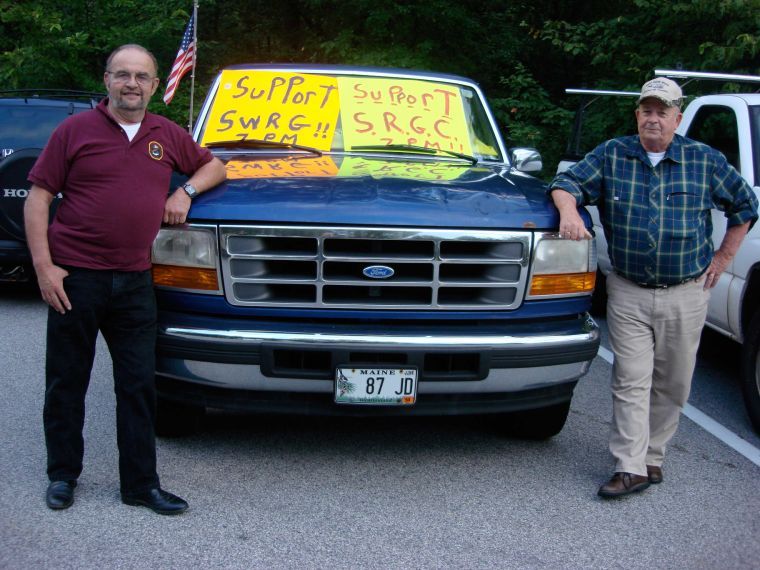 Don Burke, left, and Jim Sullivan stand by a pick-up belonging to Gary E. Morin, festooned with signs of support for the Spurwink Rod and Gun Club prior to a Cape Elizabeth Town Council workshop session last week that was called to mediate longstanding disputes between the club and its Cross Hill development neighbors.
Comments are no longer available on this story