
CAPE ELIZABETH – As Cape Elizabeth residents brainstormed priorities and programming needs for their library at an Aug. 29 community forum, Portland Public Library Director Steve Podgajny surveyed the crowded high-school cafeteria with a smile.
“You know, libraries really are the best indicator about the soul of a community,” he said. “After all, it’s a spending item that is not statutory, it’s discretionary. Entirely discretionary.”
Last November, Cape voters exercised their discretion by voting down a $6 million bond to rebuild Thomas Memorial Library. The 57 percent “No” vote left little room for doubt about the outcome, but town officials still pondered the reasoning behind the vote. Two interest groups sent out email blasts and posted roadside signs in the final days leading up to the referendum – some of which intimated a library bond might detract from future borrowing needs of the school department – but the public was otherwise silent on the issue.
In the months leading up to the vote, library boosters offered to show residents as many of the 102 building deficiencies described in a 2007 “needs assessment” as they cared to view. But just 28 people took advantage of guided tours offered in the three months before Election Day, three separate community tea events drew another 18, and an open house pulled in four others.
“I think one of our major problems was that we just couldn’t engage the public,” said Library Director Jay Scherma at the time.
By contrast, more than 70 people attended last week’s event, spending more than two hours working in small groups to decide what services and programs the library should offer over the next 25 years and, in light of the recent bond failure, whether it should be rebuilt, renovated, or somehow, even with portions of it dating to 1849, made to work as it stands.
Most of the comments mirrored questions the five-member library planning committee has asked itself since it was created by the Town Council in February: Should the building double as a community center? Should it work in concert with adjacent schools? Can the historical society or some other function be moved into vacant parts of the police department? How can any new building be made flexible enough that it is does not become quickly outdated by changing technologies?
Committee chairman Molly MacAuslan said afterward that all of the comment sheets and survey forms filled out at the meeting would be reviewed when her group meets next on Sept. 5. At that time, the committee is also expected to pick an architect to help plan how much space will be required for the services residents say they want. The committee is due to present its recommendation at the Nov. 6 Town Council meeting.
“We have done a ton of work on this committee and we have a ton more to do,” said MacAuslan. “The input we received from this forum has been incredibly valuable. In addition to the survey forms that we’ll review, several of us took our notes as well. I know I was typing furiously.”
Over the past week, the committee has interviewed the final four architectural consultants selected from a list of 11 applicants. They are Barba and Wheelock, Canal 5 Studios, Richard Reed & Co. Architecture, and Scott Simons Architects, all located in Portland.
Selecting local firms, according to Town Manager Michael McGovern, who participated in winnowing the list, was a conscious decision.
“There was a lot of concern last time that we used an out-of-state firm,” he said.
The 2007 needs assessment was prepared by Himmel & Wilson Library Consultants, of Milton, Wis. In 2011, the town hired Pennsylvania-based Casaccio Architects, which submitted various concept sketches for a new library, at least one of which was widely panned as looking too much like a strip mall. A January 2012 drawing tried to save money by retaining the old Pond Cove School, which fronts the library on Scott Dyer Road, while wiping away the older buildings tacked on behind it in favor of a new, 23,000-square-foot, two-story structure with dormers designed to evoke a Colonial-era feel.
MacAuslan stressed that whichever local firm is selected to aid the committee, it will not create actual design plans. That work, she said, will be commissioned by a future ad hoc committee should her group determine that a new building is, in fact, needed, and if the Town Council concurs.
“As a committee, we are hoping to get further definition of what a library of the future might look like, conceptually, if not visually,” she said. “They will help us determine how best to multi-purpose the space.
“In just the last two years, our technology has changed dramatically, but we still need room for books,” said MacAuslan. “My gut tells me that will remain true for the foreseeable future. But we also need other things and we need space for other things to grow and flourish over time.”
Scherma has said the current library building, an amalgam of three old school houses stuck together with “connecting structures” creating multiple levels, is “about 6,000 square feet too small.” Beyond that, Himmel & Wilson cited floors that can’t handle the weight of books, aisles that do not meet disability standards, issues with moisture and humidity, heating and cooling, poor ventilation, antiquated plumbing and no facilities to run computer wiring.
Although how to proceed will be the work of future Town Councils, MacAuslan may have a greater say in the decision-making process than she does now. She has taken out papers to run for Town Council. The decision of her committee-member, Councilor Frank Governali, to not stage a re-election bid guarantees at least one new face on the council, with three candidates to two spots as of the most recent report by Town Clerk Debra Lane.
The architectural firms that made the final four for design advice were selected by McGovern, Sherma and Facilities Director Greg Marles, along with members of the Library Planning Committee and Derek Konverse, a member of the Thomas Memorial Library Foundation with experience in construction.
Selection for the initial space-planning phase does not mean that chosen firm will be hired to design a new library, should the council opt for new building, said McGovern. This phase of the work “should cost less than $20,000 and perhaps far less,” he said.
Of the finalists, Barba and Wheelock’s resume includes work on 20 different libraries in Maine, from drafting a conditions report in Waterford to handling a complete renovation in Yarmouth. Its quote for hourly services ranged from $50 to $125, depending on the type of work performed.
Canal 5’s library work includes the Maine Medical Center Research Library. It’s also done work for Fairchild Semiconductor and L.L. Bean. Its rates ranged from $60 to $175 per hour.
Richard Reed boasts several library projects under its belt, including major renovations in New Gloucester, Harrison, North Berwick and Pittsfield, along with a new building in Denmark. It quoted $115 per hour to aid Cape Elizabeth with the space-programming phase of the process.
Finally, Scott Simons, which gave a fee range of $65 to $150 per hour, has some of the largest projects on its resume, having worked on the 2010 Portland Library renovation and providing designs this year for Bangor. Past projects include renovations in Norway, Paris, Presque Isle and Springvale.
Firms that responded to the town’s July 25 request for qualifications advertisement, who did not make the first-round cut, include Port City Architecture, Dirigo Architectural, Johnson Roberts Associates of Boston, Richard Renner Architects, Sachs Design Group, WBRC Architects and Engineers and Winton Scott Architects.
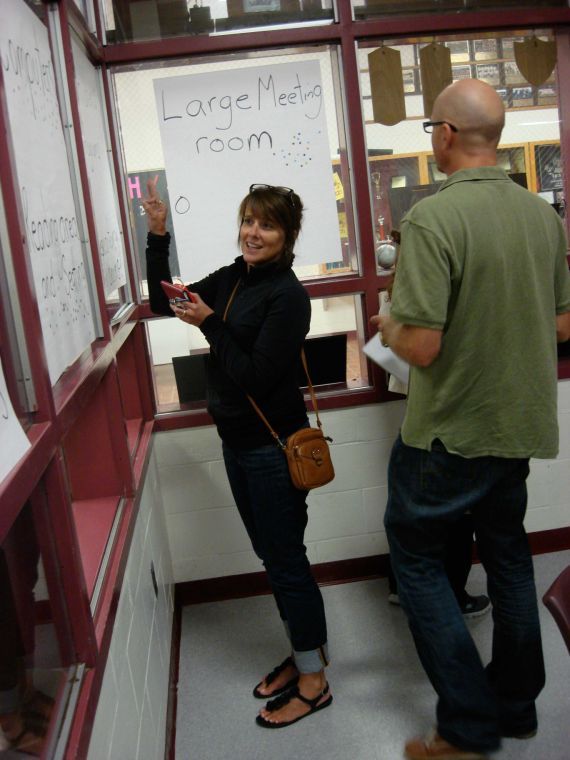 At an Aug. 29 community forum at Cape Elizabeth High School sponsored by the town’s Library Planning Committee, school board member Mary Townsend places a star next to her choice for what any new building should include.
Comments are no longer available on this story