
SOUTH PORTLAND – It’s not something that happens every day, but on Monday, the South Portland City Council made everybody happy, and, the ironic thing is, it did it by doing nothing.
Following nearly five hours of public testimony by more than 65 people, the council failed to pass a proposed Waterfront Protection Ordinance, designed to bar the import of diluted bitumen, better known as “tar sands.”
Because the measure landed at the council’s collective desk via citizen petition, the 1-5 vote means it automatically goes to referendum. Although South Portland’s City Charter gives the council 15 months to set a voting date, it unanimously picked this fall’s general election, Nov. 5.
And that’s what both environmental activists and oil industry officials say they wanted all along.
“We’re absolutely thrilled that the City Council listened to the people tonight and sent our citizen’s initiative to the ballot this November,” said Roberta Zuckerman of grassroots group Protect South Portland, known until this week as Concerned Citizens of South Portland.
“It’s democracy at its best when neighbors can come together to protect their community from big oil’s reckless plans to export tar sands out of South Portland,” she said.
“The WPO is going to be detrimental to our business,” said Chris Gillis, a longtime employee of Portland Pipe Line Corp., which stands to lose the most if the ordinance is adopted. “We urge the council to send it on to voters.”
The only other option, besides immediate adoption at Monday’s second reading of the ordinance, was for the council to draft a competing measure for voters to consider, but the council has shown no interest in doing so, preferring to let the petitioned version stand or fall at the ballot box.
Although Gillis noted that Portland Pipe Line has been “a good corporate citizen for 72 years,” paying more than $700,000 in local property taxes each year (while spending $4 million on local contractors, $5 million in local wages and generating $3.7 million in economic activity) the council paid no heed to a request made by many of his peers that it also adopt a resolution opposing the ordinance proposal.
In fact, three of the councilors who voted against immediate adoption of the ordinance signaled they might have supported a less restrictive version that would have controlled the import of tar sands without leashing Portland Pipe Line and its petroleum partners to zero future expansion.
“I don’t want tar sands in South Portland. I’m just concerned about the unintended implications of this ordinance,” said Councilor Melissa Linscott.
However the vote goes in November, few close observers of the city’s months-long fight over tar sands expect that decision to be the final word on the subject.
“It seems inevitable that there will be multiple legal challenges, whatever the outcome,” said Councilor Gerard Jalbert. “Nov. 5 is just the first mile of a marathon on this issue.”
Whatever comes next, the lead-up to November has been historic. Monday’s meeting was the largest turnout for a City Council meeting in living memory, according to Mayor Tom Blake. It easily eclipsed by nearly 100 the 350-person crowd that showed up for the first informational session on tar sands this past March. Monday’s session, held in the 90-year-old auditorium of Mahoney Middle School, also was the first live broadcast from a site outside council chambers at City Hall in the history of South Portland Community Television.
Local protests against tar sands have been gaining steam since Nov. 29, when Canadian pipeline giant, Enbridge, filed an application with Canada’s National Energy Board to reverse the flow of one of its major lines to carry “heavy crude” oil out of western Canada. According to environmental news service EcoWatch.org, “It is widely understood this filing is part of a larger oil export plan to move tar sands out of Alberta, east through Montreal and down to Maine.”
Long thought to be “garbage crude,” bitumen is surface-mined and boiled loose from sandstone. As traditional underground sources of crude oil have dried up, as technology has improved, and as rising oil prices have increased the profit motive, bitumen has become financially feasible to extract. Alberta has one of the world’s largest deposits.
However, bitumen has the consistency of peanut butter and cannot be pushed through pipelines unless it is heated or diluted with other materials. Because of these additives, and the heavy metals naturally present that may be concentrated by the extraction process, tar sands are a target for many environmental groups.
During council debate, both Councilor Patti Smith and Blake, who on June 17 publicly added his signature as the 3,779th to the WPO petition, said they are “100 percent behind” the ordinance.
“What is a dollar worth without clean air? What is a dollar worth without clean water?” asked Smith, the only councilor to vote in favor of immediately adopting the ordinance. Blake voted “no” in order to put the ordinance to a public vote, but promised to stump heavily for its passage.
“Tar sands is the dirtiest oil on earth,” he said. “Some of the decisions we have to make on the council are brutal, but I always think first about what’s best for the health and safety of our citizens, and our children.”
Despite Blake’s assertions, and those of virtually all WPO supporters who spoke Monday night, the National Research Council released a report on June 25, sponsored by the Pipeline and Hazardous Materials Safety Administration of the U.S. Department of Transportation, claiming that tar sands “has physical and chemical properties within the range of other crude oils” and that, “no aspect of its transportation by pipeline would make it more likely than other crude oils to cause accidental release.”
The report did not hazard a guess as to how an actual spill like the 2010 leak of bituminous oil from a pipeline near the Kalamazoo River in Michigan that polluted 40 miles of the waterway might differ from the environmental damage done by more traditional crude oil, should another incident occur.
The Kalamazoo spill reportedly raised benzene gas levels in the air to 15,000 parts per billion, far above the 500 parts per billion designated as a safe level by the U.S. National Institute for Occupational Safety and Health.
Councilors Linda Cohen and Melissa Linscott both voiced little support for running tar sands through South Portland terminals.
“That scares me as much as anything out there,” said Cohen. However, while both said they fear the alleged corrosiveness of tar sands, and the assertion of its opponents that the 70-year-old PPL pipeline that runs 236 miles past Sebago Lake and into South Portland from Montreal, can’t take the strain, both said the Waterfront Protection Ordinance “goes too far.”
On Aug. 13, the South Portland Planning Board expressed a similar sentiment, voting 4-2 that the proposed ordinance is inconsistent with the city’s comprehensive plan. That document, updated last year, says petroleum companies should be allowed to continue and even expand operations on land they now own in South Portland.
The Waterfront Protection Ordinance does not directly target tar sands or terminal operator Portland Pipe Line Corp. Instead, the ordinance seeks to ban any enlargement, expansion or construction of petroleum storage or distribution facilities anywhere in South Portland’s shoreland area, or in the city’s shipyard and commercial districts.
Industry leaders have argued that this not only bars Portland Pipe Line from ever reversing the flow of its line to import tar sands from Montreal, it also prevents any company in the area that handles petroleum products from enhancing, modernizing, or potentially even maintaining their equipment. Some have argued that the ordinance may even prevent them from installing various safety and environmental upgrades, as they become technologically feasible.
“This ordinance is going to have unintended consequences that will have devastating consequences for the city and will last a long time,” said Cohen.
Protect South Portland co-chair Robert Sellin called those claims “unfounded and exaggerated.” The ordinance is “narrowly crafted,” he said, stressing that it applies only to petroleum-related businesses and facilities, and “does not change, restrict or limit any existing business activity.”
“I wish we were all in a place where we could sit down together and come up with a better solution,” said Linscott.
The time for negotiating is past, however, because the ordinance must now go to voters exactly as petitioned. Still, some, like Councilor Alan Livingston, seemed to have little interest in anything but a public beat-down of the proposed ordinance. Although he lamented out loud that South Portland ever became an industrial port, he angrily recounted being approached by paid petitioners from Boston and New York, offering literature asking local residents to help stop a pair of 70-foot-tall smokestacks needed to burn off the “volatile organic compounds” added to tar sands for transport.
Portland Pipe Line President Larry Wilson has said his company “has no offer” to reverse the flow of its pipeline to import tar sands into South Portland for transport around the world, rather than pumping crude oil to Montreal for refining. However, he also has acknowledged that with the pipeline currently working at less than 60 percent of capacity, he would happily entertain that offer if it should come. However, he also has said that depending on the grade of bitumen Portland Pipe Line takes in, it might not need the smokestacks at all.
Livingston also rebutted the assertion of Cape Elizabeth attorney David Lourie, who said city officials need not administer the proposed ordinance as strictly as feared by oil industry officials.
“As a teacher and a coach, I want the rules in place,” he said. “Tell me what the rules are and I’ll abide by those. But I don’t want something that someone down the road has to interpret.”
“Is this ordinance perfect?” asked Blake, rhetorically. “No. But I could sit down with anybody here in this room tonight and we could take any ordinance we have on the books and we have hundreds of pages of them and we could interpret them differently.”
Only Jalbert refrained from signaling how he might vote in November. Councilor Michael Pock was absent from Monday’s meeting, but has previously expressed sentiments similar to Cohen, Linscott and Livingston.
At the public hearing in March, people on both sides of the issue obeyed Blake’s admonishment to withhold their applause. On Monday, first the activists, then the industry boosters, routinely disregarded his order, until every speaker on either side was met with vocal support.
Perhaps the loudest cheer of the might came early on, for the youngest speaker, 12-year-old Max Saffer-Meng.
“I was born after most of you, and when you’re not around anymore my generation will still be here cleaning up the messes you’re deciding to make right now,” he said. “South Portland is a great place to live. Two 70-foot tar sands smokestacks at a famous lighthouse is not the future I want for my community.”
 Among the crowd of 450 who attended a public hearing on a proposed Waterfront Protection Ordinance on Monday at Mahoney Middle School were three key opponents of the anti-tar sands oil measure, including, in the front row starting second from left, Deake Street resident Robert Sellin, co-chair of grassroots group Protect South Portland; his wife, Natalie West, who authored the measure; and Cape Elizabeth attorney David Lourie, who wrote the initial draft.
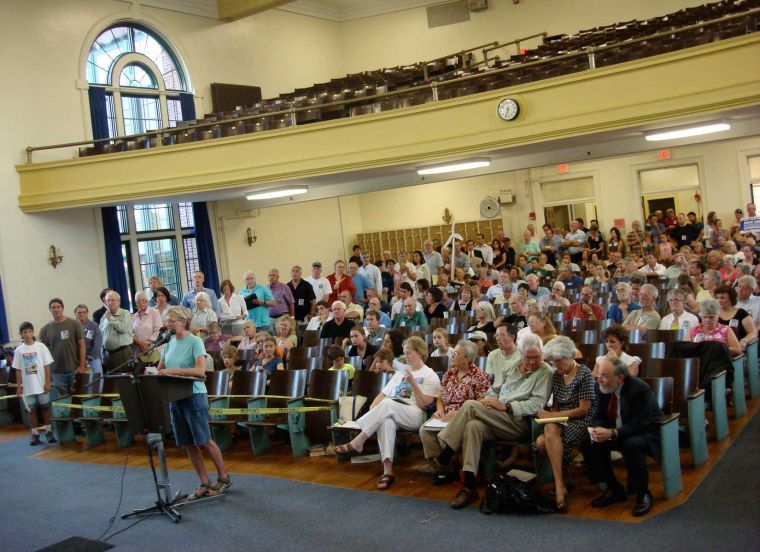 Clemons Street resident Debra Lumbert was one of more than 65 people who spoke for nearly five hours before the South Portland City Council Monday, for and against a proposed Waterfront Protection Ordinance designed to bar the importation of so-called tar sands oil into the Portland Pipe Line Corp. terminal adjacent to Bug Light Park.
Comments are no longer available on this story