
When South Portland’s Art in the Park show, held annually in Mill Creek Park, kicks off for the 34th time on Saturday, Aug. 10, Brian Plourde of Portland will be at his booth for the 22nd year. A native of Waterville, Plourde, 47, moved to Portland in 1987 and took up art on a whim three years later, attending his first Art in the Park event and selling two pieces the following year.
Such a prodigious rise might not seem unusual. After all, people from all walks of life become immediately successful as artists all the time. But consider this – Plourde is legally blind and has been from childhood.
Last week, he took time to share a little bit about himself and his work in an interview conducted at his Congress Street apartment.
Q: For how long have you had vision problems?
A: Since I was 10. I had chicken pox and it went to what they call Reye’s syndrome. I was in a coma for two and a half months. I wasn’t supposed to live but I did. The doctors told my parents, he’s either going to come out of it fully, or die. I didn’t do either one. So, I guess I fooled them. Then, when I did come out of it, they said I’d have so much brain damage I’d never do anything and my parents would have to put me in a home. But they said, nope, not going to do that. They were right there, helping with me with my rehab. They’re a big part of me being here today.
Q: Is it just the vision that you have a problem with today?
A: Vision and balance. After I came out of the coma, my eyes were stuck looking at the ceiling. My parents worked with me using a penlight, re-training me to scan back and forth, to bring my eyes so they’d work better. Once I started using my eyes more, the problem was that I started seeing double. Over time, my brain basically said, OK, if that’s going to be the case, we’ll send one eye off to the side and let them work separately.
Q: Do you still see double today?
A: No, I don’t. My brain eventually trained my eyes to work separately. Now, when I see things, I see different stuff with each eye. It’s kind of weird. It was hard to get used to, but it’s been so long, it’s like a natural thing now.
Q: So, when we say legally blind, it’s not that you can’t see?
A: Right. I just see different things. And, naturally, I don’t have good depth perception. I use a walker for my balance now. For quite a few years I didn’t. Even though I had bad balance, I still could get around OK. Not great. I would fall quite often. Finally, after many years, my doctor said, I think he qualifies for a walker. So, I have a four-wheeler.
Q: How did you become an artist?
A: It started in 1990. Spiral Arts – it used to be a place here in Portland on High Street – had different types of art classes where they took people down to Deering Oaks Park to try different things. I just thought I’d like to try something different and that was something I had never done before. I used to bowl, but I stopped doing that and I thought, well, I’ve got to do something.
Q: How did the art classes go, was it a struggle?
A: The ones who were teaching the class, they were real positive people. They had great suggestions, as far as different ways to use the brushes and ways of trying to capture what I see. It was just an eight-week class, but it got me going on something that’s been a big part of my life ever since.
Q: What medium do you use?
A: Mostly watercolor. I just like the way it comes out. I’ve done acrylics a few times, but, I don’t know, I could never get into it that much. A lot of people say it’s hard to do watercolor because things turn to “mud” so easily, but if the colors don’t come out well the way I like them I’ll change the water more often, so I’ll have bright colors again. And, I’ve done it enough now, I don’t waste a lot of paper because things get all mud.
Q: Do you have any preferred themes in your work?
A: Mostly, I want people to see the world the way I see it. Sometimes it takes a long time to do. I have once piece called “Sugarloaf in the Summertime” – my brother has a place up there – and it’s what I’m able to see around the base of the mountain and going up the mountain to the sky. That was a lot of work. It’s looks abstract, but that’s by design. It’s meant to be an impression of what I see what I try to bring everything into a single picture.
Q: Because your work has an abstract feel to it, do you find that people react to it more emotionally than if you were to depict a photo-realistic image?
A: Yeah. But it’s an emotional thing for me, too. If I’m feeling kind of down, I’ll do a lot of darker colors. I try to be upbeat. I try to be positive. I’ve always preferred to use bright colors, but that’s how it is.
Q: What challenges do you face as an artist?
A: Because I do more abstract, it can be hard to know when a piece is done. Between that and working in watercolor, just one brush stroke too much can ruin everything. That may be why I don’t always fill the page. I do more so now than I used to, but still, not always.
Q: How have you grown as an artist over the years?
A: I use a much larger color palette now. When I first started, it would just be reds and blues. Maybe some green. But I would never touch grays or purples or a peach color. Regardless of what I saw, I just didn’t think they worked well in an abstract design. Now, I try a lot more. I’m always trying new designs.
Q: Why do you keep coming back to Art in the Park?
A: I just enjoy like getting out with other people, and other artists. I like being outside anyway and Art in the Park is just a nice setting, with the pond and everything. I’d like to bring my watercolors and paint while I’m there, but it’d be another thing to carry.
Q: Do you get help attending the show, or do you have to do it all by yourself?
A: I need help setting up and taking things down. I get some help from my dad and my brother, and my sister will be helping me. I have another friend who has helped me for a lot of years, but she can’t come this year. My parents are getting up there, so I don’t know how many more years I’ll be able to do it.
Q: What has reaction to your work been like at the show?
A: Great. The first year I was in it I sold two pieces. I sell a lot every year, at least 25 pieces every year, now. That could be because I do I try to keep it affordable. My framed pieces go for $40 and my shrink-wrapped matted ones for $15 to $25.
Q: Are these prints?
A: No, they’re all original. Each piece is one of a kind.
Q: How often does each one take to complete?
A: I usually paint at least two or three a week.
Q: Where else do to you market your work?
A: I don’t. Maybe I need someone to help my on the sales end of it, to get my art into more places. But Art in the Park has always been my one show each year.
Q: That being the case, you must really hate it when it rains.
A: Oh, yeah. Like, last year, I didn’t get to go at all. As soon as we got out there it started to sprinkle. It looked like it was really going to come down, so we immediately packed up and came home. Then, as soon as we got back the sun came out. I missed the whole show! So, I’m really praying for nice weather this year.
Q: For those who have not been, what else would you like them to know about Art in the Park?
A: The people there are just real nice. They’ve always been very helpful to me. Even other artists have pitched in to lend a hand in the years when I have no had a lot of help there. I also appreciate that they’ve kept it affordable. Once reason I don’t do other shows is because of the cost. I’ve always wanted to do the Sidewalk Art Show here on Congress Street, but it costs just too darn much to rent even a tiny 10-by-10 spot. I can’t do it.
Q: Is there anything else you’d like folks to know about yourself, or your work?
A: Just that I can’t wait to see everyone there. It’s always a fun day.
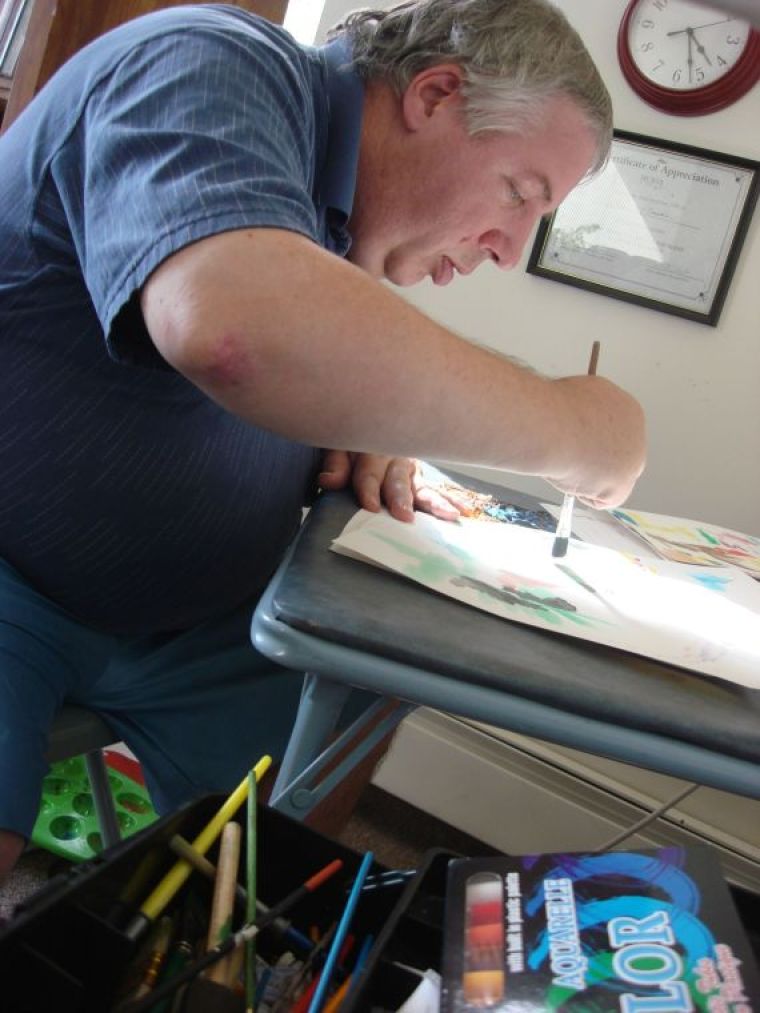 Portland resident Brian Plourde, legally blind since age 10, puts the finishing touches on a watercolor abstract for this year’s Art in the Park show, working from a studio set up in a corner of his apartment on the top floor of the historic Congress Square Hotel, now a subsidized housing complex.
Comments are no longer available on this story