
FREEPORT – The next time you’re shopping at the Banana Republic outlet in Freeport and hear footsteps, it may not be a friendly sales clerk en route to help you find the right size, but instead, it could be the ghost of Eliza Wells rattling her bones to avenge the scorn of the Freeport townsfolk in the 1850s.
This and other nuggets of history are featured on the twice-weekly historical walking tours conducted by the Freeport Historical Society’s Kim Vasel, the events coordinator for the nonprofit organization and de facto docent for the 50-minute tour.
The people who take part in the tour, which began in June, are mostly tourists who are looking for a sense of history to supplement or offset the business of shopping, said Vasel, who has been with the Freeport Historical Society since September 2012. While easy to forget among the many retail shops, downtown Freeport, or the “village,” as it’s known, has a rich history of shipbuilding barons, 19th-century philanthropists and the occasional ghost.
The tour begins at the Harrington House, home of the historical society, and makes its way across the street to the town hall, past the Freeport Community Center on Depot Street, and eventually to Jameson Tavern on Main Street. As Vasel explained to a group of nine attendees, a higher-than-average-sized group, on a tour last week, the founding fathers of modern-day Freeport are E.B. Mallett and L.L. Bean. Both men were wealthy and invested heavily in the town, but found their fortune in different ways. Mallett was a bit of a rogue, said Vasel, and inherited a large sum, roughly $340,000 – a fortune in 1845 – and built shoe factories in Freeport after relocating from Pownal. The legacy of Mallett is still visible in the downtown, most notably through the Freeport Community Center, which is housed in two “stick built” houses he constructed to house workers for his factories. The building that served as Mallett’s office is still intact on Mill Street, though dwarfed by the recent construction of a parking garage and abutting retail stores. Sadly, due to his freespending lifestyle, Mallett died penniless.
While the history of Leon Leonwood Bean may be well known by now, he was a true rags-to-riches story from the pages of a Horatio Alger novel. Bean bankrolled his education at the Kents Hill School, expensive even in the latter parts of the 19th century, by selling soap to housewives. He developed a waterproof boot and obtained a list of all Maine residents who held hunting licenses. By marketing directly to hunters, Bean promised a full money-back guarantee to anyone dissatisfied with his product, a promise he honored even after 90 percent of the boots were returned due to a correctable defect. Today, his namesake company is globally famous and the anchor of Freeport. Mallett is but a footnote.
The awkward balance of history and commerce is clear during the tour. The oldest house in the village is now a Starbucks on Main Street, and the incongruous sight of visitors ordering skim lattes from inside the building can be jarring to preservationists. The remarkable turnaround of Freeport that started in the 1980s, led by an influx of retail stores, from a mostly deserted downtown to the second most-visited destination in the state, is chiefly to blame, said Vasel.
But, she said, “the village itself has been well maintained and still retains its original character.”
For visitors, the walking tour provides historical context not only of Freeport, but also of Maine in general, said Nick Cullen, who was visiting with his wife and daughter from England.
“We visited the Longfellow Museum in Portland and heard about this tour,” said Cullen. “It’s a great way to learn while you’re on holiday.”
As for the ghost of Eliza Wells, the legend goes something like this: After marrying a Charleston, S.C., gentleman named Henry Britton, Wells mysteriously left him and returned to Maine during the Civil War with two of her sons, effectively abandoning her husband and other children. In her later years, Wells was shunned by the townsfolk of Freeport and died in the top floor of the house that now is home to Banana Republic. Employees of the store claim the sound of footsteps can be heard in the store.
“People are always surprised at what is here,” said Vasel. “It’s a little bit of everything from the past.”
A closer look
The Freeport Historical Society conducts Historic Freeport Village Guided Walking Tours each Thursday at 3 p.m. and Saturday 9 a.m. through September. All tours start at historic Harrington House, 45 Main St., and last for 50 minutes. Tickets are $10 for adults. For more information, call 865-3170 or visit www.freeporthistoricalsociety.org.
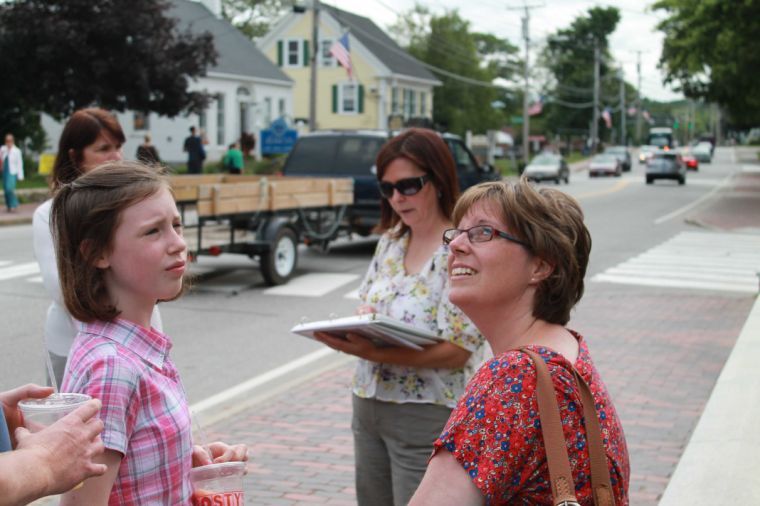 Kim Vasel, center, event coordinator for the Freeport Historical Society, explains the history of the Harrington House as attendees steal a glance at the architecture of 19th-century Freeport. Vasel is the docent for the twice weekly historical walking tours the organization holds in the summer.
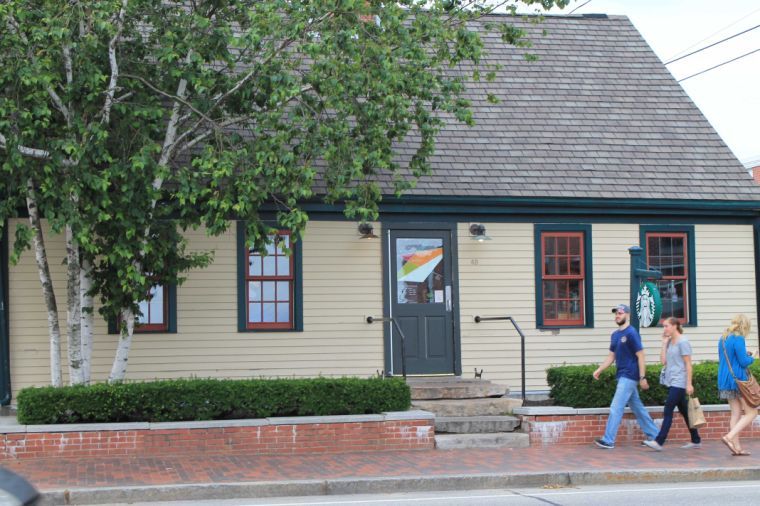 The Starbucks on Main Street is the oldest house in the Freeport village area.
Comments are no longer available on this story